Showing posts with label Jane Yolen. Show all posts

Wednesday, July 08, 2009

Pay the Piper: A Rock 'N' Roll Fairy Tale by Jane Yolen and Adam Stemple (Book 1)


A rock 'n' roll band to die for? Callie is about to find out.... Not much happens in fourteen-year-old Callie McCallan's sleepy Massachusetts town. So when the famous rock 'n' roll band, Brass Rat, schedules a concert in the Valley, it's big news. As a reporter for her school paper, Callie scores the scoop of a lifetime--a backstage pass to interview the lead singer of Brass Rat! Her friends are so jealous. But Callie isn't sure what the fuss is all about...until she meets the band. Lead singer Peter Gringras and his band mates are so cool. Especially Peter. When he plays his flute, it's as if he has some kind of hypnotic power. But there is something strange about the band, something Callie can't quite put her finger on. Maybe she's just being weird, but it's as if they're from here--but not from here--at the same time.

It's when, on Halloween night, Callie's little brother Nicky disappears--along with all the other children of Northampton--that she begins to wonder if her suspicions are so weird after all. It's crazy, but Callie thinks she knows why the children have disappeared--and who took them. To prove it--and to rescue Nicky and the other children--Callie will be forced down a road that will lead to her to a mythical world filled with fantastical creatures. A world from which there may be no return....

Title and author of book: Pay the Piper: A Rock 'N' Roll Fairy Tale by Jane Yolen and Adam Stemple (Book 1)

Fiction or non-fiction? Genre? Young Adult Fiction. Fantasy. Fairy Tale Retelling.

What led you to pick up this book? Reviews. Several people read this book and eventually I decided I had to read it! Also, for the Once Upon a Time III challenge.

Summarize the plot, but don’t give away the ending! See above...

What did you like most about the book? The fact that it was a fairy tale retelling. I have a soft spot for that genre. The connection to music also worked really well for me. It was like taking two of my favourite things and combining it in a book, so you know I had to give it a try! It was just a fun book. The characters were fun, the story was fun, and the idea behind it was fun. That's not to say that everything in the book is a good thing, though. It was a bit predictable, but that's sort of a given when you are retelling a well-known story.

What did you like least? I am not crazy about Yolen's writing style. This has been a problem for me before, actually. It is why I haven't read very much of her backlist yet. She still writes good books, but she is not an author that I have to read everything by and she is mostly an author that I would get from the library. I did like this book, though, so don't get me wrong!

Have you read any other books by this author? What did you think of those books? I have read a few of her books over the years. Most recently I read Briar Rose. This is another fairy tale retelling and I loved this book! It's why I keep reading her. (If you click on the link it brings you to my review, which was actually three years ago! Time flies!)

What did you think of the main character? I liked Callie. She was a believable character to fit the circumstances of the book. She didn't annoy me, which was great! She was not a damsel in distress character. She might not have had a concrete plan of action, but she did have a goal and set out to accomplish it. She was like a regular teenage girl, too, though, with crushes on boys and the stress of fitting in.

What about the ending? The ending didn't really surprise me. It was an ending that suited the events of the novel. Thankfully, while there is another book in this series, this book didn't have a cliffhanger ending! I want to read the next book, but the library doesn't have it...

Nymeth says: Had you ever read any other retelling of the Pied Piper? If so, how does this compare?
When I read this, the only book I had read relating to the Pied Piper was the original story itself. That I can remember, anyway. I feel like I have read others, but it was so long ago that I am not easily thinking of them at the moment. Since I read this, though, I read The Amazing Maurice and his Educated Rodents. That could be considered a retelling of the same story. They are rather different, though, so even with the retelling linking them it is hard to compare the two.

A recommended read! One of my favourites from the Once Upon a Time Challenge, actually.

Wednesday, January 07, 2009

The Book of Ballads by Charles Vess and Others


Books Completed: 9
Date Completed: January 7, 2009
Pages: 192
Publication Date: September 30, 2004

Reason for Reading: Graphic Novel Challenge

Illustrated and presented by one of the leading artists in modern fantasy, here are the great songs and folktales of the English, Irish, and Scottish traditions, re-imagined in sequential-art form, in collaboration with some of today's strongest fantasy writers. Here are New York Times bestseller Neil Gaiman with "The False Knight on the Road"; popular mystery author Sharyn McCrumb's version of "Thomas the Rhymer"; acclaimed children's writer Jane Yolen with "King Henry" and "The Great Selchie of Sule Skerrie"; popular novelist Charles de Lint's contemporary reworking of "Twa Corbies"; Bone creator Jeff Smith with "The Galtee Farmer"; Emma Bull's version of "The Black Fox," and much, much more. Introduced by award-winning editor and writer Terri Windling, and finished with full lyrics and discographies of the classic versions of these songs and tales, The Book of Ballads is an event in the worlds of fantasy and graphic storytelling alike.
Luck was with me when I was at the second-hand bookstore on Tuesday! I have tonnes of credit there, but haven't been having much luck finding books that interest me lately. Tuesday, I brought home quite the pile! When I found this book I almost did a happy dance right in the store! Think about it... This book is illustrated by Charles Vess, who is an amazing artists. The stories included in each comic are retelling ballads, which are something that I love! And, then, there are the authors of each comic. They are some of the best fantasy authors out there. Add in the fact that Terri Windling does the introduction, and you have everything that this folk tale fangirl needs! I mean, the book is second-hand, so it is not as nice as it would be if I had bought it new, but it is hardcover and has a beautiful cover! I hope the rest of 2009 is as wonderful reading-wise as this first week has been!

The book includes stories by Neil Gaiman, Jane Yolen, Sharyn McCrumb, Midori Snyder, Lee Smith, Elaine Lee, Delia Sherman, Charles de Lint, Jeff Smith, Charles Vess, and Emma Bull. Charles Vess is the main illustrator. Jane Yolen and Charles de Lint have two stories included. The best thing is that they not only rewrite these ballads, but the actual ballads are also included. I thought that was a great idea! If that is not enough for you, also included is a discography so you can actually find singers that sing these ballads and hear them for yourself! So, yes, I loved this book! It took so many wonderful things that I love and brought them all together! I am so happy that I went to the bookstore because this is a book that I will be holding onto for years to come. I also intend to spend some time looking up some of the music so I can hear it myself.

Wednesday, September 17, 2008

Don't Bet on the Prince: Contemporary Feminist Fairy Tales in North American and England - Edited by Jack Zipes

Jack Zipes has put together the first comprehensive anthology of feminist fairy tales and essays to appear since the women's movement gained momentum in the 1960's. He has selected works by such gifted writers as Angela Carter, Margaret Atwood, Tanith Lee, Jay Williams, Jane Yolen, Anne Sexton, Olga Broumas and Joanna Russ - all of whom, whether they consider themselves "feminists" or not, have written innovative stories which seek to break with the classical tradition of fairy tales. The accompanying critical essays, by Marcia Lieberman, Sandra Gilbert, Susan Gubar and Karen Rowe, discuss how fairy tales play an important role in early socialization, influencing the manner in which children perceive the world and their place in it even before they begin to read.

Don't Bet on the Prince was created out of dissatisfaction with the dominant male discourse of traditional fairy tales and with the sexist social values and institutions which it supports. This book demonstrates how recent male and female writers, by looking at the classical literary fairy tale with new eyes, have changed the aesthetic constructs and social content of fairy tales in order to reflect the major changes in the roles of sex, gender, socialization and education since the 1960's. It is an excellent example of how the literature of fantasy and imagination can be harnessed to create a new view of the world.

Don't Bet on the Prince is for all those interested in questioning the traditional values and expectations by which our perceptions of ourselves are formed. It will be of special interest to those concerned with the feminist movement, women's studies and the growing feminist sensibility in fantasy literature. Its tales will also appeal to children, and the child in every adult.

So, this probably won't be a review so much as an opinion piece. I warn you now! When I was little I loved fairy tales. I have some older editions by some of the greats that belonged to my parents and I loved to read them. Some I loved, while others I hated. As an adult I find myself wondering what I thought when I was reading them. When I read fairy tales now I have too many impressions. I have heard too many theories about what the authors were trying to do, and it means that I find myself looking for hidden meaning. Now, that is not necessarily a bad thing, but I highly doubt that when I was a child I was doing the same thing! I just read them for fun.

One thing that always gets me is how adult fairy tales are. Let me be blunt... I didn't know when I was seven that "Little Red Riding Hood" was getting raped. I thought she got eaten by the wolf, or came close to it. The sexual imagery that is actually there, I highly doubt I saw it. I did think that she was stupid for walking into the trap and not knowing that the wolf was the wolf, but I didn't know that she wanted to be raped. It just never crossed my mind. Somewhere in this book it says that the story portrayed the obvious notion that women want to be raped and men cannot control their animal instincts when a beguiling female presents themselves. And, we all know how much truth that sentence holds!

I will be the first to admit, though, that I am not a big fan of Cinderella, Sleeping Beauty, and the rest of the women who have became Disney Princesses. I wasn't a fan when I was a kid, either. I was always looking for the stories where the women had brains. I had one, so it stands to reason that one of these women was going to have one too! I was not a child that dreamed I was Cinderella and I was just waiting for my prince to come and save me. I never believed in that stuff, and maybe, I didn't have as great a childhood as I could have because I wasn't waiting for the knight on the white horse. Who knows! All I know is that this ideal never really struck my fancy. The only Disney Princess, based on classic fairy tales, that I like is Beauty from Beauty and the Beast and that was probably only because she read and was a bookworm like me.

I am trying to decide how I feel after reading this book. Some of the short stories were really good, while others I found rather uninteresting. The essays at the back were interesting, but at the same time they were trying too hard. There were a few moments where I stopped and thought about what they were saying, though, so they were not totally wasted. I find it interesting, though, that instead of writing fairy tales with equality, it seems the men have to become like the women of old in some cases, in order for the women to have a brain. Anyway, that being said, I really liked this book. It was not the best ever, but it was enlightening, and fairy tales and feminist issues are two of my favourite subject matters, so I always like to develop both further.

This was reason enough for me:

"... And Then the Prince Knealt Down and Tried to Put the Glass Slipper on Cinderella's Foot"
- Judith Viorst
I really didn't notice that he had a funny nose.
And he certainly looked better all dressed up in fancy clothes.
He's not nearly as attractive as he seemed the other night.
So I think I'll just pretend that this glass slipper feels too tight.
Yeah, I laughed when I read that story. Terrible, I know!

This collection included [My thoughts are in brackets]:
  • Fairy Tales and Poems:
    • The Princess Who Stood On Her Own Two Feet by Jeanne Desy [I wasn't sure about this story at first, but it grew on me. It is not really all that different than modern dating even if there is no prince involved!]
    • Prince Amilec by Tanith Lee [I enjoyed this story. I don't necessarily like the princesses personality, but I understand where she was coming from.]
    • Petronella by Jay Williams [A fun story that looks at the common theme from fairy tales of everything happening in threes. It breaks conventions in a fun way.]
    • The Donkey Prince by Angela Carter [A very good story from Carter. I just recently read her for the first time, so it was nice to see her included. This breaks fairy tale conventions as well.]
    • ...And Then The Prince Knelt Down and Tried to Put the Glass Slipper on Cinderella’s Foot by Judith Viorst [I laughed... ]
    • Snow White by The Merseyside Fairy Story Collective [Snow White with a brain! Very good story of good verses evil.]
    • The Moon Ribbon by Jane Yolen [A Cinderella-type story that I really enjoyed.]
    • Russalka or The Seacoast of Bohemia by Joanna Russ [Retelling of The Little Mermaid... This just goes to show you don't always know what you want until it is too late!]
    • A Fairy Tale for Our Time by Jack Zipes [I really liked this story. I think it is because it is something that I can relate to. It is why I read fairy tales, in a way.]
    • The Green Woman by Meghan B. Collins [Not my favourite story in the collection, but readable. It is a very believable story, though.]
    • Briar Rose (Sleeping Beauty) by Anne Sexton [Look, I am doing better with my strong dislike of short story collections, but I still don't really like poetry... It was just brutalized for me for too many years!]
    • Little Red Riding Hood by Olga Broumas [See above]
    • Rapunzel by Sara Henderson Hay [And again]
    • Wolfland by Tanith Lee [A great story for the paranormal fan in me!]
    • Malagan and the Lady of Rascas by Michael de Larrabeiti [Could not get into this story at all! Probably my least favourite.]
    • Bluebeard’s Egg by Margaret Atwood [I both loved and hated this story. Every time I think about it I change my mind.]
  • Essays:
    • ‘Some Day My Prince Will Come’: Female Acculturation through the Fairy Tale by Marcia K. Lieberman
    • The Queen’s Looking Glass by Sandra M. Gilbert & Susan Gubar
    • Feminism and Fairy Tales by Karen E. Rowe
    • A Second Gaze at Little Red Riding Hood’s Trials and Tribulations by Jack Zipes
So, see, I did like most of the stories in this book! I suggest you take the chance to read it, you will not be disappointed.

Wednesday, August 30, 2006

Oops

Because of the rather... large... post I made today, the finishing up of my reviews are not showing up on this page. So, I will post the links here as I go along. If you scroll down, you can still see Briar Rose, but I also reviewed Sean Russell's World Without End today.

That leaves left to review:

The Green Knight
Gods in Alabama
West Side Story
Persepolis II

I might have changed my mind about what I want to finish by the end of the month. I might try and finish some of the smaller books I have on the go today and tomorrow and read The Historian to completion the first week of September. We will see what I am in the mood for at work later.

Saturday, August 26, 2006

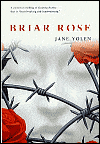
Briar Rose - Jane Yolen [August/06]


I love fairy tale retellings, and this is a very creative way of retelling of Sleeping Beauty written for a young adult.

From the back of the book:

It is an old, old tale, the German story of BRIAR ROSE, the Sleeping Beauty. Now one of America's most celebrated writers tells it afresh, set this time in the forests patrolled by the German army during World War II. A tale of castles, of mists and thorns, of a beautiful sleeping princess, and an astonishing revelation of death and rebirth.

A tale that will leave you changed forever

The tale of BRIAR ROSE.


I saw this book at the book store the other day, and immediately had to buy it. It is part of The Fairy Tale Series, which was created by Terri Windling. Sadly, most of the books in this series are out-of-print, so I pick them up whenever I see them. I also own Tam Lin by Pamela Dean from this series, but I have not read it yet.

This is one of the most interesting fairy tale retellings I have read this year. As the front of the book states: "The Bright Tale of Sleeping Beauty, the dark tale of the Holocaust - Twined together in a story you will never forget." I was happy with this because fairy tale retellings and World War II are examples of things that I like to read about. Putting them together was a creative idea.

This is a young adult book, so it is very short, but in the 200 pages or so, a magnificant story is told. The novel is written with scenes taking place in the present, with flashback images where the grandmother of the main character, Becca, tells the story of Sleeping Beauty. Becca's grandmother, Gemma, is really the main character because this is her story. Little is known of Gemma's background before she came to the United States, all she tells her children, grandchildren, and great grandchildren is the story of Briar Rose.

When Gemma dies, Becca gets a wooden box that holds clues to who her grandmother was in the past. With these clues in hand, Becca embarks on a mission to discover the identity of her grandmother and see if she really was a princess in Poland and lived a life like Sleeping Beauty. Traveling to Poland, Becca begins to put the pieces together, and as a result the reader can see where Gemma got the idea for her story and just how true it really was.

I strongly suggest this book, even if you just read it to seek the truth. Is the tale of Sleeping Beauty comparable to the story of this woman who lived in Poland at the time of the Holocaust? I warn you, I found Becca annoying at times, but in the end it is not really her story, she is just telling it.

4/5