Showing posts with label World War II literature. Show all posts

Friday, June 06, 2014

Book Review: Blossoms and Bayonets by Jana McBurney-Lin and Hi-Dong Chai

Blossoms and Bayonets by Jana McBurney-Lin and Hi-Dong Chai


Completion Date: May, 2014
Length: 316 Pages
"McBurney-Lin crafts…an engaging and entertaining read from beginning to end." --Midwest Book Review
"Impossible to put down—or to forget—authors’ grippingly suspenseful and deeply affecting historical novel limns the lives of a Korean family under Japanese rule with astonishing grace and power." --Caroline Leavitt, New York Times bestselling author of Pictures of You
"Riveting internal dialogue and narration interspersed with quotes from those running the war efforts on various fronts combine to compel the reader forward. I say compel rather than propel, because I had to read. I had to know how this family and those around them would fare in the end."—Keri Rojas, bookseller at Cornerstone Cottage, Hampton, IA.
Hi-Dong Chai and Jana McBurney-Lin, the award-winning author of My Half of the Sky, turn their hands to a remarkable story of a family and country torn apart by outside forces.
The time is 1942, the place, Japanese-occupied Seoul, Korea. Fifteen-year-old He-Seung is full of fire, ready to take on these Japanese…if only he could convince his father, a Christian minister more concerned about saving his flock in a time when Emperor-worship has become mandatory.
Since occupation, the Japanese have eradicated the Korean language, names, even the country’s flower. Now they are seeking Korean boys as volunteers for their army. When his father is arrested by the Japanese, however, He-Seung must swallow his hatred of the enemy. Even harder, he must leave his mother and baby brother He-Dong to fend for themselves.
Based on a true story, Blossoms & Bayonets is suffused with the tense atmosphere of the period. The story lends an eyewitness perspective to events as they unfold. revealing an era of nuance and complexity, and shedding a bit of light on why --and how--one war led to the next.
The problem with getting away from blogging is that it makes it harder and harder to get back in the groove. I sit down to blog, but I wind up staring at a blank screen. Then, I fall behind entirely and that makes it seem like work to catch-up and blogging is supposed to be fun. I told myself I would make June a blogging month, but it has taken me this long to actually sit down and post. It's sad.

One of my favourite subjects to read about is WWII, so, when I saw this was set during then I knew I was going to have to snatch up a copy. Especially since I typically read books about the Canadian involvement and have been a bit slack with everyone else. This book is about the Japanese-occupied Seoul, Korea. This is something that I have been aware of, but never read a book that centres around it. And, it is based on the true story of Hi-Dong Chai, the co-author, so it definitely paints a picture of this time period. I think it is fantastic to take advantage of these resources before we don't have them any more.

Each chapter of the book opens with real quotes said during this difficult time. It helps frame the story and shows a wide-range of people around then. I loved how this book was written. It was very well-written with the three different narrators telling the story. The narrators, the wife and sons of a Christian minister, were great choices. This definitely was a story of love, faith, and courage during a difficult time. I am glad I read it!

Recommended!

Friday, January 17, 2014

Audiobook Review: Henrietta's War by Joyce Dennys

Henrietta's War: News from the Homefront 1939-1942 by Joyce Dennys


Completed: January 11, 2014
Length: 3 Hours, 47 Minutes (158 Pages)
Narrated by: Mandy Gasson

Synopsis from Audible:
Spirited Henrietta wishes she was the kind of doctor's wife who knew exactly how to deal with the daily upheavals of war. But then, everyone in her close-knit Devonshire village seems to find different ways to cope: There's the indomitable Lady B, who writes to Hitler every night to tell him precisely what she thinks of him; the terrifyingly efficient Mrs. Savernack, who relishes the opportunity to sit on umpteen committees and boss everyone around; flighty, flirtatious Faith who is utterly preoccupied with the latest hats and flashing her shapely legs; and then there's Charles, Henrietta's hard-working husband who manages to sleep through a bomb landing in their neighbour's garden.
With life turned upside down under the shadow of war, Henrietta chronicles the dramas, squabbles, and loyal friendships that unfold in her affectionate letters to her "dear childhood friend" Robert. Warm, witty, and perfectly observed, Henrietta's War brings to life a sparkling community of determined troopers who pull together to fight the good fight with patriotic fervour and good humour.
Henrietta's War is part of The Bloomsbury Group, a new library of books from the early 20th-century chosen by readers for readers.
What Lead You to Pick Up the Book?: I was curious. I have heard good things about this book for ages and planned to buy it at Christmastime, but there was a reason that I couldn't. So, I went the audiobook route instead. I still would like to own the paperbacks at some point.

Summarize the Plot: The novel is entirely told from Henrietta's point of view through letters that she writes to her friend Robert. Robert is serving in the war, and Henrietta is keeping up to date on life on the home front. Through her letters, we learn about her husband and the cast of colourful characters that make up her community. By the end of the book, you feel as if you have been visiting with old friends.

What Did you Like Most About the Book?: I think my favourite part of the book is how everything comes to life during Henrietta's letters. Henrietta herself is the focal point, but she describes others so well that you feel as if you know them. There is Lady B, for example, who writes a letter to Hitler every evening telling him what she thinks of him. Then there is Faith, who has the choir master wrapped around her little finger. The choir master himself comes to life by visiting Henrietta in her bedroom to lament about his fate in the world. 

What Did you Like Least?: I wanted more. The book is very short, and I wish it wasn't. There is a sequel, though, and I may feel better once I have read that. (I am just disappointed that it is a different narrator for the audio because now Henrietta won't sound right.)

What Did you Think of the Writing Style: Well, I love books told through letters. I know there are many people that don't feel it gives enough to have a book written that way, but I am a huge fan and some of my favourite books are written through letters, diaries, etc. (This is why I joined the Postal Reading Challenge this year). I think that Dennys does a very successful job of telling what life was like on the Home Front during World War II.

What Did you Think of the Main Character?: Henrietta was very human. When there was something to be scared of, she was scared. When there was action going on, she got in the midst of it when it was necessary and ran away when it wasn't. Dennys made her seem like a real person instead of attempting to create a larger than life or impractical British woman. There was one scene where she gives blood that was particularly well-done and believable.

What did you think of the ending?: The book only covers the first part of the war, so I tend to think of the sequel as the real ending. That being said it ended fine and with no compulsion to have to read the sequel, but I want to see how things play out for Henrietta, her family, Robert, and the members of her community during the rest of the war.

Strongly recommended!

Thoughts on the Audio: I liked Mandy Gasson. She did a very good job talking in the conversational tones of the letters that Henrietta was writing to Robert. I went to see what else she has narrated, but this is her only book. As I mentioned above, I am disappointed she doesn't narrate the sequel.

Friday, July 27, 2012

Shadows Walking by Douglas R. Skopp

Shadows Walking by Douglas R. Skopp

Completion Date: May 26, 2012
Reason for Reading: Anna, of Diary of an Eccentric, mentioned to the author I might like the book and he sent me a copy. Thanks Anna!
Johann Brenner, an idealistic physician and ardent German nationalist, has joined the Nazi Party and willingly participated in its "crimes against humanity." His Jewish childhood friend, Philipp Stein, has also become a doctor. Their lives inevitably intersect until their last, fateful meeting. After the war, Brenner, with stolen papers and a new name, has become a janitor in the courthouse where the Nuremberg Trials are being held. Hoping to "heal himself" and begin a new life with his estranged wife, he decides that he must write her a letter telling what he has done--and why.
Over the years I have battled with myself over what my favourite reads of the year are come the end. This year, though, I have not had a hard time at all picking my favourites. I am not sure what it is, but I could rattle them off to you right now with no problems. They just stand very high above the rest this year. Shadows Rising by Douglas R. Skopp is one such book. I will start the review off by saying that I thought this book was fantastic and that everyone needs to read it. The problem with really good books is that I have a hard time doing the book justice. I think I put too much pressure on myself; so a lot of times I don't review them at all and then I regret it. This is me attempting to do justice to a book that will be on my best of list for the year.

One of my favourite aspects of historical fiction is World War II. If you took a close look at the history I have on my shelves you would find a lot of books that cover this time period. This book, though, was different than my normal selections. It is about a Nazi doctor before, during, and after the events of WWII. After the war has ended he has decided to write a letter to his wife about the horrors he has witnessed and participated in. It was the first time I have ever read a WWII book from this viewpoint. It was horrifying at times. I have heard countless times what it was like to live through the war, especially if you are Jewish, but this is the first time I have seen it through the eyes of the ones committing the atrocities. I really felt Skopp did an excellent job getting in the minds of his characters and show the reader the horrors of the Second World War. I especially liked watching the progression from just a regular doctor living in Germany to an SS doctor working in concentration camps. It seemed entirely believable to me.

The novel follows Johann Brennar. It is after the war and he is actually writing a letter to his wife telling her what he did during the years when he did not see her at all. He thought he was doing the right thing and quickly got in over his head. Now that the war has ended, and even during it at some points, he knew he was in the wrong and feels guilty for the things that he has done. Let me tell you, there are some rather graphic descriptions of the things he did. This was the sort of book that had my jaw dropping and me rattling off what happened to the guy. Skopp does not hold back. In some moments Johann is made to seem human, but there are other times where you can't help looking upon everything as a monstrous turn of events. I am now playing over some of the scenes in my mind and am horrified all over again.

As an interesting contrast the book also talks about Philipp Stein. He is Johann's friend when they are children and also becomes a doctor. He is Jewish, though. His life heads in a completely different direction than Johann's. And, things get complicated for their friendship. The story rotates between the two and includes moments when they are together. It gets more and more complicated as the word escalates and offers a fascinating two-sided view to something I have never really explored in fiction.

This review has been very hard to put into words. All I can say is it is one of my favourite reads of the year and I recommend that if you get a chance you read it for yourself. And, I will point out it is something you have to talk about. I rattled on about this book the whole time I was reading it. There were moments where it was just so appalling. I knew these things happened, but to witness them through the eyes of the characters horrified me. I cannot believe that people were capable of these acts and Skopp does a good job of pointing out that at their core they were only human. So, yes, just read the book and then you will understand just how compelling it all is.

Strongly recommended!

Tuesday, May 08, 2012

Code Name Verity by Elizabeth Wein

Code Name Verity by Elizabeth Wein

Completion Date: May 6, 2012
Reason for Reading: Fun!
I have two weeks. You'll shoot me at the end no matter what I do. 
That's what you do to enemy agents. It's what we do to enemy agents. But I look at all the dark and twisted roads ahead and cooperation is the easy way out. Possibly the only way out for a girl caught red-handed doing dirty work like mine — and I will do anything, anything, to avoid SS-Hauptsturmführer von Linden interrogating me again. 
He has said that I can have as much paper as I need. All I have to do is cough up everything I can remember about the British War Effort. And I'm going to. But the story of how I came to be here starts with my friend Maddie. She is the pilot who flew me into France — an Allied Invasion of Two. 
We are a sensational team.
On February 10, 2012, Ana reviewed this book on Book Smugglers and gave it a 10/10. I was immediately interested because I love books set during World War 2 and this book sounded like something I would enjoy. I had just been on a book buying spree, though, so I set out to wait. Then, another Ana, this time from things mean a lot, reviewed this book and she loved it. I immediately opened a new tab and ordered the book. Then, I waited impatiently for it to arrive. And when it finally I did was in the middle of a reading slump. I was so upset because I knew I was going to enjoy this book, but I was worried my cranky reading habit would destroy the experience. So, as a result I read it very slowly. Soon, though, I was caught up in the story and was thrilled to bits with it. Folks, this book is awesome! It will make my best of list for 2012 without a doubt. I think that everyone needs to read it... Actually, I may have been emailing people telling them it was available on Netgalley before I even finished because really, everyone needs to read this book.

I guess it is supposed to be young adult, but it deals with some very heavy subject matters. I think it is definitely the best... no, wait... It is definitely one of the best fictional accounts of World War 2 I have ever read. (I almost forgot Briar Rose by Jane Yolen!) This book was so good I am having a hard time deciding what to say about it that is even remotely coherent. That is why I wasted a paragraph explaining why I have it. When I finished the book I hugged it and then sat there mulling things over for a bit. The story is told in two parts. First, we hear from Queenie aka Verity. I hate to even name her because that is a bit of a spoiler, but you need to start somewhere. She has been captured and has come to an agreement where she is to write down everything she knows about the war from the British point-of-view. She chooses to write a story, so we learn about her personal life as much as about the war effort. It makes for a very captivating read, folks. Queenie, who is entirely fictional, is a fantastic character. She really comes to life for you and you feel like you know her by the end.

Then, for the second half of the book we follow the story from Maddie's point of view. Her story is equally as captivating and because we have heard so much about her from Queenie, we can't help loving her from the moment her story starts. I love stories told in epistolary format and the way that Wein chose to address it in this book works so well. Queenie is a spy writing her story under duress. She says over and over again that she has told the truth and that she is a coward because she gave into them, but the entire time I was wondering if things were true. There is a sense of doubt the entire time you are reading it because you are so caught up in what she is saying and you believe it to be true, but it is not the most reliable way to get information out of someone. There is no doubt that she has been tortured and the other inmates all hate her because they think she is weak. I am not entirely sure I would be able to put up with what she did... Maddie is basically writing her story in the beginning to help pass the time. She is not under duress, though, so you tend to believe what she says more.

I fear I am not doing this review justice, so I recommend reading the two Ana's Reviews... The Book Smugglers/ things mean a lot 

The very interesting thing about this all is the entire time I have been reading this book, and even back when I was hearing about it, I thought the author name sounded familiar. I've read her before. Isn't it sad that I forgot? Would you like to do know why... I blocked the memory because I absolutely hated the book. I am so glad that I didn't remember because that could have really ruined this experience.

But, she has redeemed herself. I don't really rate books, but we are talking 5/5 or 10/10 or A+. Fantastic stuff!

This book counts for the Historical Fiction Reading Challenge and for Trish's Pin-it and Do It Challenge because I actually had posted it (twice...).

Thursday, August 18, 2011

Next to Love by Ellen Feldman

Next to Love by Ellen Feldman

Completion Date: August 11, 2011
Reason for Reading: Received review copy from Random House via NetGalley.
"War . . . next to love, has most captured the world's imagination."-Eric Partridge, British lexicographer, 1914

A story of love, war, loss, and the scars they leave, Next to Love follows the lives of three young women and their men during the years of World War II and its aftermath, beginning with the men going off to war and ending a generation later, when their children are on the cusp of their own adulthood.

Set in a small town in Massachusetts, the novel follows three childhood friends, Babe, Millie, and Grace, whose lives are unmoored when their men are called to duty. And yet the changes that are thrust upon them move them in directions they never dreamed possible-while their husbands and boyfriends are enduring their own transformations. In the decades that follow, the three friends lose their innocence, struggle to raise their children, and find meaning and love in unexpected places. And as they change, so does America-from a country in which people know their place in the social hierarchy to a world in which feminism, the Civil Rights movement, and technological innovations present new possibilities-and uncertainties. And yet Babe, Millie, and Grace remain bonded by their past, even as their children grow up and away and a new society rises from the ashes of the war.

Beautifully crafted and unforgettable, Next to Love depicts the enduring power of love and friendship, and illuminates a transformational moment in American history.
I tend to read all over the place, but there are a few trends in my reading. I enjoy books connected with World War 1 or World War 2. There is just something about those time periods that appeal to me. I enjoy reading about their lifestyles, the sacrifice, and the repercussions of countries at war. It is not a pleasant time in our history, but it has had lasting effects on the world that we live in today. I think that is why I love history as a whole. I enjoy watching the country evolve and pin-pointing changes throughout history.

I had been seeing reviews of this book here and there and it sounded right up my alley. This is a book about 3 women on the Homefront and what it was like for them during and after the Second World War. That is not a subject I see a lot of books about; so I was interested to see how Feldman pulled it off. I cannot even imagine what it was like to either be off fighting during the wars or what it was like for those that were left behind. These women had to fend for themselves and never entirely know if their loved ones would make it back alive. And, if they did, they would be drastically changed from the men they originally said good-bye to.

What I really enjoyed about this book, though, was it went many years beyond the war and showed just how lasting its effects could be. I found that all really fascinating, to be honest. It was something I have thought a lot about. My grandfather fought in World War 2 and I didn't come around until many years later and you could still tell the war stuck with him. He refused to talk about it except to say how disheartened he was by the aftermath. He used to say it sickened him how the men he knew came home and drowned their sorrows in alcohol because they knew no other way to cope. There were packages to give money to returning soldiers, as is shown several times in this book, but there was not always the support. These men came home different people and it was up to them and their loved ones to adapt. It was not always easy.

This novel follows Babe, Millie, and Grace. When their men go off to fight in the war, they are still very young. The before time was a time of innocence, but as the novel progresses and the war drags on you say a drastic change in them. It only gets worse when some of the men don't make it home at all and those that do have been changed drastically. When the war ends these women essentially have to start their lives over all over again. They always remain friends because of their bonds as young children, but it is apparent that things will never be the same. There are many moments where they do not understand each other at all.

Babe feels lost because she never has children of her own, despite wanting some, so has to find other ways to occupy her time. There are moments where she feels like as her husband is getting better, she is getting worse. It is through her that was experience the events of the Civil Rights and Feminist Movements. Through Millie we experience what it is like to be married to a Jewish man after the war has ended. The Americans fought against those that wanted to eradicate the entire religion, but when the ashes settle they do not always treat them very fairly considering they helped win them their freedom. Grace is struggling just to get by from day to day. She feels lost in this new world and doesn't always make the best choices.

Overall, I found this book was a great exploration of what it was like living during and after World War 2. My only major issue was that the author felt she needed to make sex such a big part of the story. I think the book would have been just as effective if she hadn't concentrated on this quite so much. The book was still written well enough that I enjoyed reading it, though, and I look forward to diving into Feldman's backlist. I guess what I am trying to say is that even though I didn't love this book, I still recommend it.

This book counts for the Historical Fiction Challenge.

Monday, June 06, 2011

The Beauty Chorus by Kate Lord Brown

The Beauty Chorus by Kate Lord Brown

Completion Date: May 14, 2011
Reason for Reading: Fun!
New Year's Eve, 1940: Evie Chase, the beautiful debutante daughter of a rich and adoring RAF commander, listens wistfully to the swing music drifting out from the ballroom, unable to join in the fun. With bombs falling nightly in London, she is determined that the coming year will bring a lot more than dances, picnics and tennis matches. She is determined to make a difference to the war effort.

5th January, 1941: Evie curses her fashionable heels as they skid on the frozen ground of her local airfield. She is here to join the ATA, the civilian pilots who ferry Tiger Moths and Spitfires to bases across war-torn Britain. Two other women wait nervously to join up: Stella Grainger, a forlorn young mother who has returned from Singapore without her baby boy and Megan Jones, an idealistic teenager who has never left her Welsh village. Billeted together in a tiny cottage in a sleepy country village, Evie, Stella and Megan must learn to live and work together. Brave, beautiful and fiercely independent, these women soon move beyond their different backgrounds as they find romance, confront loss, and forge friendships that will last a lifetime.
A couple months ago, Karen (Sassymonkey) sent me an email telling me that this book looked to be right up my alley. She was right! I had recently read the non-fiction book Spitfire Women of World War II and this was a good companion fiction book to move on to next. I just had to get a copy because I had all ready ordered books recently when this book came out, so when the cc ordered online I convinced him to add this to the order. Between Karen telling me about it, mentions of the book online, and the fact that the cc actually bought me a copy... I knew I had to read it right away! It's because of books like this that my reading has been suffering of late. It was really good!

I have always been fascinated with female pilots. I think it is because in the back of my mind, I have always wanted to learn how to fly a plane myself. I am not sure if I ever will, so in the meantime it is fun to live through the lives of other women who had the chance. This book predominately follows the life of Evie Chase. She comes from a rich background, so has lived a rather sheltered life. Now, though, she has decided to make a difference in the war. While at a party for New Year's Eve she meets a man that sets that whole dream in motion. She gets off to a rocky start, but soon she is taking to the skies in model after model of plane. Through her, we can understand just how difficult and risky this life was for the women who lead it. They were equally as brave as the men who flew, even if it was not in combat. The men had much better training than these women did at most times.

The book also looks at Stella Grainger and Megan Jones. They are roommates with Evie, so they add to the story. Stella is suffering through a lot of guilt and Megan is very naive. It is an interesting contrast. Especially when you add Evie to the mix! You get to see the lives of these three women intermixed with their jobs as pilots. It brings a human touch to the story of women pilots. Brown also works in the tragic death of one of the most famous pilots, Amy Johnson. She was covered extensively in the Spitfire Women book if anyone is interested. There are other books, but I haven't read them yet to be able to recommend them.

I am very glad that I read this book. It is really well-done and I got quite caught up in the story. The author did a very good job and I recommend this book strongly.

This book counts for the Historical Fiction Challenge.

Cross-posted at Historical Tapestry.

Thursday, July 29, 2010

Some Mini-Reviews...

The German Woman by Paul Griner
This riveting war story introduces us to beautiful Kate Zweig, the English widow of a German surgeon, and Claus Murphy, an exiled American with German rootstwo lovers with complicated loyalties. In 1918, Kate and her husband,Horst, are taken for spies by Russian soldiers and forced to flee their field hospital on the eastern front, barely escaping with their lives. Years later, in London during the Nazis V-1 reign of terror, Claus spends his days making propaganda films and his nights as a British spy, worn down by the war and his own many secrets. When Claus meets the intriguing Kate Zweig, he finds himself powerfully drawn to hereven after evidence surfaces that she might not be exactly who she seems. As the war hurtles to a violent end, Claus must define where his own loyalties lie, whether he can make a difference in the warand what might be gained by taking a leap of faith with Kate. Echoing Pat Barkers spare power and Sebastian Faulkss sweeping historical sagas, and reminiscent of the haunting romance of Michael Ondaatjes The English Patient, The German Woman takes us inside the two world wars that defined the twentieth century and the hidden histories of two unforgettable characters whose love story will haunt readers hearts and minds.
This book has a great premise, but it fell flat for me. I gave up on it with only like fifty pages left to read. I very rarely do that, but I just couldn't take it anymore! I suppose I should have seen how it ended, but I didn't even care. I am not sure what it was about the book that didn't work for me. The story was interesting, I suppose, but the writing didn't really work for me. There were times when I lost track of the point of the story. It's too bad because it did sound like my sort of book. I don't even know what to talk about. I just am not really interested in this book at all!

A Woman of Independent Means by Elizabeth Forsythe Hailey

A woman coming of age early in the century had few choices... unless she had independent means. Bess Steed Garner inherits a legacy -- of wealth, determination, and desire. She loves one man with all her heart only to discover the price of such devotion. She struggles with the flaws of marriage and its irresistible rewards. She sets out to conquer high society and forces oil-rich Dallas to its knees. But her own daughter may break her heart... and the man she chooses may rob her of the one thing she prizes the most -- her manipulating, delightful, bossy, and believable independence. For Bess is a woman of independent means.
I am not even sure where I heard about this. I know it was a blog, but I tend to add books and not record where I heard of them. The review must have been good because I read the book without even really knowing what it was about. I really liked it, though. Sometimes when you write a book in letter format there can be a lot lacking from the story, but I found myself getting caught up in the story. I wasn't sure that I liked Bess at first, but she grew on me. She was a bit annoying at times, but I suppose that is what is happens when you only hear one side of every story. I found myself wishing sometimes to hear another side. She is a compelling, if flawed, character that intrigues me. I am glad that a blogger lead me to this book because I probably never would have read it otherwise.

Fallen by Lauren Kate

There's something achingly familiar about Daniel Grigori.

Mysterious and aloof, he captures Luce Price's attention from the moment she sees him on her first day at the Sword & Cross boarding school in sultry Savannah, Georgia. He's the one bright spot in a place where cell phones are forbidden, the other students are all screw-ups, and security cameras watch every move.

Even though Daniel wants nothing to do with Luce--and goes out of his way to make that very clear--she can't let it go. Drawn to him like a moth to a flame, she has to find out what Daniel is so desperate to keep secret . . . even if it kills her.

Dangerously exciting and darkly romantic, Fallen is a page turning thriller and the ultimate love story.
I have seen this book mentioned on blogs and I have to admit that I was a bit curious about it. There is something about the cover that kept catching my attention. I received it from the library a couple months ago, but it is really popular and I didn't get a chance to read it. Recently I saw it mentioned on another blog and it made me think I should try again. This time I read it right away and I did like it. There are other series I like better, but I probably will get the next book in the series when it comes out later in the year. I wouldn't call it the ultimate love story, and actually the love story gets a bit trying at times, but it deals with a paranormal aspect that I haven't read a lot of books about. It does have more romance than I normally read, but it was still pretty good, I guess.

A Thousand Sisters: My Journey into the Worst Place on Earth to be a Woman by Lisa Shannon
Lisa Shannon had what some would call a good life—her own business, a successful fiancé, a secure home. The one day in 2005, shortly after her father’s death, an episode of Oprah changed everything. The show about women in the Congo depicted atrocities too horrible to comprehend: millions dead, women gang-raped and tortured, children starving and dying in shocking numbers. That day Lisa woke up to her dissatisfaction with the “good” life and to her role as an activist and a sister.

She created a foundation called Run for Congo Women, with the goal to raise money to sponsor 30 Congolese women. What started as a solo 30-mile run has now grown into a national organization in connection with Women for Women International. Run for Congo Women holds fundraising runs in four countries and ten states, and continues to raise money and awareness. In A Thousand Sisters,Lisa shares firsthand accounts of her experiences visiting the Congo, the women she’s helped, and the relationships she’s formed. With compelling stories of why she remains committed to this cause, Lisa inspires her audience to reach out and help as well, forming a sisterhood that transcends geographic boundaries.

I really liked this book! I think it many ways I liked this book because it is almost inspiring. I always wanted to do something 'big' with my life, and here is a book about a regular person doing a very important thing. I liked learning about it. I enjoy books about anything to do with helping women out, to be honest. Learning about Women in Congo was something I didn't really know a lot about. I know that some people don't like Oprah, but she does do amazing things. In response to a show about the Congo a woman did what she could do for women over there. It will be sad when the show goes off the air next year if it leads to things like that. Anyways, this book is very readable (unlike these reviews) and engaging. I am glad I read it!

Friday, November 13, 2009

Tatiana & Alexander by Paullina Simons

The world at war … two people in love. Tatiana is eighteen years old and pregnant when she miraculously escapes war-torn Leningrad to the West, believing herself to be a widow. Her husband, Major Alexander Belov, a decorated hero of the Soviet Union, has been arrested by Stalin's infamous secret police and is awaiting imminent death as a traitor and a spy. Tatiana begins her new life in America. In wartime New York City she finds work, friends and a life beyond her dreams. However, her grief is inescapable and she keeps hearing Alexander calling out to her. Meanwhile, Alexander faces the greatest danger he's ever known. An American trapped in Russia since adolescence, he has been serving in the Red Army and posing as a Soviet citizen to protect himself. For him, Russia's war is not over, and both victory and defeat will mean certain death. As the Second World War moves into its spectacular close, Tatiana and Alexander are surrounded by the ghosts of their past and each other. They must struggle against destiny and despair as they find themselves in the fight of their lives. A master of the historical epic, Paullina Simons takes us on a journey across continents, time, and the entire breadth of human emotion, to create a heartrendingly beautiful love story that will live on long after the final page is turned.

It is always good when you host an unofficial reading challenge and actually manage to finish a book yourself! I have challenged myself to read a couple World War I, World War II, etc books this November. This book takes place during the Second World War and just after it, so I think it was a perfect choice.

I have read a lot of books this year, but you know, I haven't been blown away with as many as you would expect. I have only strongly disliked a few books I have read, but I just haven't 'loved to death and want everyone to read NOW' as many books this year as I was expecting. So, when I get really excited about a book, you must understand it is because I am still on the high from a great book AND because I have one more book to add to that very elite list of books you have to read NOW! Namely, this book. I read The Bronze Horseman back in 2007 and started this book right afterwards, but as seems to happen with similar authors (although, not so much this year) I didn't wind up finishing the book at the time. I am determined to decrease the amount of series and trilogies I have on the go, though, so I decided to make this trilogy one of my goals. I AM SO HAPPY THAT I DID!

I have to be frank. I don't like romance novels. I don't like books that are marketed as something else and have extreme levels of romance in them. This is not to say that there are not exceptions to this. This was an exception. In The Bronze Horseman Tatiana and Alexander met, fell in love, and all that came with that during the Second World War in a war-torn Soviet Union. This presented LOTS of obstacles that the couple had to face. Now, some time has gone by and the couple has been married and is expecting their first child. The only problem is (and it is a big problem) Alexander is an American living in Soviet Russia. The Russians think they know this and arrest him, which separates the two lovers. Tatiana is lead to think that Alexander is dead, but since the novel is told from her viewpoint and his, we know he is alive.

I tried to read this slowly. I thought about Marg, who recommended these books to me, and how she read The Bronze Horseman in one night, called in sick for work, bought this book, and then read it in a night. As much as I knew there was a strong possibility I would want to do this, too, I made myself read this book slowly. I limited myself to 50 pages a night. By the end, though, I HAD to know what was going to happen and I ended up reading 200 pages one night to finish it up. I did, when you think about it, limit myself because I started this book two years ago, but that is just so typical me we should ignore that factor! All I will say is that I loved this book! I think everyone who is looking for a good historical fiction novel, a good book set during the Second World War, or even a good romance novel has to read this trilogy!

I still regret that I never reviewed The Bronze Horseman. I loved it, too, though! Tatiana is a great, strong female character who is going through a lot during the war. She is living in New York with her newborn child. She thinks she is a widow, but she is not ready to move on in love. Then, there is Alexander who is still in Soviet Russia. The things that he goes through blow the mind. I loved both characters and thought that Simons wrote them really well! My issue at the moment is book three. I found that this book cleared everything up really well at the end, so I am baffled what there is to talk about in book three. I hope it doesn't take me two more years to find out!

Bottom line: READ THIS BOOK! It will make my best of list for the year. That is a guarantee!

Saturday, November 29, 2008

I Was a Child of Holocaust Survivors by Bernice Eisenstein


I Was a Child of Holocaust Survivors distills, through text and drawings, including panels in the comic-book format, Bernice Eisenstein’s memories of her 1950s’ childhood in Toronto with her Yiddish-speaking parents, whose often unspoken experiences of war were nevertheless always present. The memories also draw on inherited fragments of stories about relatives lost to the war whom she never met.

Eisenstein’s parents met in Auschwitz, near the end of the war and were married shortly after Liberation. The book began to take root in her imagination several years ago, almost a decade after her father’s death.

With poignancy and searing honesty, Eisenstein explores with ineffable sadness and bittersweet humour her childhood growing up in the shadow of the Holocaust. But more than a book about the Holocaust and its far-reaching shadows, this moving, visually ravishing graphic memoir speaks universally about memory, loss, and recovery of the past.

No one who sees this book will not be deeply affected by its beautiful, highly evocative writing and brilliantly original and haunting artwork created by the author. I Was a Child of Holocaust Survivors is destined to become a classic.

“I am lost in memory. It is not a place that has been mapped, fixed by coordinates of longitude and latitude, whereby I can retrace a step and come to the same place again. Each time is different. . . .

“While my father was alive, I searched to find his face among those documented
photographs of survivors of Auschwitz — actually, photos from any camp would do. If I could see him staring out through barbed wire, I thought I would then know how to remember him, know what he was made to become, and then possibly know what he might have been. All my life, I’ve looked for more in order to fill in the parts of my father that had gone missing. . . .”

—Excerpts from I Was a Child of Holocaust Survivors
I have no idea why it has taken me so long to read this book. I remember seeing a review of it back when it was about to come out in paperback, so I knew I was going to have to read it, and soon after that it entered my house. I just never got around to actually reading it! Then, earlier this month it was brought to my attention that my dh had never seen Schindler's List! I was shocked, to say the least. I am the first to admit that there a lot of movies I should have seen that I have never got around to watching, but I think everyone should watch Schindler's List. We of course ended up watching it (I own it, of course), and he said that he liked it, so then I had the Holocaust on my mind. When I was rearranging my books, I noticed this one and decided that now was as good a time as any to read it.

I have never been able to grasp the idea behind the Holocaust. It is something that I have heard about probably my entire life, and I cannot believe that it actually happened! I know that it did occur, though, I am not one of those people that does not believe it happened. I think that the experiences of World War II were horrific enough to hear about, so when you add these events on top of it, I think I am glad that I did not have to live through what they had to live through. There is no Jewish blood in my immediate family, so short of books and movies, I have never had anyone tell me their experiences during that horrible time.

Bernice Eisenstein is the daughter of parents that were both involved in the Holocaust. They actually met near the time of liberation and married soon afterwards. Her father rarely said what it was like to live during this time, he would just tell bits and pieces that she would have to make a full story out of. Her mother did an interview for some archives, though, so she heard what her mother had to say. Using pictures and words, Eisenstein speaks of her parents past and how it affects her. She was obsessed with the Holocaust her entire life, so I suppose it is fitting that she writes another book to add to the growing collection.

If you haven't read this book, I do recommend. I think it could probably count as a graphic novel, so something to keep in mind if the challenge is repeated next year. She is a fantastic prose writer and she has created haunting pictures that I believe will stay with me for some time. While it is a short book, not even 200 pages, it packs a punch and will get you thinking.

Thanks to McClelland & Stewart for this book!

Friday, November 14, 2008

The Journal of Helene Berr translated by David Bellos


Not since The Diary of Anne Frank has there been such a book as this: The joyful but ultimately heartbreaking journal of a young Jewish woman in occupied Paris, now being published for the first time, 63 years after her death in a Nazi concentration camp.

On April 7, 1942, Hélène Berr, a 21-year-old Jewish student of English literature at the Sorbonne, took up her pen and started to keep a journal, writing with verve and style about her everyday life in Paris — about her studies, her friends, her growing affection for the “boy with the grey eyes,” about the sun in the dewdrops, and about the effect of the growing restrictions imposed by France’s Nazi occupiers. Berr brought a keen literary sensibility to her writing, a talent that renders the story it relates all the more rich, all the more heartbreaking.

The first day Berr has to wear the yellow star on her coat, she writes, “I held my head high and looked people so straight in the eye they turned away. But it’s hard.” More, many more, humiliations were to follow, which she records, now with a view to posterity. She wants the journal to go to her fiancé, who has enrolled with the Free French Forces, as she knows she may not live much longer. She was right. The final entry is dated February 15, 1944, and ends with the chilling words: “Horror! Horror! Horror!” Berr and her family were arrested three weeks later. She went — as was discovered later — on the death march from Auschwitz to Bergen-Belsen, where she died of typhus in April 1945, within a month of Anne Frank and just days before the liberation of the camp.

The journal did eventually reach her fiancé, and for over fifty years it was kept private. In 2002, it was donated to the Memorial of the Shoah in Paris. Before it was first published in France in January 2008, translation rights had already been sold for twelve languages.
I hate to write this review. I actually finished this book yesterday, but I wasn't sure what to say! The truth of the matter is, I did not like this book at all! And, you know, it wasn't the subject matter, it was the translation. I imagine that if you were reading this book in the original, it would really work for you, but I found the writing so hard to read! It just didn't flow and I had to work at it so much that I would get to the end of a page and feel like I had been reading the same one over and over again. I am sure it is just the switch from one language to another, and that I am being way too picky, but there you have it, this book drove me crazy!

There was another problem, too. Frankly, Helene must know every person in Paris. That's great, it is good to have lots of friends, but she of course would write about them in her journal because she spent days with them. She didn't plan on becoming a published author. Seriously, though, I spent way too much time trying to keep everyone straight! And, the translator put the names in and then didn't do much foot-noting, so I was totally lost as to the relavance of these people. I would start to wonder if I should remember the names because they were going to become vital later, or is this just a passing reference. This was the first part of the book. By the time I sludged through all that I was just too overwhelmed with names and it probably soured me for the later parts of this book.

I had to say I didn't like it because it is about such an important aspect of history and it is normally something that I would like. I have to wonder if someone else had translated it, would I like it better? I mean, she lived a very interesting and depressing life. It is a part of our history, what happened to her and her family. I just didn't like how the story was presented! This is the problems with journals that are turned into books... too much pointless rambling! So, I hate to say it, but I don't recommend this book at all! It's a pity, really! That being said, I think that if you get a chance to read it, you still should. Like I said, it is an important part of our history, and is not the fault of Helene that her story was told so poorly... Does this make sense?

I do thank McClelland & Stewart for the chance to read this book, though!

Friday, January 19, 2007

The Night Watch by Sarah Waters

Books Completed: 6
Completion Date: January 16, 2007
Publication Year: 2006
Pages: 470
Owned Prior to 2007
Shortlisted for Man Booker and The Orange Prize

Moving back through the 1940s, through air raids, blacked out streets, illicit liaisons, sexual adventure, to end with its beginning in 1941, The Night Watch is the work of a truly brilliant and compelling storyteller.

This is the story of four Londoners - three women and a young man with a past, drawn with absolute truth and intimacy. Kay, who drove an ambulance during the war and lived life at full throttle, now dresses in mannish clothes and wanders the streets with a restless hunger, searching . . . Helen, clever, sweet, much-loved, harbours a painful secret . . . Viv, glamour girl, is stubbornly, even foolishly loyal, to her soldier lover . . . Duncan, an apparent innocent, has had his own demons to fight during the war. Their lives, and their secrets connect in sometimes startling ways. War leads to strange alliances . . .

Tender, tragic and beautifully poignant, set against the backdrop of feats of heroism both epic and ordinary, here is a novel of relationships that offers up subtle surprises and twists. The Night Watch is thrilling. A towering achievement.
This book was one of my Christmas presents to myself this past Christmas. I enjoy books that are set during the World Wars, so when I started to hear good things about this book, I knew that I was going to have to read it. I am very glad I did. The first book for the Chunkster Challenge, which means I have completed one of my goals for the month of January.

I am going to have to say, this is one of the more original books set during the Second World War that I have ever read. For starters, the majority of the characters in the book, both major and minor, are women. Many of the popular World War literature focuses on the men's side of things, so it was interesting to see women as main characters. Having never read Sarah Waters before, I think this book was a very good introduction to her. I did not really know what to expect, so the fact that the main characters were almost all women was something I expected, the fact that several of the characters are gay surprised me. I did not know that this was a staple of Sarah Waters writing because I had never read her before, but it was not a bad thing. I do not really mind the sexuality of the characters that I read, but I can see this book being not for everyone.

I am not sure who out of the main characters was my favourite. The four main characters are Kay, Helen, Viv, and Duncan. They all have a past in this novel, and with the writing style starting at the end and working backwards, you find yourself curious about how things turned out the way that they did. Kay is an interesting character. As is said several times through the book, she is looking for a wife, but luck does not appear to be on her side. She really is sweet, but she never seems to end up with what she is looking for. She also often gets mistaken for a boy because of her short hair and boyish style of dressing. She was the one that I looked forward to learning more about because when you meet her, she is nothing like she was earlier in the war. Helen surprised me, but annoyed me at the same time. She never seems to know what she is doing, and seems to be influenced a lot by the people around her. Then there is Viv, she is involved a situation common to the last century, but you cannot help feeling both bad for her and want to tell her to smarted up at the same time.

Then, there is Duncan. He is quite an interesting character to read about, especially as you read more about him the earlier years. He is at battle with his demons, and I am not sure that his story is ever clearly revealed, it is more something that you assume from the information that is presented. All the characters are interesting to read about, as well as the other characters that show up in the story because of the main characters. It really is a very enjoyable read, and a very good book to start the New Year out on. Worth every page.

4.5/5

Author Gender:
Male: 1
Female: 5

This was a new to me author.

Wednesday, August 16, 2006

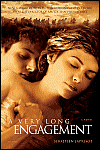
A Very Long Engagement - Sebastien Japrisot [August/06]


I have always had a big interest in the two world wars from a historical point of view. That being said, I like to read novels that are set during either World War I or World War II.

From the back:

Set during and after the First World War, AVERY LONG ENGAGEMENT tells the story of a young woman's search for her fiance, whom she believes might still be alive despite having offically been reported as "killed in the line of duty." Unable to walk since childhood, fearless Mathilde Donnay is undeterred in her quest as she scours the country for information about five wounded French soldiers who were butually abandoned by their own troops. A VERY LONG ENGAGEMENT is a mystery, a love story, and an extraordinary portrait of life in France before and after the War.

This was a very wonderful read, let me tell you. I like certain periods in history. I enjoy reading Canadian history in its entirety because that's where I live. The other things I enjoy are novels about Troy, Arthurian legends, the World Wars, and the surrounding time periods. Other things are enjoyable as well, but these things are the things that will make the books something I have to try. Other time periods I am more particular about. So, when I saw this book mentioned on a blog at one point and time, I added it to my to read list and it came up the other day when I was ordering from Amazon. I got it in the mail, sat down and read it, and I thought it was very well written.

If you haven't noticed, not a major reader of romance novels. So, I admit this was an iffy read because at its core, it is a romance novel. But it has so many other things going on that I could not help enjoying it. For starters, to think that men were executed during the war for not wanting to fight. It is rather depressing, these men shot themselves so that they would be sent home. They were considered cowards, but I don't really think they were. They shot off their arms, that is rather brave when you think about it. Can we really judge people that do not want to take lives. Look at all the lasting effects war has on people, to see all that slaughter. You really have to question whether or not war is worth it. To these men, some of them would rather not be able to write again than stay on the fields. And this really happened, too. That's the sad thing, the actual people may not be real, but the reality is.

Mathilde is an interesting character. The war has been over for several years and there she is still trying to find out what happened to her fiance. Many people try and prevent her from learning the truth, but she has the determination to learn the truth. She is not easily distracted, and actually brings hope to the other women that lost their husbands on that fateless day. Five men were let out into enemy lines to be shot by the enemy. Seems to me the method they chose to execute them was more cowardly than the actual act. It is a novel that will have you trying to solve the mystery of whether her finance died or not and at the same time, it makes you think about the consequences of war.

Has anyone seen the movie? I was wondering if it was worth watching.

4.5/5