Showing posts with label award-winning. Show all posts

Wednesday, October 31, 2007

Some Progress Reports

I have been paying attention to some of the reading awards this year. Here is a progress report of sorts of how successful I am. I was concentrating on the Giller, but since I own all the Governor General nominees in fiction, I will likely end up reading those too. The Booker, at this point I will read the few I have and maybe the rest of the short list. I plan to read the winner but the bookstores do not seem to have it.

Booker Awards:

  • Darkmans by Nicola Barker (4th Estate) - Getting for Christmas
  • Self Help by Edward Docx (Picador)
  • The Gathering by Anne Enright (Jonathan Cape) - Waiting for the bookstore to get it back
  • The Reluctant Fundamentalist by Mohsin Hamid (Hamish Hamilton)
  • The Welsh Girl by Peter Ho Davies (Sceptre)
  • Mister Pip by Lloyd Jones (John Murray)
  • Gifted by Nikita Lalwani (Viking)
  • On Chesil Beach by Ian McEwan (Jonathan Cape)
  • What Was Lost by Catherine O’Flynn (Tindal Street)
  • Consolation by Michael Redhill (William Heinemann) - Own but have not read.
  • Animal’s People by Indra Sinha (Simon & Schuster) - Still need to track down a copy.
  • Gift Of Rain by Tan Twan Eng (Myrmidon)
  • Winnie & Wolf by A.N.Wilson (Hutchinson)
Giller Award:
  • David Chariandy for his novel "Soucouyant" (Arsenal Pulp Press)
  • Sharon English for her short-story collection "Zero Gravity" (The Porcupine's Quill)
  • Barbara Gowdy for her novel "Helpless" (HarperCollins Canada)
  • Elizabeth Hay for her novel "Late Nights on Air" (McClelland & Stewart)
  • Lawrence Hill for his novel "The Book of Negroes" (HarperCollins Canada) - Own
  • Paulette Jiles for her novel "Stormy Weather" (HarperCollins Canada) - Own
  • D.R. MacDonald for his novel "Lauchlin of the Bad Heart" (HarperCollins Canada) - Own
  • Claire Mulligan for her novel "The Reckoning of Boston Jim" (Brindle & Glass Publishing)
  • Mary Novik for her novel "Conceit" (Doubleday Canada) - Own
  • Daniel Poliquin for his novel "A Secret Between Us," translated by Donald Winkler (Douglas & McIntyre)
  • Michael Winter for his novel "The Architects Are Here" (Penguin Books Canada)
  • Alissa York for her novel "Effigy" (Random House Canada) - Own
  • Richard Wright for his novel "October" (HarperCollins Canada)
  • Michael Ondaatje for his novel "Diversadero" (McClelland & Stewart)
  • M.G. Vassanji for his novel "The Assassin's Song" (Doubleday Canada)
Governor Generals Award:
Fiction:
David Chariandy, Vancouver, for Soucouyant
Barbara Gowdy, Toronto, for Helpless
Michael Ondaatje, Toronto, for Divisadero
Heather O’Neill, Montreal, for Lullabies for Little Criminals - Own
M.G. Vassanji, Toronto, for The Assassin’s Song - Own

Non-fiction:
Rodrigo Bascuñán and Christian Pearce for Enter the Babylon System: Unpacking Gun Culture from Samuel Colt to 50 Cent
John English for Citizen of the World: The Life of Pierre Elliott Trudeau, Volume One: 1919-1968
Stephanie Nolen for 28: Stories of AIDS in Africa
Karolyn Smardz Frost for I’ve Got a Home in Glory Land: A Lost Tale of the Underground Railroad
Bridget Stutchbury for Silence of the Songbirds: How We Are Losing the World’s Songbirds and What We Can Do to Save Them

Wednesday, June 27, 2007

Sounder by William Armstrong and Speak by Laurie Halse Anderson


So, the other day I got all the books that I have read and was not a big fan of together and off to the second hand store I went. This means that I no longer have these books handy, and I really did not like them, so they are not really fresh in my mind any longer. Sounder won a Newbery Award, and it was a cute book, but I just could not find the big attraction with it. It is likely more reflective of the time it was released in than anything. Not liking Speak surprised me because I had heard really good things about it. I just could not get into it at all, and I think part of it was the writing style.

So, I will just leave you with the book descriptions and you can make your own decisions about whether or not you want to read them.

Speak description:

The first ten lies they tell you in high school
"Speak up for yourself - we want to know what you have to say." From the first moment of her freshman year at Merryweather High, Melinda knows that this is a big fat lie, part of the nonsense of high school. She is friendless, outcast, because she busted an end-of-summer party by calling the cops, so now nobody will talk to her, let alone listen to her. As time passes, she becomes increasingly isolated and practically stops talking altogether. Only her art class offers any solace, and is is through her work on an art project that she is finally able to face what really happened at that terrible party: she was raped by an upperclassman, a guy who still attends Merryweather and is still a threat to her. Her healing process has just begun when she has another violent encounter with him. But this time Melinda fights back, refuses to be silent, and thereby achieves a measure of vindication. In this powerful novel, an utterly believeable heroine with a bitterly ironic voice delivers a blow to the hypocritical world of high school. She speaks for many a disenfranchised teenager while demonstrating the importance of speaking up for oneself.
I am wondering if this book did not work for me because I am not a teen anymore... not sure.

Description for Sounder:
A landmark in children's literature, winner of the 1970 Newbery Medal, and the basis of an acclaimed film, Sounder traces the keen sorrow and the abiding faith of a poor African-American boy in the 19th century South. The boy's father is a sharecropper, struggling to feed his family in hard times. Night after night, he and his great coon dog, Sounder, return to the cabin empty-handed. Then, one morning, almost like a miracle, a sweet-smelling ham is cooking in the family's kitchen. At last the family will have a good meal. But that night, an angry sheriff and deputies come, and the boy's life will never be the same.

Tuesday, June 12, 2007

Middlesex by Jeffrey Eugenides


Completion Date: June 11, 2007
Publication Year: 2004
Pages: 544
Owned Prior to 2007

A dazzling triumph from the bestselling author of The Virgin Suicides--the astonishing tale of a gene that passes down through three generations of a Greek-American family and flowers in the body of a teenage girl.

In the spring of 1974, Calliope Stephanides, a student at a girls' school in Grosse Pointe, finds herself drawn to a chain-smoking, strawberry blond clasmate with a gift for acting. The passion that furtively develops between them--along with Callie's failure to develop--leads Callie to suspect that she is not like other girls. In fact, she is not really a girl at all.

The explanation for this shocking state of affairs takes us out of suburbia- back before the Detroit race riots of 1967, before the rise of the Motor City and Prohibition, to 1922, when the Turks sacked Smyrna and Callie's grandparents fled for their lives. Back to a tiny village in Asia Minor where two lovers, and one rare genetic mutation, set in motion the metamorphosis that will turn Callie into a being both mythical and perfectly real: a hermaphrodite.

Spanning eight decades--and one unusually awkward adolescence- Jeffrey Eugenides's long-awaited second novel is a grand, utterly original fable of crossed bloodlines, the intricacies of gender, and the deep, untidy promptings of desire. It marks the fulfillment of a huge talent, named one of America's best young novelists by both Granta and The New Yorker.
This book won the Pulitizer Prize and is the newest Oprah Book Club pick. It has been sitting on my to be read pile for a couple years now. I did not read it because was the Oprah summer pick, but more because I have wanted to read it for a while and was just really slow getting around to it. I really enjoyed The Virgin Suicides by him, but I think I liked this book better. It took a while to come out, and you can see the research put into it.

This book does a very good job of covering gender identity. Calliope was born, and because of a quick glance, believed to be a normal, healthy baby girl. It was her teenage years before the doctor discovered he had made a mistake, she spent many years as a girl and then learned that this might not be the right thing for her. Instead of just talking about Callope Stephanides as the 41-year-old narrator, Cal tells the story of the grandparents that started the genes moving towards her, of her parents that carried the family genes that were together for the first time and could thus be passed on to her. Engenides creates the history and the background for why Cal was born the way that he was.

There are some great characters in this book. The story is told from Cal's point of view as him writing his memoirs, so we get a taste of him as both a child and a few glimpses into his current adult life. Through his eyes, we learn what it is like to be a hermaphodite and the struggles that creates for a person. Eugenides decides to have the child that was raised as a girl become a man when they learn the truth of what they are. Cal, if they had a good doctor, would have been marked as a boy from the start, but the doctor did not look closely enough and so she was raised as a girl. Despite the fact that they feel compelled to change to a different gender, Cal says that he was comfortable when he was a girl and not so comfortable as a male. Gender identity is a very fluid thing that is more inspired by your up-bringing than anything else. There are rules as to what it is to be male or female.

Desdemona, Cal's grandmother is a very interesting character to read about. She feels that what happens to Cal is punishment for the sins that she has committed and worried about since she was a young woman. She was expecting something bad to happen, but when Cal was thought to have been born fine, she thought that the danger had passed. She comes from a small place that was very common for intermarriage, and thus often had cases of babies being born one sex and discovering they were another when they were older. I find that while her husband, Lefty was in the novel, the story relied more on the female side of the relationship. I feel I got to know Desdemona better than Lefty.

Other characters include Cal's brother, Chapter Eleven, which I had hoped to learn the name origin for, but it was never revealed. He got off slightly okay, his cousins had names like Plato and Cleopatra. I do not find that the parents were covered as much as the grandparents, but we get to see how they met and how their relationship played out, as well as a few other glimpses throughout the novel. I just found myself wondering how they could have overlooked Cal's complete lack of development for so long and what they did notice, consider normal.

My only problem with this book were there were a few spots where the book dragged a bit and I found myself skimming. Overall, though, it was a very good read. I recommend this book! It's very different than the normal fiction covering the shelves.

Sunday, June 11, 2006

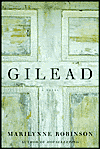
Gilead - Marilynne Robinson [June/06]


For a book club that I read with online, each member was allowed to choose one book, and those are the books we are going to read over the next year. The book for June is Gilead by Marilynne Robinson. It won the Pulitizer Prize, so you would think that it is an exceptional novel. From the front flap:

An intimate tale of three generations, from the Civil War to the twentieth century: a story about fathers and sons, and the spiritual battles that rage within all of us.

It's 1956 in Gilead, Iowa, towards the end of the Reverand John Ames's life. The son and grandson of preachers, he is absorbed in recording his family's story, a legacy for the young child he will never see grow up. Haunted by his grandfather's presence, John tells of the rift between his grandfather and his father: the elder, an angry visionary who fought for the abolitionist cause, and his son, an ardent pacifist. He is troubled, too, by his prodigal namesake, Jack (John Ames} Boughton, his best friend's lost son who returns to Gilead searching for a salvation the town might hold.

Told in John Ames's joyous, rambling voice that finds beauty, humor and truth in the smallest of life's details, Gilead is a wonderful, heartfelt song of celebration and acceptance of the best and the worst the world has to offer. At its heart is a tale of the sacred bonds between fathers and sons, pitch-perfect in style and story.

This is a very slow read. It just took forever to get through and it is not even that many pages long! I can understand why it would appeal to the judges for the pulitizer, but it just did not work well for me. The book jumps around a lot, that can be annoying at many times, but more importantly, it is just plain hard to get into. It is one of those books that you either like or hate, I am not sure there is much road in between. For many people it seems to be the fact that you are left thinking about legacies that appeals to the readers. I just could not get into it enough to appreciate it.

2.5/5

Friday, December 16, 2005

A Complicated Kindness - Miriam Toews (November/05)


When I read it I had this to say on another site:

I wanted to read this book because it won a big award in Canada, The Governor General's award. I am a Canadian, so I am big on supporting the writers of my country, and this book was one of the better pieces of fiction I have read from here. It is about a Mennonite community in Ontario (province in Canada, I know not everyone is a pro at geography). Anyways, they are very religious and primitive, but the children are starting to break the mould so to speak. This book follows Nomi through her 12th year of high school, with flashbacks to the life that she lived before. I really enjoyed it!

4.5/5

I also have another book to read by Miriam Toews:
Swing Low: A Life