Showing posts with label Bess Crawford Mystery Series. Show all posts

Monday, June 18, 2012

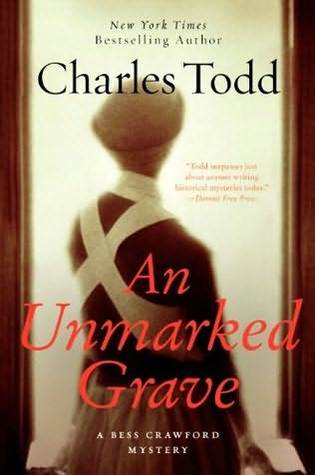
An Unmarked Grave (Bess Crawford #4) by Charles Todd

An Unmarked Grave (Bess Crawford Series, Book 4) by Charles Todd

Completion Date: June 15, 2012
Reason for Reading: Next book in the series/TLC Book Tour.
World War I nurse and amateur sleuth Bess Crawford matches wits with a devious killer in this exciting and suspenseful adventure from New York Times bestselling author Charles Todd.
In the spring of 1918, the Spanish flu epidemic spreads, killing millions of soldiers and civilians across the globe. Overwhelmed by the constant flow of wounded soldiers coming from the French front, battlefield nurse Bess Crawford must now contend with hundreds of influenza patients as well.
However, war and disease are not the only killers to strike. Bess discovers, concealed among the dead waiting for burial, the body of an officer who has been murdered. Though she is devoted to all her patients, this soldier's death touches her deeply. Not only did the man serve in her father's former regiment, he was also a family friend.
Before she can report the terrible news, Bess falls ill, the latest victim of the flu. By the time she recovers, the murdered officer has been buried, and the only other person who saw the body has hanged himself. Or did he?
Working her father's connections in the military, Bess begins to piece together what little evidence she can find to unmask the elusive killer and see justice served. But she must be as vigilant as she is tenacious. With a determined killer on her heels, each move Bess makes could be her last.
Where this is the 4th book in a series, it makes it harder to talk about it. So, I am going to share some brief thoughts instead.

  • I continue to enjoy the setting of this series. I appreciated the fact that there are actual scenes from the home front, but there are also moments from the field.
  • Bess is an interesting character. Sometimes I find her a bit too perfect, but ultimately she has grown on me with each book. I like her much more now than I did in the beginning.
  • One thing that I can't help thinking about is how every guy that she meets seems to fall in love with her. It's almost getting overdone. It might be time for her to have feelings for a guy, too.
  • I really enjoyed how much of Simon there was in this book. I find we are really getting to know him and I really like him. I continue to be curious what role he was play in Bess' future.
  • I think this might be my first novel set during the Spanish Influenza. I thought it was an interesting addition to the story. It touched many lives while it was spreading through the ranks.
  • This makes me think about how I enjoy the details about WWI that are scattered throughout the books. It talks about gas masks, the dangers of the gases used, etc. It's also more from a medical viewpoint which is different from the norm.
  • It is nice that characters from other books are at least mentioned even if they do not appear in the actual book. It gives underlining story-lines. They are always nice.
  • My biggest problem with this book, though, was the ending. I actually got confused because I found it was a bit out of left field and very rushed. I am not quite sure I found it believable. It was page-turning, though. It was a mixed reaction ending.
  • I look forward to the next book in the series!

Thanks to TLC Book Tours for hosting this tour and for my copy of this book.

Bess Crawford Series:
A Duty to the Dead
An Impartial Witness
A Bitter Truth
An Unmarked Grave

This also means I successfully completed the Bess Crawford Read-Along. I am bad with read-alongs... So big deal! The book counts for the War through the Generations and Historical Fiction Reading Challenges.

Wednesday, June 13, 2012

A Bitter Truth (Bess Crawford Series, Book 3) by Charles Todd

A Bitter Truth (Bess Crawford Series, Book 3) by Charles Todd

Completion Date: June 5, 2012
Reason for Reading: Carry on with the series.
World War One battlefield nurse Bess Crawford is featured for a third time in A Bitter Truth . Bess reaches out to help an abused and frightened young woman, only to discover that no good deed ever goes unpunished when the good Samaritan nurse finds herself falsely accused of murder.
1.) How did A Bitter Truth stack up for you against Bess' previous two adventures?
I always find that I have a hard time initially getting into this series. It has happened with all three books so far, but once I am engrossed in the story things seem to go rather well. I have almost entirely read the three books in one sitting each. I actually think the series is getting better, though. The writing is improving and the overall stories. They are getting to know Bess Crawford better with each book and as a result, the readers is able to get more and more lost in the stories. My one little problem remains, though. I sometimes find Bess Crawford too morally superior. It doesn't always strike me as believable. I know this was different times, but not everyone does the right thing every time. I was amazed when there was a chance for Crawford to do 'the right thing' in this book and instead she did the nicer thing. There are some times where 'the right thing' isn't necessarily the right thing. I think if she had done what her first instinct was in this case I would have lost all respect for her as a character.

2.) I really enjoyed the mystery in this novel, and confess I was quite confounded as to who the killer was, until the very end. How about you?
I think the mystery is where the writing evolution is the most apparent. In the first book I solved the mystery very early on in the story. In this one I was a bit more hesitant about my conclusion. I had theories and kept reading to find out if I was right or not. They are getting better at throwing situations in to make you look in different directions only to find out that it was a 'red herring'. I like being surprised and such, so I am glad things are getting more complicated.

3.) The plight of orphans in the war is brought to the forefront in this novel - what do you think of Lydia's and Bess' feelings and plans for Sophie?
I had a really hard time with my thoughts on this. On the one hand, I agreed with Lydia. But then I had other moments where Bess was more likely right. I think that Sophie should be with her family instead of the nuns, but I understand that the nuns would also be distraught thinking that something had happened to the child. It is an example of Bess' moral superiority. I was left thinking right or wrong, I could not imagine bringing a child out of the horrors of France only to bring her back again. I just couldn't agree with Bess on that issue despite also understanding where she was coming from. I was glad with how things played out because I ultimately thought they were the best for the child at that time. I also appreciated the glimpse at what it was like for orphans of WWI. It is something that gets buried in other aspects of the war experience.

4.) I was struck by the passage in chapter 15, when Todd speaks of the evolution of the war: "The days when men lined up in their dozens to be the first to enlist had long since passed. Now the reality of the trenches had scoured away that bravado, and in its place were these recruits, afraid of shaming themselves in front of their mates but probably wishing themselves anywhere but here." How did you see the war changing people and events in the novel?
When I look back on the two major wars I am always impressed with the men and women that rushed out to join up in the beginning. Especially for WWII because they had often grown up hearing about the first war from their parents and yet they still wanted to fight. I often toy with how I would have felt in the same situation. In the beginning, though, it is the heroic thing to do and a chance to vanquish the enemies. Later on, it is still important but you become more aware of what it is really like and only do so because it is right or because your friends are doing it. Then, there was the idea of the 'white feather'. Citizens would present men of the correct age with a feather branding them as cowards. It made it even harder to stay out of the mix. By the time this book takes place, though, the lustre is off the war. It is dragging on, the death toll is high, and people are attempting to desert which has devastating repercussions if they are caught. Alternatively, they sometimes shoot themselves in certain areas to get necessary leave or get out entirely.

5.) Simon Brandon plays an even greater role in this book than the last, though I don't think Bess sees his interest as more than professional or familial. What do you think his intentions are? And do you think Bess recognizes them?
I am not sure what to make of Simon. I really like him and I think he really likes Bess from different things he has said and such, but now there is this Aussie thrown in the mix. I think it will depend on if he is in the next book where Simon fits into everything. Bess seems to like the Aussie and he seems to like her. I hope that Simon continues to play a role in the books and I guess we will see how things go.

This book counts for the War Through the Generations Challenge and the Historical Fiction Reading Challenge.

Wednesday, May 02, 2012

An Impartial Witness: A Bess Crawford Novel (Book 2) by Charles Todd

An Impartial Witness: A Bess Crawford Novel (Book 2) by Charles Todd

Completion Date: April 19, 2012
Reason for Reading: Next book in the series/Bess Crawford Read-along.
World War I nurse Bess Crawford, introduced in "A Duty to the Dead," returns in an exciting new mystery in which a murder leads her into the clutches of awily killer.
Today I am posting my answers to the questions asked about the second book in the Bess Crawford series. Tune in on May 29 (or thereabouts) to see my thoughts on book 3.

1) As in A Duty to the Dead, long-seated familial animosities and jealousies play a role in the crimes committed. What did you think of the Garrison and Melton families? How do they compare to Bess' family, or to the families of soldiers and nurses created by war?
This book just seemed like drama, drama, drama. That is not necessarily a bad thing, it kept things interesting, but it seemed like everyone was having some sort of a problem in this book. I find that sometimes Bess and her family are shown as just a bit too perfect. They always seem to get along and Bess is always on a quest to do the right thing. There doesn't seem to be enough flaws to round out the characters. I think that is why despite enjoying the series, I am still a bit leery of Bess. It is something I have been trying to put my finger on since I read the first book.  It could also be because the other people in the book are so flawed it makes for almost a black and white comparison. And, when everything comes out in the end you can't help thinking 'Seriously?'. It is amazing how people can act, I tell you. The Garrison and Melton families were interesting, but it seemed like everyone was a bit crazy. There were some sympathetic moments, but it is sad that things played out the way that they did.

2) Simon Brandon plays a far greater role in this novel than he did in A Duty to the Dead. What do you make of that and do you think his intentions stem from his duty to Bess' father, or from his affections for Bess herself?
I am so glad you asked this question because I have been thinking a lot about Simon Brandon. I think he is going to continue to become more and more of a central character. And, I think it is clear from some of the scenes that it has more to do with his affection for Bess than loyalty to her father. I think this is one of the interesting things about this book because I am curious how the authors will choose to play it out.

3) Simon strives to curtail the risks that Bess takes throughout the novel. This advice of his struck me particularly: "We have to move on. Put the living first. There are already enough monuments to the dead." Do you think Bess's drive to right the wrongs she sees puts her at odds with this advice, to her detriment?
That was an interesting piece of advice and I suppose it makes sense, but I can also see where Bess is coming from. The police are getting no where with the case and she feels like since she was one of the last people who saw the victim alive, it was her responsibility to make sure her story was told. If she was a victim of a war than yes, there would be lots of monuments. She died senselessly, though, and she needed someone on her side. Sometimes Bess might go a bit too far, and it does seem like to her detriment, but ultimately it all plays out in the end and I think that redeems everything.

4) Do you think there is any such thing as an "impartial witness?" Bess admits to adding her own perspective and interpretation to what she sees at the railway station. Later, Mrs. Hennessey is referred to by Bess as an "impartial witness," presumably because she's completely in the dark about what's been happening. But what do you think of the phrase, and what do you think the authors mean us to to think of it?
I don't think there is such thing as an impartial witness. No matter what happens, you are going to put your life experiences and opinions into play when addressing a situation. I think it just happens no matter how hard you try. The authors, though, it is hard to say what they were thinking. I think it is likely they were trying to show there is really no such thing as someone that is impartial, but that could just be my opinions clouding things.

5) What did you think of the ending of the novel? Were you expecting a confrontation, or confession, that you didn't see? And if so, why do you think it was written that way?
Well, firstly, I solved the mystery in this one. I had this feeling and I was happy to see that I was right come the end of the book. There were a few moments where I doubted myself, but ultimately I thought I had the right guy. Secondly, I thought the book played out well in the end. I wasn't really disappointed by the ending. It was just the best way to finish everything up.

6) Did you learn any new phrases while reading An Impartial Witness? For me it was "Well, it's shank's mare, then," which Sister Benning says to Bess when they have to walk behind the ambulance of wounded soldiers on their way to safer ground. Turns out that "shanks mare" is an Irish phrase referring to having to hoof it on your own two legs.
I had the same one. I had no idea what 'shanks mare' meant. It was the first I had ever saw it used in a book, so I had to look it up. It's a rather entertaining phrase!

Bess Crawford Series:
A Duty to the Dead 
An Impartial Witness
Bitter Truths
An Unmarked Grave

This book counts for both the War Through the Generations Challenge and The Historical Fiction Challenge.

Thursday, April 19, 2012

A Duty to the Dead: A Bess Crawford Mystery (Book 1) by Charles Todd

A Duty to the Dead by Charles Todd

Completion Date: March 3, 2012
Reason for Reading: Bess Crawford Read-Along
The daughter of a distinguished soldier' Bess Crawford follows in his footsteps and signs up to go overseas as a nurse during the Great War' helping to deal with the many wounded. There' serving on a hospital ship' she makes a promise to a dying young lieutenant to take a message to his brother' Jonathan Graham: "Tell Jonathan that I lied. I did it for Mother′s sake. But it has to be set right." Later' when her ship is sunk by a mine and she′s sidelined by a broken arm' Bess returns home to England' determined to fulfill her promise.
It′s not so easy' however. She travels to the village in Kent where the Grahams live and passes on to Jonathan his brother′s plea. Oddly' neither Jonathan' his mother' nor his younger brother admit to knowing what the message means. Then Bess learns that there′s another brother' incarcerated in a lunatic asylum since the age of 14 when he was accused of brutally murdering a housemaid.
Bess rightly guesses that the dying soldier′s last words had something to do with the fourth brother. Because the family seems unwilling to do anything' she decides that she will investigate. It′s her own duty to the dead.
I had never heard about this series, but Jen at Devourer of Books posted about a read-along that was being hosted by Book Club Girl. I am not a huge fan of mystery series, but I do have a few exceptions. The fact that this one was centred around a female nurse, Bess Crawford, during WWI immediately caught my attention. I am a huge fan of Jacqueline Winspear's Maisie Dobbs series, so I am always looking for series of that same nature. Plus, I don't read as many books set during WWI as WWII and that is something I really need to remedy. I actually missed the first discussion for the read-along because I was doing up my Titanic posts, but I am finally taking the time to talk about this book.

Here are the questions that were posted for the discussion I missed:


1) Was this the first book that you read by Charles Todd, or, the first book set in this time period? I first encountered WWI-era-England with Jacqueline Winspear's Maisie Dobbs series, and then, of course with the tv sensation Downton Abbey. If you have read more in this time period, what other books do you recommend?
- Yes, this was my first time reading Charles Todd. I have noticed his other series while browsing the second-hand bookstore, but I hadn't heard enough to pick anything up. I also have read Jacqueline Winspear's series. I have read other books centred around WWI, but not very many and none that immediately jump to mind. There are just more books centred around WWII...

2) What was your first impression of Bess Crawford? Were you surprised by the independence she enjoyed as a woman in this time, and that her parents afforded her so much freedom? Did your opinion of Bess change throughout the novel?
- I actually think as far as her independence goes, she is probably more realistic than Maisie Dobb's. Her parents are constantly checking up on Bess and there is Simon, a friend of the family, who is around the rest of the time. She still does move around a fair bit, but not without some restrictions. I also think that her being a nurse in WWI and the changes that brought for women opened up some of the freedom for her. As to my first impression, I wasn't sure what to make of Bess. I enjoy the setting and all that, but I am not so sure about Bess herself. I don't dislike her, but she is not my favourite literary character ever. There is just something about her that is keeping her at a distance (and I have read two books in the series at this point).

3) Bess has an interesting back story, growing up as she did in India. How did the authors use that part of her life to help define her character, and that of her parents and their relationship?
The India connection was interesting. I enjoyed learning about her life there and such, but unfortunately with everything else happening in the book the details haven't really stuck with me. I think I am going to skip this question...

4) Did you know that large ocean liners, such as the Brittanic, which was a sister ship to both the Titanic and the Olympic, were called into service as hospital ships during the war? Brittanic was indeed sunk as well, just as the Todds write it in the book. Did you know that so many of the men who died on the hospital ships were buried at sea? Of course it makes sense, but I hadn't realized the number and that those men's families were left with no grave at home to visit, as Bess reflects, "In the sea there were no markers for the dead. No place in the deep to mourn, no place to leave flowers."
-I have always been fascinated with the Titanic, but with that comes interest in the sister ships. The Olympic was also used as a hospital ship during the war and there is a historical picture of it docked at the Halifax Harbour. I think this might be the first fictional book, though, that contained the Britannic. That I have read anyway. How quickly the ship sank considering all the modifications that were made to it following the Titanic surprised me the most each time I read about it. It just goes to show there is no such think as an 'unsinkable' ship. I was not surprised about the bodies buried at sea. That was something that was just done even if it wasn't an incident during the war. It is just the naval way.

4) What did you think of Arthur's message? Do you think it was fair of him to ask Bess to deliver it? Why do you think she was so committed to not only delivering it, but to making sure it was followed by the Graham family?
-I was a little surprised by the message in the beginning. You find out about it early in the novel and I wasn't sure what to expect. We still didn't really know Bess, so it was hard to entirely say how she would handle things. I thought it was nice that she made sure the message was delivered, but I was a bit surprised by how obsessed she was about things. Obviously if she hadn't the book would be rather short, but I think it might be her need to get wrapped up in other people's affairs that is making her so hard to grow on me. I am not entirely sure if it is believable.

5) What did you think of Mrs. Graham and her sons? I was struck by how much Bess was at their mercy and whim while staying in their house. Do you think they abused her kind nature in asking her to care for Peregrine?
- I couldn't get over the Graham family. Arthur seemed so normal, but wow, when you get into things there is a lot going on there. I went back and forth on Mrs. Graham. I sometimes was very sympathetic about her, but then there were other times where I just didn't like her at all. Her sons were no different, but I think I knew more clearly how I felt about them when everything played out. And, yes, I was both surprised by how it was well Bess was staying with them and how they treated her in regards to Peregrine. Again, I was a bit hesitant to find it believable.

6) Did you guess who the real killer was before he was revealed? I confess I went back and forth a few times, wondering.
- I went back and forth, too. I would think I had it solved and then I wouldn't be so sure any more. I wasn't surprised by the ending, though. I do think the Todd's did a good job of keeping things mysterious.

7) What new word did you learn in A Duty to the Dead? For me it was "ratings," which refers to "a classification according to grade; specifically: a military or naval specialist classification, or more precisely: "chiefly British: a naval enlisted man." (Merriam Webster's Collegiate Dictionary, 11th edition).
-hm, I am sure there was something, but again, been a while since I read the book...

In conclusion, I do enjoy this series, but I have a few reservations about this book.

This read counts for the War Through the Generations and the Historical Fiction Reading Challenges.

Bess Crawford Series:
A Duty to the Dead
An Impartial Witness
A Bitter Truth
An Unmarked Grave