Showing posts with label World War I literature. Show all posts

Thursday, April 17, 2014

Book Review: Wake by Anna Hope

Wake by Anna Hope


Completed: February 21, 2014
Length: 304 Pages

Synopsis from Goodreads:
A brilliant debut for readers of The Guernsey Literary and Potato Peel Pie Society, in which three women must deal with the aftershocks of WWI and its impact on the men in their lives—a son, a brother and a lover. Their tragic connection is slowly revealed as the book unfolds.
Wake: 1) Emerge or cause to emerge from sleep 2) Ritual for the dead 3) Consequence or aftermath.
Hettie, a dance instructress at the Palais, lives at home with her mother and her brother, mute and lost after his return from the war. One night, at work, she meets a wealthy, educated man and has reason to think he is as smitten with her as she is with him. Still there is something distracted about him, something she cannot reach...Evelyn works at the Pensions Exchange through which thousands of men have claimed benefits from wounds or debilitating distress. Embittered by her own loss, more and more estranged from her posh parents, she looks for solace in her adored brother who has not been the same since he returned from the front...Ada is beset by visions of her son on every street, convinced he is still alive. Helpless, her loving husband of 25 years has withdrawn from her. Then one day a young man appears at her door with notions to peddle, like hundreds of out of work veterans. But when he shows signs of being seriously disturbed—she recognizes the symptoms of "shell shock"—and utters the name of her son she is jolted to the core...
The lives of these three women are braided together, their stories gathering tremendous power as the ties that bind them become clear, and the body of the unknown soldier moves closer and closer to its final resting place.
Fiction or Non-Fiction? Genre?: Historical Fiction.

What Lead You to Pick-up This Book?: hm... I think I saw it on a list of books out in 2014 and thought it sounded good. It was on Netgalley, so I grabbed a copy.

Summarize the Plot: This book takes place over 5 days. WWI is over, but the men and women of this novel are still dealing with things in their own way. The novel follows three women over these five days: Hettie, Evelyn, and Ada. Hettie is a dance instructor at a local dance club. She is one of the women that men pay to dance with. She is still living at home with her mother and her emotionally-disturbed brother. One night she meets a wealthy man and takes a shine to him. She thinks that he likes her as much, but things are not always as they seem. Then there is Evelyn. She is wealthy, but chooses to live in a flat and work for the war department at the Pension Exchange. She is dealing with her own loss from the war and trying to deal with her brother who is dealing with different demons in different ways. Lastly, there is Ada. She has not taken the loss of her son well and her husband has grown distant from her. Then a young man shows up at her door and sets everything back in motion for her. The three characters wind up with unknown connections to each other, but they are also connected by the moving of an unknown soldiers body as it moves towards its final resting place.

What Did You Like Most About This Book?: I really liked that the book took place after the war. It still illuminates the tragic events, but it also shows what it is like for the people afterwards. The war may be over, but there are still many things to deal with. It is a very humanizing story. Plus, it is about the women who don't always get as much attention in the overall picture of war. It doesn't just show them, though. They interact with men and we get to see their sides of things, too.

What Did You Like the Least?: There is a question that specifically pertains to my problem with this book, so I will mention it there. Otherwise, I quite enjoyed this book and have no major complaints.

What Did You Think of the Writing Style?: This is a debut novel, but all ready Anna Hope is a fantastic author. I was drawn in right away and found that I was eager to turn the pages and find out what happened next. I actually was having e-reader issues when I first started this book and read the first half or so on my computer. I didn't mind at all. I really look forward to seeing where her writing takes her next.

What Did You Think of the Main Character?: As I mentioned above, the book follows Hettie, Evelyn, and Ada. I have to say that I enjoyed them all. In many ways they have grown up very differently and had very different experiences during the war, but on the other hand they are very much the same. The war touches everyone and makes complete strangers similar to one anther. It does turn out that there are connecting lines between the characters, but that isn't entirely apparent in the beginning and doesn't always mean the characters themselves are even aware of it. I enjoyed learning about all three of them and seeing things from their points of view.

What Did You Think of the Ending?: *ahem* I finished this book in February. It has taken me this long to review the book... I still remember the book very clearly considering it has been so long. I would even go to say that it might have been one of my top reads of the year... And then the ending happened. I was reading an e-galley and thought maybe there was something wrong with it. I finally got definite confirmation today that there was nothing at all wrong. What do I even say? I hated the ending. I glanced around Goodreads, though, and no one said anything about it... I am not sure if I would have liked it better if I didn't think it was some sort of error?

I am glad I don't rate books because I am not sure what I would even give this one... A great rating for the book and then a separate rating with the ending? It has been a couple months and I still have no idea what to think.

So, recommended, but with a warning...

Wednesday, October 31, 2012

Dulce et decorum est pro patria mori - Poetry Project November

I have been reading war poetry... Can you tell? I do not normally speak in Latin  but 'Dulce et decorum est pro patria mori' means 'it is sweet and right to die for your country'. I thought it was a fitting title for the month. You can just say "War Remembrance" or something along those lines.

The title actually comes from me reading 'Dulce Et Decorum Est' by Wilfred Owen. I was googling WWI poets and he was one that came up. I read him ages ago, but I don't really seek out and read poetry enough to call myself an expert on his poetry. I just was looking for WWI-related stuff. It's hard to believe this poem didn't stick with me more. It is graphic and descriptive of the events of WWI. I have always paid more attention to WWII than WWI. I think it was because several of my relatives had lived through that and were still alive when I was growing up. It is gaining popularity right now because the 100th anniversary is not too far away.

Then I moved on to 'Here Dead We Lie'. It is by A E Housman. It ends with the line 'And we were young'. You can't help pausing and thinking just how young. The sign-up age was 18, but kids lied and joined in anyway. It was definitely a different time. I wonder often how the same situation would be handled in this day and age. Kids are used to a very different lifestyle. Would they rush to join up? Lie about their ages? It's something I hope we never have to test...

Another poem that I had on my mind was written in response to 'In Flanders Fields'. I included the original poem on my post the other day. I honestly only knew that one existed and racked my brain trying to think of how it goes. It turns out that there are lots of responses to the famous poem. It was interesting to read poems written over the years in response to a scribbled few lines on a battlefield. Every year when Remembrance Day comes around I get another poem in my mind. It is a considerable amount longer, but it is actually the fourth stanza that I always remember:
They shall grow not old, as we that are left grow old; 
Age shall not weary them, nor the years condemn. 
At the going down of the sun and in the morning, 
We will remember them.
You can read the full seven stanzas here.

Share your own War Remembrance poems below. I look forward to the posts!


Tuesday, August 21, 2012

The Shoemaker's Wife by Adriana Trigiani (With a Give-away)

The Shoemaker's Wife by Adriana Trigiani

Completion Date: August 20, 2012
Reason for Reading: TLC Book Tour.
The fateful first meeting of Enza and Ciro takes place amid the haunting majesty of the Italian Alps at the turn of the last century. Still teenagers, they are separated when Ciro is banished from his village and sent to hide in New York’s Little Italy, apprenticed to a shoemaker, leaving a bereft Enza behind. But when her own family faces disaster, she, too, is forced to emigrate to America. Though destiny will reunite the star-crossed lovers, it will, just as abruptly, separate them once again—sending Ciro off to serve in World War I, while Enza is drawn into the glamorous world of the opera . . . and into the life of the international singing sensation Enrico Caruso. Still, Enza and Ciro have been touched by fate—and, ultimately, the power of their love will change their lives forever.
A riveting historical epic of love and family, war and loss, risk and destiny, inspired by the author’s own family history, The Shoemaker’s Wife is the novel Adriana Trigiani was born to write.
I had this book out from the library once before, but just wasn't in the right frame of mind for it at the time. Then, I saw a copy at the store and decided I had a better chance of reading my own copy. The TLC Book Tour was added inspiration after all the positive reviews I have seen circulating around the blogosphere. I have always wanted to read Trigiani and this was my first attempt. Thankfully, when I sat down with the book for the second time everything clicked and I was quickly pulled away into the world she has created.

I love nothing better than to read a historical fiction novel that is so believable I feel like I am there. The Shoemaker's Wife was one such book. There was nothing happening that seemed far-fetched or impossible. I read the book feeling like everything that was happening made entire sense. It was the story of a young man and a young woman who are born on the mountains of Italy. The financial situation is poor and they each have to do what they can to get by. The young man, Ciro, has lost his father and his mother cannot afford to raise him and his brother. They go and live in a convent. The young girl, Enza, comes from a large family that just can't seem to make ends meet. The situation plays out that they both end up in America to start new lives for themselves. They start from the bottom and work themselves up. They experience the real struggles for their times.

The book follows them from the early part of the 20th century, through WWI, and then ends just after WWII. During this time they get older and the cast of characters fluctuates, but it is ultimately their story. I don't think I have read many books where Italians and Italy itself play a major role. I found this refreshing in the midst of all the 'fads' in historical fiction. The wars were just a background to the overall story. They may have influenced the lives of the characters, but the book was more about the people. You really felt like you knew them and could see where they were coming from. When things were good you cheered long with them. And, in the bad times you could experience their heartache. Trigiani doesn't hold anything back.

I really enjoyed reading the story of Enza and Ciro. I also loved many of the secondary characters and felt they came alive for the readers, too. A real story is not just about the main characters but about the people that they meet who influence and give shape to their story. I think that Trigiani had a good mix of their story and the other characters story, too. Ciro and Enza wouldn't have became the people they were at the end of the story without the people they met along the way. It gives more depth to things.  If you haven't had a chance to enjoy this book you really should.

And, if you live in the United States or Canada you might get your own copy from this blog. I have one to give-away. I very rarely do give-aways on here; but I really should from time to time, right? (There are couple more in the future.) So, if you interested leave a comment. It would be nice if you actually said something in the comment, too.... Not just "Thanks for the give-away" or whatever. That's just me, though. The give-away will close on August 29, 2012. 

Friday, July 20, 2012

My Dear I Wanted To Tell You by Louisa Young

My Dear I Wanted To Tell You by Louisa Young

Completion Date: July 20, 2012
Reason for Reading: TLC Book Tour Stop
The lives of two very different couples--an officer and his aristocratic wife and a young soldier and his childhood sweetheart--are irrevocably intertwined and forever changed in this stunning World War I epic.
I always claim to be a big fan of books set during WWI and WWII, but when the yearly lists are drawn up it never seems that I read many books that qualify. I used to. I find so many changes in my reading over the years. I am not sure if I would have noticed if I wasn't keeping track. That being said, would the changes have happened if I wasn't keeping track? Thanks to the Bess Crawford Read-Along and TLC Book Tours, I finally seem to be sneaking some WWI books back into my reading. And, good WWI books. That's always a plus!

I have to admit that my participation in particular TLC tours is very laid back. I saw that this book was historical fiction and then saw WWI and I signed up. I actually didn't have the slightest idea what I was signing myself up for other than that. Then, the book arrived and I thought the cover was a bit artistic and I liked the font. I still didn't look at the back of the book. I find that despite the best intentions there can be spoilers and I decided I wanted to be surprised. So, I cracked the spine and prepared to enter a time almost 100 years ago. And, I have to say, I mostly enjoyed my reading experience in that time period.

My Dear I Wanted To Tell You covers two couples before, during, and after WWI. One couple is married and is relatively well off. The other couple has liked each other since they were very little, but come from different sides of the tracks. The book circulates between their viewpoints, but it also includes a nurse that is related to the aristocratic couple. She works because circumstances have brought her into the lives of all the characters so her viewpoint is just as valid. The aristocratic couple, Peter and Julia, have to deal with the war in the terms that it horrifies him and she has no idea how to handle it. He felt that he was doing his patriotic duty and left early in their marriage. She has always been 'pretty' and is not sure how to deal with the changing world. It is interesting to see their two viewpoints. Then, the other couple, Nadine and Riley, are attempting to love each other against differences in social standing and a war raging. They feature in the majority of the book.

I am still toying with what I actually thought of this book. Initially I thought I was going to love it. The characters are well-written, the storyline is believable, and the author chooses to look at aspects of the war that are not necessarily the norm. I found myself engaged in what was going on and curious about how everything was going to play out. Then, the ending happened. I am still not sure if I liked it. It almost seemed rushed to me and on the one hand so much was going on, but on the other hand she was racing to conclude everything. I think I ultimately like how the book ended, but I am not so happy about how it played out. I still really enjoyed the book, but I am not quite as enamoured as I was in the beginning. The thing is if I think about it a bit longer I might get my head around things more, so I wouldn't not read the book because I am still mulling things over. It captures WWI very well, talks about interesting aspects of it, and has great characters.

To sum things up... Did I love the book? Mostly, but with a bit of a quibble. Do I recommend it? Of course! Despite my quibbles the book is still worth reading.

Thanks to TLC Book Tours for including me in this tour!

Casey was either jealous or wanted the book all to herself.

Monday, June 18, 2012

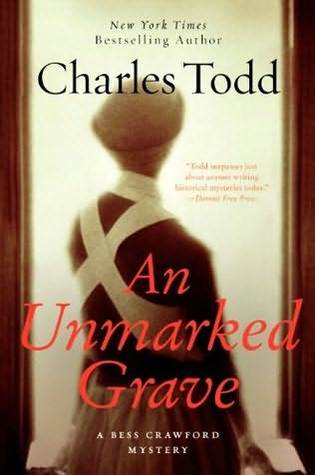
An Unmarked Grave (Bess Crawford #4) by Charles Todd

An Unmarked Grave (Bess Crawford Series, Book 4) by Charles Todd

Completion Date: June 15, 2012
Reason for Reading: Next book in the series/TLC Book Tour.
World War I nurse and amateur sleuth Bess Crawford matches wits with a devious killer in this exciting and suspenseful adventure from New York Times bestselling author Charles Todd.
In the spring of 1918, the Spanish flu epidemic spreads, killing millions of soldiers and civilians across the globe. Overwhelmed by the constant flow of wounded soldiers coming from the French front, battlefield nurse Bess Crawford must now contend with hundreds of influenza patients as well.
However, war and disease are not the only killers to strike. Bess discovers, concealed among the dead waiting for burial, the body of an officer who has been murdered. Though she is devoted to all her patients, this soldier's death touches her deeply. Not only did the man serve in her father's former regiment, he was also a family friend.
Before she can report the terrible news, Bess falls ill, the latest victim of the flu. By the time she recovers, the murdered officer has been buried, and the only other person who saw the body has hanged himself. Or did he?
Working her father's connections in the military, Bess begins to piece together what little evidence she can find to unmask the elusive killer and see justice served. But she must be as vigilant as she is tenacious. With a determined killer on her heels, each move Bess makes could be her last.
Where this is the 4th book in a series, it makes it harder to talk about it. So, I am going to share some brief thoughts instead.

  • I continue to enjoy the setting of this series. I appreciated the fact that there are actual scenes from the home front, but there are also moments from the field.
  • Bess is an interesting character. Sometimes I find her a bit too perfect, but ultimately she has grown on me with each book. I like her much more now than I did in the beginning.
  • One thing that I can't help thinking about is how every guy that she meets seems to fall in love with her. It's almost getting overdone. It might be time for her to have feelings for a guy, too.
  • I really enjoyed how much of Simon there was in this book. I find we are really getting to know him and I really like him. I continue to be curious what role he was play in Bess' future.
  • I think this might be my first novel set during the Spanish Influenza. I thought it was an interesting addition to the story. It touched many lives while it was spreading through the ranks.
  • This makes me think about how I enjoy the details about WWI that are scattered throughout the books. It talks about gas masks, the dangers of the gases used, etc. It's also more from a medical viewpoint which is different from the norm.
  • It is nice that characters from other books are at least mentioned even if they do not appear in the actual book. It gives underlining story-lines. They are always nice.
  • My biggest problem with this book, though, was the ending. I actually got confused because I found it was a bit out of left field and very rushed. I am not quite sure I found it believable. It was page-turning, though. It was a mixed reaction ending.
  • I look forward to the next book in the series!

Thanks to TLC Book Tours for hosting this tour and for my copy of this book.

Bess Crawford Series:
A Duty to the Dead
An Impartial Witness
A Bitter Truth
An Unmarked Grave

This also means I successfully completed the Bess Crawford Read-Along. I am bad with read-alongs... So big deal! The book counts for the War through the Generations and Historical Fiction Reading Challenges.

Wednesday, June 13, 2012

A Bitter Truth (Bess Crawford Series, Book 3) by Charles Todd

A Bitter Truth (Bess Crawford Series, Book 3) by Charles Todd

Completion Date: June 5, 2012
Reason for Reading: Carry on with the series.
World War One battlefield nurse Bess Crawford is featured for a third time in A Bitter Truth . Bess reaches out to help an abused and frightened young woman, only to discover that no good deed ever goes unpunished when the good Samaritan nurse finds herself falsely accused of murder.
1.) How did A Bitter Truth stack up for you against Bess' previous two adventures?
I always find that I have a hard time initially getting into this series. It has happened with all three books so far, but once I am engrossed in the story things seem to go rather well. I have almost entirely read the three books in one sitting each. I actually think the series is getting better, though. The writing is improving and the overall stories. They are getting to know Bess Crawford better with each book and as a result, the readers is able to get more and more lost in the stories. My one little problem remains, though. I sometimes find Bess Crawford too morally superior. It doesn't always strike me as believable. I know this was different times, but not everyone does the right thing every time. I was amazed when there was a chance for Crawford to do 'the right thing' in this book and instead she did the nicer thing. There are some times where 'the right thing' isn't necessarily the right thing. I think if she had done what her first instinct was in this case I would have lost all respect for her as a character.

2.) I really enjoyed the mystery in this novel, and confess I was quite confounded as to who the killer was, until the very end. How about you?
I think the mystery is where the writing evolution is the most apparent. In the first book I solved the mystery very early on in the story. In this one I was a bit more hesitant about my conclusion. I had theories and kept reading to find out if I was right or not. They are getting better at throwing situations in to make you look in different directions only to find out that it was a 'red herring'. I like being surprised and such, so I am glad things are getting more complicated.

3.) The plight of orphans in the war is brought to the forefront in this novel - what do you think of Lydia's and Bess' feelings and plans for Sophie?
I had a really hard time with my thoughts on this. On the one hand, I agreed with Lydia. But then I had other moments where Bess was more likely right. I think that Sophie should be with her family instead of the nuns, but I understand that the nuns would also be distraught thinking that something had happened to the child. It is an example of Bess' moral superiority. I was left thinking right or wrong, I could not imagine bringing a child out of the horrors of France only to bring her back again. I just couldn't agree with Bess on that issue despite also understanding where she was coming from. I was glad with how things played out because I ultimately thought they were the best for the child at that time. I also appreciated the glimpse at what it was like for orphans of WWI. It is something that gets buried in other aspects of the war experience.

4.) I was struck by the passage in chapter 15, when Todd speaks of the evolution of the war: "The days when men lined up in their dozens to be the first to enlist had long since passed. Now the reality of the trenches had scoured away that bravado, and in its place were these recruits, afraid of shaming themselves in front of their mates but probably wishing themselves anywhere but here." How did you see the war changing people and events in the novel?
When I look back on the two major wars I am always impressed with the men and women that rushed out to join up in the beginning. Especially for WWII because they had often grown up hearing about the first war from their parents and yet they still wanted to fight. I often toy with how I would have felt in the same situation. In the beginning, though, it is the heroic thing to do and a chance to vanquish the enemies. Later on, it is still important but you become more aware of what it is really like and only do so because it is right or because your friends are doing it. Then, there was the idea of the 'white feather'. Citizens would present men of the correct age with a feather branding them as cowards. It made it even harder to stay out of the mix. By the time this book takes place, though, the lustre is off the war. It is dragging on, the death toll is high, and people are attempting to desert which has devastating repercussions if they are caught. Alternatively, they sometimes shoot themselves in certain areas to get necessary leave or get out entirely.

5.) Simon Brandon plays an even greater role in this book than the last, though I don't think Bess sees his interest as more than professional or familial. What do you think his intentions are? And do you think Bess recognizes them?
I am not sure what to make of Simon. I really like him and I think he really likes Bess from different things he has said and such, but now there is this Aussie thrown in the mix. I think it will depend on if he is in the next book where Simon fits into everything. Bess seems to like the Aussie and he seems to like her. I hope that Simon continues to play a role in the books and I guess we will see how things go.

This book counts for the War Through the Generations Challenge and the Historical Fiction Reading Challenge.

Monday, June 11, 2012

The Unseen by Katherine Webb

The Unseen by Katherine Webb

Completion Date: May 17, 2012
Reason for Reading: TLC Blog Tour.
From Katherine Webb, the author of the acclaimed international bestseller The Legacy, comes a compelling tale of love, deception, and illusion.
A vicar with a passion for nature, the Reverend Albert Canning leads a happy existence with his naive wife, Hester, in their sleepy Berkshire village in the year 1911. But as the English summer dawns, the Cannings’ lives are forever changed by two new arrivals: Cat, their new maid, a disaffected, free-spirited young woman sent down from London after entanglements with the law; and Robin Durrant, a leading expert in the occult, enticed by tales of elemental beings in the water meadows nearby.
Quickly finding a place for herself in the underbelly of local society, Cat secretly plots her escape. Meanwhile, Robin, a young man of considerable magnetic charm and beauty, soon becomes an object of fascination and desire. Sweltering in the oppressive summer heat, the peaceful rectory turns into a hotbed of dangerous ambition, forbidden love, and jealousy—a potent mixture of emotions that ultimately leads to murder.
I read The Legacy by Katherine Webb in August of 2011. I was originally drawn to Katherine Webb because she was being compared to Diane Setterfield and Kate Morton. I have enjoyed these authors and their styles; so I am always on the look-out for comparable new authors to try. To start off, I will admit that I enjoyed The Legacy more than The Unseen. This surprised me because I thought the WWI connection to this book would easily make it the better of the two. The interesting thing is that in my review of The Legacy I thought that Webb would only get better. I am disappointed to find that I was wrong. That's not to say that I didn't enjoy The Unseen - it had its qualities, too.

Despite being interested in what Webb did next, I missed the information that this book was expected. I guess I was not expecting a new release so soon after her other one. I jumped at the chance to read it because I have always been intrigued by WWI and WWII books. And, I was captivated by the story in the beginning. I liked the idea of a 100 year old mystery. It begins as a story about an unknown WWI soldier, an ex-boyfriend, and his ex-girlfriend reporter. She is working freelance and needs a big story. He thinks he wants her back. What happens is a novel that flips back and forth from 2011 to 1911. The flipping viewpoints is similar to the story-telling method in The Legacy. I did enjoy the history lesson and, done right, changing viewpoints are a good way to tell a story.

So, I suppose you are wondering why I didn't like this book as much? If I had to put a finger on it I would say the characters. I found them much more interesting in The Legacy. As a result I was more intrigued by the overall story. In The Unseen I was interested, but not blown away and invested in the characters. I never seemed to lose myself in the story. As a result, The Legacy remains my favourite, but I still want to read more from Webb. I still think she has a lot of potential.

It is not that this book was bad. I just know that Webb can do better. I hope that an authors new book will be better than their previous one and am disappointed when it doesn't meet my expectations. Hopefully book 3 will get her back on track for me. I haven't given up yet!


Katherine’s Tour Stops

Wednesday, May 23rd: No More Grumpy Bookseller
Friday, June 1st: Peeking Between the Pages
Tuesday, June 5th: Unabridged Chick
Wednesday, June 6th: Literature and a Lens
Thursday, June 7th: “That’s Swell!”
Friday, June 8th: Life In Review
Monday, June 11th: The Written World
Tuesday, June 12th: Luxury Reading

Wednesday, May 02, 2012

An Impartial Witness: A Bess Crawford Novel (Book 2) by Charles Todd

An Impartial Witness: A Bess Crawford Novel (Book 2) by Charles Todd

Completion Date: April 19, 2012
Reason for Reading: Next book in the series/Bess Crawford Read-along.
World War I nurse Bess Crawford, introduced in "A Duty to the Dead," returns in an exciting new mystery in which a murder leads her into the clutches of awily killer.
Today I am posting my answers to the questions asked about the second book in the Bess Crawford series. Tune in on May 29 (or thereabouts) to see my thoughts on book 3.

1) As in A Duty to the Dead, long-seated familial animosities and jealousies play a role in the crimes committed. What did you think of the Garrison and Melton families? How do they compare to Bess' family, or to the families of soldiers and nurses created by war?
This book just seemed like drama, drama, drama. That is not necessarily a bad thing, it kept things interesting, but it seemed like everyone was having some sort of a problem in this book. I find that sometimes Bess and her family are shown as just a bit too perfect. They always seem to get along and Bess is always on a quest to do the right thing. There doesn't seem to be enough flaws to round out the characters. I think that is why despite enjoying the series, I am still a bit leery of Bess. It is something I have been trying to put my finger on since I read the first book.  It could also be because the other people in the book are so flawed it makes for almost a black and white comparison. And, when everything comes out in the end you can't help thinking 'Seriously?'. It is amazing how people can act, I tell you. The Garrison and Melton families were interesting, but it seemed like everyone was a bit crazy. There were some sympathetic moments, but it is sad that things played out the way that they did.

2) Simon Brandon plays a far greater role in this novel than he did in A Duty to the Dead. What do you make of that and do you think his intentions stem from his duty to Bess' father, or from his affections for Bess herself?
I am so glad you asked this question because I have been thinking a lot about Simon Brandon. I think he is going to continue to become more and more of a central character. And, I think it is clear from some of the scenes that it has more to do with his affection for Bess than loyalty to her father. I think this is one of the interesting things about this book because I am curious how the authors will choose to play it out.

3) Simon strives to curtail the risks that Bess takes throughout the novel. This advice of his struck me particularly: "We have to move on. Put the living first. There are already enough monuments to the dead." Do you think Bess's drive to right the wrongs she sees puts her at odds with this advice, to her detriment?
That was an interesting piece of advice and I suppose it makes sense, but I can also see where Bess is coming from. The police are getting no where with the case and she feels like since she was one of the last people who saw the victim alive, it was her responsibility to make sure her story was told. If she was a victim of a war than yes, there would be lots of monuments. She died senselessly, though, and she needed someone on her side. Sometimes Bess might go a bit too far, and it does seem like to her detriment, but ultimately it all plays out in the end and I think that redeems everything.

4) Do you think there is any such thing as an "impartial witness?" Bess admits to adding her own perspective and interpretation to what she sees at the railway station. Later, Mrs. Hennessey is referred to by Bess as an "impartial witness," presumably because she's completely in the dark about what's been happening. But what do you think of the phrase, and what do you think the authors mean us to to think of it?
I don't think there is such thing as an impartial witness. No matter what happens, you are going to put your life experiences and opinions into play when addressing a situation. I think it just happens no matter how hard you try. The authors, though, it is hard to say what they were thinking. I think it is likely they were trying to show there is really no such thing as someone that is impartial, but that could just be my opinions clouding things.

5) What did you think of the ending of the novel? Were you expecting a confrontation, or confession, that you didn't see? And if so, why do you think it was written that way?
Well, firstly, I solved the mystery in this one. I had this feeling and I was happy to see that I was right come the end of the book. There were a few moments where I doubted myself, but ultimately I thought I had the right guy. Secondly, I thought the book played out well in the end. I wasn't really disappointed by the ending. It was just the best way to finish everything up.

6) Did you learn any new phrases while reading An Impartial Witness? For me it was "Well, it's shank's mare, then," which Sister Benning says to Bess when they have to walk behind the ambulance of wounded soldiers on their way to safer ground. Turns out that "shanks mare" is an Irish phrase referring to having to hoof it on your own two legs.
I had the same one. I had no idea what 'shanks mare' meant. It was the first I had ever saw it used in a book, so I had to look it up. It's a rather entertaining phrase!

Bess Crawford Series:
A Duty to the Dead 
An Impartial Witness
Bitter Truths
An Unmarked Grave

This book counts for both the War Through the Generations Challenge and The Historical Fiction Challenge.

Thursday, April 19, 2012

A Duty to the Dead: A Bess Crawford Mystery (Book 1) by Charles Todd

A Duty to the Dead by Charles Todd

Completion Date: March 3, 2012
Reason for Reading: Bess Crawford Read-Along
The daughter of a distinguished soldier' Bess Crawford follows in his footsteps and signs up to go overseas as a nurse during the Great War' helping to deal with the many wounded. There' serving on a hospital ship' she makes a promise to a dying young lieutenant to take a message to his brother' Jonathan Graham: "Tell Jonathan that I lied. I did it for Mother′s sake. But it has to be set right." Later' when her ship is sunk by a mine and she′s sidelined by a broken arm' Bess returns home to England' determined to fulfill her promise.
It′s not so easy' however. She travels to the village in Kent where the Grahams live and passes on to Jonathan his brother′s plea. Oddly' neither Jonathan' his mother' nor his younger brother admit to knowing what the message means. Then Bess learns that there′s another brother' incarcerated in a lunatic asylum since the age of 14 when he was accused of brutally murdering a housemaid.
Bess rightly guesses that the dying soldier′s last words had something to do with the fourth brother. Because the family seems unwilling to do anything' she decides that she will investigate. It′s her own duty to the dead.
I had never heard about this series, but Jen at Devourer of Books posted about a read-along that was being hosted by Book Club Girl. I am not a huge fan of mystery series, but I do have a few exceptions. The fact that this one was centred around a female nurse, Bess Crawford, during WWI immediately caught my attention. I am a huge fan of Jacqueline Winspear's Maisie Dobbs series, so I am always looking for series of that same nature. Plus, I don't read as many books set during WWI as WWII and that is something I really need to remedy. I actually missed the first discussion for the read-along because I was doing up my Titanic posts, but I am finally taking the time to talk about this book.

Here are the questions that were posted for the discussion I missed:


1) Was this the first book that you read by Charles Todd, or, the first book set in this time period? I first encountered WWI-era-England with Jacqueline Winspear's Maisie Dobbs series, and then, of course with the tv sensation Downton Abbey. If you have read more in this time period, what other books do you recommend?
- Yes, this was my first time reading Charles Todd. I have noticed his other series while browsing the second-hand bookstore, but I hadn't heard enough to pick anything up. I also have read Jacqueline Winspear's series. I have read other books centred around WWI, but not very many and none that immediately jump to mind. There are just more books centred around WWII...

2) What was your first impression of Bess Crawford? Were you surprised by the independence she enjoyed as a woman in this time, and that her parents afforded her so much freedom? Did your opinion of Bess change throughout the novel?
- I actually think as far as her independence goes, she is probably more realistic than Maisie Dobb's. Her parents are constantly checking up on Bess and there is Simon, a friend of the family, who is around the rest of the time. She still does move around a fair bit, but not without some restrictions. I also think that her being a nurse in WWI and the changes that brought for women opened up some of the freedom for her. As to my first impression, I wasn't sure what to make of Bess. I enjoy the setting and all that, but I am not so sure about Bess herself. I don't dislike her, but she is not my favourite literary character ever. There is just something about her that is keeping her at a distance (and I have read two books in the series at this point).

3) Bess has an interesting back story, growing up as she did in India. How did the authors use that part of her life to help define her character, and that of her parents and their relationship?
The India connection was interesting. I enjoyed learning about her life there and such, but unfortunately with everything else happening in the book the details haven't really stuck with me. I think I am going to skip this question...

4) Did you know that large ocean liners, such as the Brittanic, which was a sister ship to both the Titanic and the Olympic, were called into service as hospital ships during the war? Brittanic was indeed sunk as well, just as the Todds write it in the book. Did you know that so many of the men who died on the hospital ships were buried at sea? Of course it makes sense, but I hadn't realized the number and that those men's families were left with no grave at home to visit, as Bess reflects, "In the sea there were no markers for the dead. No place in the deep to mourn, no place to leave flowers."
-I have always been fascinated with the Titanic, but with that comes interest in the sister ships. The Olympic was also used as a hospital ship during the war and there is a historical picture of it docked at the Halifax Harbour. I think this might be the first fictional book, though, that contained the Britannic. That I have read anyway. How quickly the ship sank considering all the modifications that were made to it following the Titanic surprised me the most each time I read about it. It just goes to show there is no such think as an 'unsinkable' ship. I was not surprised about the bodies buried at sea. That was something that was just done even if it wasn't an incident during the war. It is just the naval way.

4) What did you think of Arthur's message? Do you think it was fair of him to ask Bess to deliver it? Why do you think she was so committed to not only delivering it, but to making sure it was followed by the Graham family?
-I was a little surprised by the message in the beginning. You find out about it early in the novel and I wasn't sure what to expect. We still didn't really know Bess, so it was hard to entirely say how she would handle things. I thought it was nice that she made sure the message was delivered, but I was a bit surprised by how obsessed she was about things. Obviously if she hadn't the book would be rather short, but I think it might be her need to get wrapped up in other people's affairs that is making her so hard to grow on me. I am not entirely sure if it is believable.

5) What did you think of Mrs. Graham and her sons? I was struck by how much Bess was at their mercy and whim while staying in their house. Do you think they abused her kind nature in asking her to care for Peregrine?
- I couldn't get over the Graham family. Arthur seemed so normal, but wow, when you get into things there is a lot going on there. I went back and forth on Mrs. Graham. I sometimes was very sympathetic about her, but then there were other times where I just didn't like her at all. Her sons were no different, but I think I knew more clearly how I felt about them when everything played out. And, yes, I was both surprised by how it was well Bess was staying with them and how they treated her in regards to Peregrine. Again, I was a bit hesitant to find it believable.

6) Did you guess who the real killer was before he was revealed? I confess I went back and forth a few times, wondering.
- I went back and forth, too. I would think I had it solved and then I wouldn't be so sure any more. I wasn't surprised by the ending, though. I do think the Todd's did a good job of keeping things mysterious.

7) What new word did you learn in A Duty to the Dead? For me it was "ratings," which refers to "a classification according to grade; specifically: a military or naval specialist classification, or more precisely: "chiefly British: a naval enlisted man." (Merriam Webster's Collegiate Dictionary, 11th edition).
-hm, I am sure there was something, but again, been a while since I read the book...

In conclusion, I do enjoy this series, but I have a few reservations about this book.

This read counts for the War Through the Generations and the Historical Fiction Reading Challenges.

Bess Crawford Series:
A Duty to the Dead
An Impartial Witness
A Bitter Truth
An Unmarked Grave