Showing posts with label Charles de Lint. Show all posts

Wednesday, June 22, 2016

30 Days of Books ~ Day 25


Day 25 ~ A character who you can relate to the most


Jilly! I love Jilly! I honestly am not like her per say, but I just have always been drawn to her... I think it is because de Lint writes regular people in extraordinary situations. It makes the characters easier to relate to while you are enjoying the fantasy aspects. It is not just Jilly. I love all the characters in Newford, but if I am reading a new book description for one of his books and it mentions Jilly... I get really excited! She may not be like me, but you can still relate to her.

Wednesday, May 30, 2012

Tapping the Dream Tree by Charles de Lint - A Once Upon a Time Group Read - Week 2

So, first we took a week off and now I am a day late... Bad blogger! Here are my thoughts, finally, on the questions Carl asked for our Tapping the Dream Tree discussion this week.

1. “Many Worlds are Born Tonight” posits the idea of multiple worlds happening at the same time, each birthed out of the decisions we make, or don’t make. How do you think it would affect you to the option to view all those worlds the way Spyboy seems to do at the end?
I actually really liked this story. We had read it before and I was happy to reread it. It's a fun idea, and one that is explored in many different ways throughout other books, movies, etc. I think the use of a Ferris wheel was a good way to illustrate the idea. It is actually a big philosophical idea and philosophy sort of hurts my head at times, but it is fun to think about nonetheless. In this story it is in answer to some bad steps in the characters life and he finds that he might have to escape his past. I would like to think that it is possible for happier reasons, too, but then if you were happy maybe you wouldn't need to escape in quite that manner. I know that most people rethink situations: "If I did this instead of this, what would have happened?" or inner conversations along the same lines. It is an interesting idea!

2. In “The Buffalo Man” we see how Jilly sees the world vs. how the Buffalo man sees it, at least at the beginning of the story. What do you think of the ideas Charles de Lint examines through these viewpoints? Can you relate to either or both viewpoints?
I think I am sort of in the middle with these characters. I can see both sides of the coin... On the one hand, the Buffalo Man is overwhelmed with the negativity in the world. Then, there is Jilly that never lets much get her down. I can be a bit of both. There are certain things that I cannot entirely get away from, so I do know how the Buffalo Man feels. Being around people that are negative ALL the time is overwhelming and there seems to be a lot of unhappy people in the world. Just logging into places like Facebook and Twitter can be reminders of that. As a result, I have my moments where I know how the Buffalo Man feels. How I try to be, though, is more like Jilly. If it is possible, I avoid those instances and try to focus on the good in the world.

3. In “Second Chances” the narrator states: “There are people that need stories, that can’t exist without them.” What does that statement mean to you?
I think almost everyone can relate to this idea. Even people that do not necessarily read will maybe watch television, listen to music, or go to the movies. There are stories in those mediums, too. I think the majority of the population thrives on stories in their many different forms and need it in their life. That's how I take it, anyway...

Be sure and visit Carl's blog for his answers. Hopefully I will be more organized next week!

Tuesday, May 15, 2012

Tapping the Dream Tree by Charles de Lint - A Once Upon a Time Group Read - Week 1

Good morning! Once again Carl and I are reading a Charles de Lint book together, but for a fun change Susan has decided to join in, too. We will be posting on Tuesdays for the next little while about the book Tapping the Dream Tree. It is a short story collection that we have broken up into 3 stories a week and will be taking turns coming up with questions and then answering them. This first week I came up with some questions and will be answering them below. Be sure to visit Carl and Susan's blog to see their answers. And, if you have the book and want to join in let us know. It is not too late to catch-up.

1. One of the common themes in de Lint’s books is the use of music. What did you think of the musical elements of in ‘Ten for the Devil’? Did it make a believable story?
I think that de Lint does a wonderful job of using music in his books. It has played at least some role in everything I have read by him before and it is obvious that music is an important thing to him. It means that the music parts of the book really come alive when you read about them. And, they are different. There are conventional musicians, but there are also moments where the music takes on a life of its own. This story is one such example. Carl and I recently met Robert Lonnie in Spirits in the Wires. As a result I knew what to expect from him, but technically Spirits in the Wires hadn't happened yet chronologically. This was an introduction to Lonnie if you were reading in order. Music is a very important part of Lonnie's character. It is addressed in greater detail in the novel, but this book hints at the importance. What the story does centre around is Staley, a woman that is very gifted in her music, but was unaware of her real powers. I thought the connection between her music and the 'other' world was a really nice idea. It is something that has happened before with de Lint and I really think he writes it in such a way that it is believable.

2. Once again ‘Wingless Angels’ uses music as, what turns out to be, a major plot device. What did you think of the way music was used? What were your thoughts on a canister of film turning out to predict the future? Were you sceptical of the story at all?
I wasn't really sure what to make of this story. On the one hand it was rather interesting; but on the other hand I thought it was kind of bizarre. I wasn't entirely sure what to make of it for a while, but I think when it ended I was a huge fan. Actually, I thought ending was really great. I think my initial problem was how everything was so orchestrated. It didn't entirely seem believable to me. I also have never really been sure about strange plot elements about predicting the future. I wasn't sure if it was going to work for me. So, I guess I had my sceptical moments. But, as always, de Lint comes through. The story grew on me and by the end I was very happy with it. I think part of my initial problem is one of the main characters in the story is called Christiana. That is the name of another major Newford character, so I kept expecting it to be her and it wasn't. It confused me.

3. The third story, ‘The Words That Remain’, was a bit of a ghost story, but it also used ideas that we can probably relate to ourselves at one time or another. What did you think of how de Lint chose to address this?
Now, this story, this story was good. This is a really creative look at conforming and changing yourself to suit someone else. I feel like if I say too much about it, though, it will ruin the story. I would rather other people go out and and read it. I was happy to see a Christy story. After being introduced to him more in Spirits in the Wires I am even more interested to see more from him. I think of all the talents that the characters have in these books, his being a writer is the one I am able to relate to more. I am a reader, after all. I don't really paint and my musical skills are limited. So, while I enjoy those other characters, I like that Christy is the character that captures everything.

Now, I open it up to you readers. Have you read this collection? Feel free to chime in. And, what are your favourite Charles de Lint books? Carl and I will likely read another one together at some point in the future, so recommendations are always welcome.

Monday, April 09, 2012

Spirits in the Wires by Charles de Lint - Discussion Part 2

Spirits in the Wires by Charles de Lint

Completion Date: April 3, 2012
Reason for Reading: Buddy Read With Carl at Stainless Steel Droppings.

Part 2 of our 2 Part Discussion. You can read Part 1 here.
At a popular Newford online research and library Web site called the Wordwood, a mysterious crash occurs. Everyone visiting the site at the moment of the crash vanishes from where they were sitting in front of their computers. Christy Ridding's girldfriend Saskia disappears right before his eyes, along with countless others.
To rescue their missing friends, Christy and his companions must journey into Newford's otherworld, where the Wordwood, it transpires, has a physical presence of its own...
1. This book made several references to incidents that happened in other stories. Were there any in particular that stood out to you?
One of the first things I observed about this book was how it chronologically falls between The Onion Girl and Widdershins. I have read both so I knew where they were coming from, but I also knew where they were headed. I actually liked that this book filled in a bit of the in-between time. It wasn't a Jilly story, but it still contained characters like Christy, Geordie, Holly, etc. I have always been interested in Christy because he has always been a secondary character in the other novels that I have read by de Lint. It was interesting to see the full picture of who he is as a character. It was also interesting to learn more about his Shadow because she has popped up in other books, but again as only a secondary character. The other story that came to mind was the one about Holly and the Pixies. That is a short story that we read last year and it was referenced several times throughout the book. It was interesting to see the story almost developed upon for a novel. I am not sure what came first, though. The novel could even have came before the story.

2. Suzi and Aaron were certainly the most distrusted characters as the story progressed. What were your feelings about them throughout the story and were they any different when all was said and done?
Yes, Aaron. I wanted to talk about him this week anyway. Can we say 'wow'? What a huge turnaround he went through during the course of this book. I was a bit sceptical to be honest, but then the end happened and I thought it was believable. I actually sort of expected him to do something amazing to change impressions of him. I also think he was believable and now I want a book about him and Suzi because I think there is more to look into there. I didn't get caught up in Suzi as much, though. I don't think we could really appreciate her strangeness because we didn't get enough background. I did think it was strange she was there at all, though. She sort of came out of no where, but again it all worked out in the end.

3. Charles de Lint wrote some chapters from a first person point of view and others were not. How did you feel about this back and forth style of storytelling?
It didn't really bother me at all. I actually paused for a moment and thought 'He did?'. I thought it worked really well for the type of story that he was telling. There were times when first person point of view wouldn't have worked and then there are times when first person point of view worked the best. I think he figured out the best way to tell the story.

4. As the story came to a close, which character(s) were you most drawn to? Which one(s) did you make an emotional connection with?
Well, I want to see more from Holly, Geordie, Christy, Aaran, Saskia, Christiana, and Suzi. I think they all have more stories to tell and I want to know more. Some I have read about a lot, but others I feel like we have just scratched the surface of who they. Geordie of course features prominently in Widdershins, so we know where he is headed. And, Christy and Saskia are still together, so we know that much, but they are all great characters and through them we experience even more great characters.

5. We seem to ask some version of this question whenever we discuss his works: what makes Charles de Lint's stories so special? Or to bring it down to just this particular story, what, if anything, makes Spirits in the Wires a special book?
I love Charles de Lint because he easily takes the unbelievable and makes it believable. When I visit Newford I feel like I could entirely go there and visit with Jilly or see Geordie making music on a street corner. It just seems like a real place. I want to go there each and every time I read about it. I read a lot of books each year, but there is just something about Newford and the characters that inhabit it that sticks with you long after you have closed the pages of the book that other books don't seem to have. I constantly want to read more from there, but at the same time I want to go back and revisit ones I have read before. There is just something special about this series. As to Spirits in the Wire, I was happy to visit with old friends. These names have come up or have been explored in detail, so it was nice to see a name I knew and experience a new chapter in their life. It's almost like the adventures they get into are secondary to the great characterizations that de Lint comes up with.

6. Any other thoughts you would like to share about Spirits in the Wires?
um-mm... This book is another example of why everyone should rush out and read de Lint.

Monday, April 02, 2012

Spirits in the Wires by Charles de Lint - Discussion Part 1

Spirits in the Wires (Newford #13) by Charles de Lint

A Discussion of the 1st Half of the Book.
At a popular Newford online research and library Web site called the Wordwood, a mysterious crash occurs. Everyone visiting the site at the moment of the crash vanishes from where they were sitting in front of their computers. Christy Ridding's girldfriend Saskia disappears right before his eyes, along with countless others.
To rescue their missing friends, Christy and his companions must journey into Newford's otherworld, where the Wordwood, it transpires, has a physical presence of its own...
Today I am discussing the first half of Spirits in the Wire with Carl from Stainless Steel Droppings. We are reading it together as part of the Once Upon a Time Challenge. Be sure and check out his blog for his answers!

This week I cam up with 5 questions and next week Carl will come up with questions about the second half.

1. What are your initial impressions of Spirits in the Wire? How does it compare, so far, with other books you have read by de Lint.
I actually started this book a few years ago before I had read much else by de Lint and I couldn't get into it. I put it aside until later. Now that I have read more books by de Lint I found this one worked really well for me. It mentions character from books that I have read and refers to events that I am aware of from reading them before. I still think all Newford books can be read as standalone books, but it does pay to know what has happened before to get a basis for the storyline. I think I like some of the other story-lines from other books a bit better, but this one is still really good so far.

2. The book has a large cast of characters so far. Are any standing out for you?
I got a bit excited when appearances by Meran and Jilly were hinted around to, but the book isn't bad without them. I have to say there are a LOT of characters. Every time a new chapter starts, there is a new person I swear. I hope they don't add too many more because sometimes I have to think for a second about who is who. It is not too bad, though. You get a chance to get to know the characters. I am sure that people will stand out more as the book progresses.

3. What are your thoughts on the overall theme of the book? Is the idea of ‘Sprits in the Wires’ believable?
I have to admit I was a bit sceptical about the idea behind this book. I am sure that is why it didn't work for me so well the first time around. I wasn't read to give it a chance. Now that I am halfway through the book, though, I think it is a creative idea so far. It does stand to reason that the 'little people' can get inside anything that is habitable for them. There has always been the idea of gremlins in wires, so it is not like it is a new idea. And, really, machinery can have a mind of its own. So, yes, I believe this is a good idea for a book.

4. The book is a bit earlier in computer technology, does this affect your reading of it or do you think it still works for today’s readers?
The technology is a bit dated, but it isn't as bad as it could be to the point where it would take away from the reading. I suppose it helps that I remember when technology was like it is in this book. I am not sure if this book will stand up to future generations, though, but then H.G. Wells and such are still being read and they have limited technology in their books.

5. We have also been introduced to a few ‘other’ characters (the hob, Christy’s shadow, etc). Which is your favourite?
This question is actually a bit hard for me. I really like all the different sort of characters that are introduced in de Lint's book. The hob, for example, is a wonderful character because he loves books and lives in a book store. Then there is Christy's shadow who is a whole lot of fun. These are both characters that I have experienced before and enjoyed in their previous stories. I look forward to what else we are introduced to in the second half of the book.

Don't forget to visit Carl's blog!

Saturday, November 12, 2011

Six Sentence Saturday - November 12, 2011

Welcome to Six Sentence Saturday.
Where I try to express my thoughts on recent reads using only 6 sentences!!!!.
At the end of each review I will post a
rating scale of 1-5 using the cute and original (lol) Playing Cards.
Rating scale will be as follows:
5 of Hearts- You must read this book NOW!!
4 of Hearts- A great read, put it on your TBR list.
3 of Hearts- Glad I read but no big deal
2 of Hearts- Why did I finish this?
Joker Card - Don't bother (why did I?)

Six Sentence Saturday is an idea that I occasionally borrow from Staci at Life in the Thumb.

Princess of Glass by Jessica Day George
Completion Date: May 25, 2011
Reason for Reading: Sequel to Princess of the Midnight Ball.
Hoping to escape the troubles in her kingdom, Princess Poppy reluctantly agrees to take part in a royal exchange program, whereby young princes and princesses travel to each other's countries in the name of better political alliances--and potential marriages. It's got the makings of a fairy tale--until a hapless servant named Eleanor is tricked by a vengeful fairy godmother into competing with Poppy for the eligible prince. Ballgowns, cinders, and enchanted glass slippers fly in this romantic and action-packed happily-ever-after quest from an author with a flair for embroidering tales in her own delightful way.
I really enjoy fairy tale retellings, so I am very happy to be enjoying this series by Jessica Day George. One of the sisters from the first book, Princess Poppy, is the main character this time. She is on an exchange program where there is a chance she can find a potential husband, but things do not quite go as planned. The story involves an evil fairy godmother, enchanted glass slippers, and a servant who wants more from life. This is not my favourite series ever, but it is enjoyable enough because George tells well-known aspects of fairy tales and writes creative stories. I look forward to what direction her next book will go into.

This book was read for the Once Upon a Time Challenge. (Bit slow on the review, I know!)


Princess Series:
Princess of Glass

The Hundred Thousand Kingdoms: Book One of the Inheritance Trilogy by N.K. Jemisin
Completion Date: May 26, 2011
Reason for Reading: Fun!
Yeine Darr is an outcast from the barbarian north. But when her mother dies under mysterious circumstances, she is summoned to the majestic city of Sky. There, to her shock, Yeine is named an heiress to the king. But the throne of the Hundred Thousand Kingdoms is not easily won, and Yeine is thrust into a vicious power struggle with cousins she never knew she had. As she fights for her life, she draws ever closer to the secrets of her mother's death and her family's bloody history.

With the fate of the world hanging in the balance, Yeine will learn how perilous it can be when love and hate - and gods and mortals - are bound inseparably together.
I wasn't sure what to make of this book, not even when I finished reading it, but it was a bit different. I don't read a lot of books where gods play a major role, so it was nice to break out of the normal comfort zone. There is so much going on in this book, so it is hard to narrow down what to even talk about. I really enjoyed it and look forward to getting to book 2 sometime in this century. Yeine is the main character and both her herself and her interactions with other characters make her very readable. I recommend this book for its different idea and good writing.

This book was read for the Once Upon a Time Challenge.


The Inheritance Trilogy:
The Hundred Thousand Kingdoms
The Broken Kingdoms
Kingdom of Gods

Promises to Keep by Charles de Lint (Newford Series, Book 21)
Completion Date: May 27, 2011
Reason for Reading: Part of the Newford Series.
With the help of a mentor and an anonymous benefactor, Jilly Coppercorn has overcome abuse, addiction, and a stint in juvie. Though she still struggles to stay clean, she has found safety and love in a newly formed family that includes her loyal best friend, a lovely artist, and her caseworker. Temptation comes knocking, however, when her best friend from the bad old days rides in on a motorcycle and takes Jilly to a beautiful, mysterious city full of wonderful opportunities. It seems perfect at first, until Jilly discovers that it was a one-way trip—and she still has unfinished business in Newford. At turns playful and serious, this urban fantasy introduces de Lint’s most enduring character and grapples with the realities of life-changing choices.
I really enjoy Jilly Coppercorn as a character in the Newford world, but this book was a disappointment. It really just rehashes information that has all ready been revealed in The Onion Girl and Widdershins, so if you have not read either of these books this is a good introduction, but otherwise you should just stick with those two books. There were a few different ideas, don't get me wrong, but it still wasn't enough to make me love this book. I still enjoy Jilly, though, and if you have experienced the wonder that is Charles de Lint and his Newford series, you really need to do so! I did enjoy the trip into the world of the dead, but I am not sure I would want to visit there myself. I guess I just don't think this book was really necessary.

This book was read for the Once Upon a Time challenge.


Newford Series:
The Dreaming Place
From a Whisper to a Scream
I'll Be Watching You
Memory and Dream
Trader
Someplace to be Flying (Read, but not reviewed)
Moonlight and Vines
Seven Wild Sisters
Tapping the Dream Tree
Spirits in the Wires
Medicine Road
The Blue Girl (Read, but not reviewed)
Widdershins
Make a Joyful Noise
The Hour Before Dawn
Old Man Crow
Little (Grrl) Lost (Read, but not reviewed)
Promises to Keep

Thursday, July 07, 2011

The Very Best of Charles de Lint - A Discussion of the Book and the Author

The Very Best of Charles de Lint

Completion Date: June 19, 2011
Reason for Reading: Buddy Read with Carl for the Once Upon a Time challenge.
At turns whimsical, dark, and mystical, this extraordinary collection of retold fairy tales and new, modern myths redefine the boundaries of magic. Compiling favored stories suggested by the author and his fans, this delightful treasury contains the most esteemed and beloved selections that de Lint has to offer. Innovative characters in unexpected places are the key to each plot: playful Crow Girls who sneak into the homes of their sleeping neighbors; a graffiti artist who risks everything to expose a long-standing conspiracy; a half-human girl who must choose between her village and her strange birthright; and an unrepentant trickster who throws one last party to reveal a folkloric tradition. Showcasing some of the finest offerings within the realms of urban fantasy and magical realism, this essential compendium of timeless tales will charm and inspire.
Over the last few months I have been reading this book with Carl from Stainless Steel Droppings. We finished it up in June, but we thought we should do a bit of a wrap-up. The post that follows is the first part of a discussion of both the book and the author. You can read the second half on Carl's Blog. Enjoy!

1. Like me, you’ve read several of Charles de Lint’s short story collections. How do you feel this one stacks up to the others you have read?


K: I would love to say that this is the best because it collects all of what other people consider his best stories in one place, but I think Dreams Underfoot worked better for me as a collection. This collection had a random assortment, while Dreams Underfoot was centred around the common theme of being introduced to Newford and meeting the characters that you would know and love. With de Lint, I always find I can read anything by him and not be lost, but I am not sure I would suggest this as a first glimpse at him. Yes, it gives a varied view of what he is capable of, but I felt like something was lacking. I think it is mainly that I really only read his Newford series, so when I pick a book by him it is to visit with those characters and visit that place.

What do you think?

C: I am having a hard time choosing exactly which collection of his I like best. Moonlight and Vines or The Ivory and the Horn would probably be my ultimate pick. There are some true gems in The Very Best of Charles de Lint and other than a few stories I felt like they were all worth reading. The reason I don’t consider it his very best collection is largely because of the fan involvement in this one. Previous de Lint collections seem to have a subtle, subconscious thematic element to them. It isn’t generally one I can put my finger on but you can feel it there. This one feels a bit hodgepodge and the ordering of the stories was a bit off at times.

2. Are there any stories that were not included in this Best Of collection that you believe should have been present?

C: “Sweet Forget-Me-Not” from the Muse and Reverie collection is one that I think should have made its way into this book. “The Forest is Crying” and “The Pochade Box” from The Ivory and the Horn are ones I would have also liked to see included. I think they are standout stories in these collections and were better than some of the ones from these collections that made it into this volume. Of course that is the beauty of opening the Table of Contents up to public opinion as we all have stories that touch us in different ways. How about you?

K: Well, this is a hard question. Short stories do not stick in my head as well as novels, so I can’t necessary remember the names of anything. I think I would have preferred if this was a collection of Newford stories and then he had another collection that represented the rest of his writing and wad divided into sections. I really felt this collection was missing something by being a random assortment of stories. Sometimes you would read two stories in a row and the second story would chronological take place before the first story. I know that I enjoyed the three stories you mentioned. I think in order to correctly answer this question I would need to reread his short story collections with this question in mind.

3. Addressing something that I said above, do you think you typically enjoy de Lint’s short story collections or do you prefer his novels?

C: That is a difficult question for me to answer with any degree of “expertise” because I’ve only read two of Charles de Lint’s novels: Widdershins, which was my first de Lint experience and one I was blown away by, and The Mystery of Grace which disappointed me something fierce. I like short stories, period, and Charles de Lint is masterful at telling them. If more of his novels are like Widdershins then count me a fan of those as well.

As you mentioned above, the random nature of this collection works against it to some degree. We have both discussed how three of the Jilly stories in a row would have been better if they had actually been placed in chronological order. Even though putting the books in sections would have just been an artificial division, I believe that having that division would have made the book feel more structured and purposeful.

In thinking about your short stories vs. novels question I suddenly started wishing that Charles de Lint would write a “novel” in the tradition of what Gaiman did with The Graveyard Book--a series of short stories interconnected into an overall narrative. And maybe he has done that and I am just unaware of it. He has so many wonderful Newford stories that would work well if collected that way, and I would also like to read a novel like that about Meran.

What about you, do you prefer the short story collections or the novels?

K: Oh, yes, more Meran would be wonderful! I love Jilly, but the last couple things I have read lately by de Lint have had some glimpses of Meran, so I am rather curious about more about her. Jilly is a ‘regular’ person with an interesting personality, but Meran has a very interesting backstory that I would love to see explored more. So, yes, I am very interested in a story like The Graveyard Book about Meran. That’s a great idea!

Anyway, I have read a few more of de Lint’s novels than you have, but still not everything. The very first novel I ever read by de Lint I hated and then it was years and years before I got my nose out of joint and FINALLY read him again. This time I chose The Onion Girl and I LOVED it! Suddenly I was very excited to see what else there was to offer from him. I have read several of his young adult books, but only a couple of his adult books, so I suppose I am still like you and have read more of his short story collections than novels. I am not normally a short story person. I like novels because I enjoy the details that short stories cannot provide, but de Lint is something special and I read three short story collections by him for the Once Upon a Time challenge. I didn’t really answer the question, but it’s a hard question!

4. Since we were both not HUGELY excited about the arrangement of this collection, what would you consider a good representation of Charles de Lint so far? Do you have a favourite, or is it hard to decide?

C: I’m sort of leaning two directions here. On one hand I think this collection could be a great introductory representation of de Lint’s work if you did the following:

Start with Meran’s tales and read:

1. “Laughter in the Leaves”
2. “The Badger in the Bag”
3. “And the Rafters were Ringing”
4. “Merlin Dreams in the Moondream”

Then read the Jilly/Sophie stories in this order:

5. “The Moon is Drowning While I Sleep”
6. “In the House of My Enemy”
7. “Mr Truepenny’s Book Emporium and Gallery”

And perhaps finish up with:

8. “The Crow Girls”
9. “Pixel Pixies” (as it is a book lover’s story)
10. “The Winter Was Hard” (ending with a Jilly/Geordie story)

That, given my tastes and opinions of de Lint’s short story telling abilities, would be a perfect collection of stories.

Given that, this might be the best collection of Charles de Lint depending on what you read and how you read it. As for the collections as a whole as they already exist, I would probably lean towards The Ivory and the Horn. But I have enjoyed all of his short story collections thus far and the difference between them has been negligible for me.

Going back to your previous answer it reminds me of what I like to tell new-to-de Lint readers and that is not to go back and try to read his novels in the order they were written. I’ve heard enough mixed reviews about his earlier stuff in comparison to later works and I would hate to see anyone have an experience where they read something and choose to write off a man who is a truly gifted author and wonderful weaver of enchanting stories.

What about you, do you have a favorite collection that you think best represents the work of Charles de Lint.

And:

5. We both have some favorite de Lint characters. What about those characters makes them stand out in your mind/imagination?

K: I started de Lint for real with a novel, The Onion Girl. I thought it was a very good start to reading him and it probably remains my favourite book by him. I know that you haven’t read it, but you have read Widdershins, the sequel. I think both books stand very well on their own. I tend to read de Lint as the books come available to me. When I first finished The Onion Girl I thought I would go back and start from the beginning, but I have yet to actually do so. I haven’t found reading them out of order has taken away from the reading experience for me as of yet. As for the short story collections, I didn’t love Muse & Reverie as much as The Ivory and the Horn and Dreams Underfoot. I think Dreams Underfoot best represents Newford, but The Ivory and the Horn is a good representation of his overall writing style. I will agree with you there.

I love de Lint’s characters. The two that stand out for me the most are Jilly Coppercorn and Meran. I think a lot of Jilly for me is because she is a free-spirit and doesn’t let things get her down. Sometimes I wish I could be more like her, actually. I respect her as a person and enjoy every opportunity to explore her character further. I also love that she has a wonderful imagination. It inspires my own imagination. Meran, on the other hand, is not a character that has been explored a lot so far. I have read short stories that feature her, but as far as I know there is not novel that features her in depth. I am curious about her. She has a fascinating backstory that I would love to see played out more. There are many other characters I enjoy, too, though. These two are just my favourite.

What about you?

C: Jilly Coppercorn is one of my all time favorites. The fact that she is an artist is very appealing to me. Her willingness to believe in things outside of the realm of “reality” is of course another because that is what leads her to so many adventurous interactions with folklorish, fairy tale creatures. She is one of the kindest characters in all of fantasy fiction and when you learn her background story she becomes such a multi-dimensional, authentic character. And I like her cute, pixie-ish description. I picture her as looking like Magdalene Veen, former singer in the band Abney Park:

http://www.myspace.com/magdaleneveen/photos/1713572#{%22ImageId%22%3A1713572}

http://a3.l3-images.myspacecdn.com/images01/113/14cd6672a125e3d50d335028006bee5d/l.jpg


Although I had read at least one Meran story before, I only vaguely remembered it and Meran became a HUGE favorite after reading this collection. I started reading this book hot on the heels of Patrick Rothfuss’ novel, The Name of the Wind, and I enjoyed his description of Kvothe’s people, the Edema Ruh. I couldn’t help but picture Meran and her husband as being a part of that same people. There is something very romantic about nomadic artistic people, “gypsies”, as some would call them. While the reality is/was no doubt not always as romantic, even today I admire people who do that and get a bit wistful thinking about them. For a time artist Rima Stains ( http://intothehermitage.blogspot.com/ ), a folk artist I admire, traveled around in a caravan and I loved reading about her adventures. I’m holding out hope for more Meran stories and a Meran collection. And perhaps someone can convince Charles de Lint to do the Meran collection ala The Graveyard Book as mentioned before, a series of short stories interconnected by an overarching theme into a novel format.

Finally I really connect with Christopher Dennison. He is a social worker and I have a social work degree and work in that field, so I completely relate to him as a character and to his frustrations in trying to help people. There are some really good Dennison stories in The Ivory and The Horn.

Remember, to read the second half of this post head over to Carl's blog!

Previous Weeks:
Wednesday, June 08, 2011

Short Story Monday - The Very Best of Charles de Lint Part 8 and 9

At turns whimsical, dark, and mystical, this extraordinary collection of retold fairy tales and new, modern myths redefine the boundaries of magic. Compiling favored stories suggested by the author and his fans, this delightful treasury contains the most esteemed and beloved selections that de Lint has to offer. Innovative characters in unexpected places are the key to each plot: playful Crow Girls who sneak into the homes of their sleeping neighbors; a graffiti artist who risks everything to expose a long-standing conspiracy; a half-human girl who must choose between her village and her strange birthright; and an unrepentant trickster who throws one last party to reveal a folkloric tradition. Showcasing some of the finest offerings within the realms of urban fantasy and magical realism, this essential compendium of timeless tales will charm and inspire.
You would think we did not know the days of the week, but I assure you we do. We are just a couple days late! Well, for the second part. So, here is another edition of my buddy read with Carl from Stainless Steel Droppings.

Stories Read This Week:
'In the Pines'
'Pixel Pixies'
'Many Worlds are Born Tonight'
'Sisters'
'Pal o' Mine'
That Was Radio Clash'

Part 8: Questions that Carl Asked:

1. "In the Pines" seems to invite trying a different perspective when looking back at one's life and one's dreams. What do you think of the message in this story?
This story has ruminated around in my mind for a while. I was entirely sure if I received the message that de Lint was trying to get across. The woman in this story had big dreams starting out, but never really lived up to them the way that she hoped. It was starting to get her down, but a visit from an important person from her past puts everything back into perspective. I think people need that once in a while. They are so fixated on the dreams they have when they are children, that they refuse to change them when they are an adult. She was thinking she was a failure, but she was just not concentrating on the right things.

2. "Pixel Pixies" had a couple of wonderful thoughts about books and reading in it, particularly "Wise and clever humans..." on page 303 and the first paragraph on page 315. Pick one (and for the sake of our readers type out that small section, and then discuss it if you would. (I'll choose whichever one you don't pick).
Wise and clever humans had used some marvelous spells to imbue each book with every kind of story and character you could imagine, and many you couldn't. If you knew the key to unlock the words, you could experience them all.
This was a delightful story. I believe the basic idea has been expanded on in the novel Spirits in the Wire. This one, though, has a strong bookish connection because it takes place in a bookstore. This speaks to the idea of being able to read. At one point, Dick, was unable to read. When he learned how to it opened up a whole new world to him. To him, this was magic. The ability to read is magical, though. I couldn't imagine what it would be like to go a large percentage of your life without being able to read. When you just look at the pages and see gibberish, it does seem like magic that people can make sense of these things.

It reminds me of an episode of Oprah. There was a man on there and by the time he was on the show, he was around 100 years old. He had spent his entire life not being able to read, but at the age 98 (I think) was given the opportunity. This story has always stuck with me because I think it is an excellent example of the magic of reading, but also the idea that you are never to old to experience something new.

3. "Many Worlds are Born Tonight" has some science fictional elements in the concept of multiple universes being created by our decisions. What do you think of that idea either in general or particularly in light of the protagonist and some of the decisions he did or did not make?
This story was interesting. I like the idea that when something happens, each possible answer to it starts its own universe. Then, you really could make any of the decisions. At first, it quite went over my head because it was a strange idea, but I have come around to it now. It still opens up some big questions, though, because of course you are thinking about whether or not it is possible and then thinking about your own life and how there could be more than one of you, and then it sort of hurts the head.

Part 9: Questions That I Asked:

1. What did you think of the vampire story 'Sisters' compared to the popular vampire novels out nowadays?
This was actually a rather good vampire story. I am getting tired of paranormal-type stuff, but this turned out to not bother me that badly. It was an interesting enough twist that it kept me reading. The story is narrated by a vampire and then you also see her sisters side of things, too. The main character did not have a choice to become a vampire, but she is offering her sister the chance to join her. I think he handled things well enough that it was believable. He changed the 'normal' beliefs about vampires, but not so insanely that it will drive you nuts.

2. This is one of those stories that I am not really sure what specific question to ask, so I will have to just ask what you thought of the story 'Pal o' Mine'?
I had read this story before and still found myself wrapped up in it with the reread. It just makes me sad. There are very original people in this world that are being held back by the 'normal' people. If you push the envelope, you are considered strange and often ridiculed or not understood. That is what the character in this story is dealing with. She writes amazing music, but it is not with the 'norm', so people are constantly trying to change her in order to fit in. Instead of giving in, though, she just gives up and ends it all. It's sad that these things happen. It takes all the really interesting people out of society and I like being different, so I would be bored if everyone was the same.

3. If you had the chance, would you take the opportunity offered to the characters in 'That Was Radio Clash'?
This was another reread. It is an interesting idea. The characters are given the chance to go back to before their life all went wrong and change things to make a different outcome. There are times where I consider it... I know that everything that you go through makes you the person that you are, but that doesn't mean it isn't tempting to know what is going to happen sometimes and avoid it. I am not sure if I would actually do it, but there are moments.

Previous Weeks:

Wednesday, May 25, 2011

Short Story Monday - The Very Best of Charles de Lint Part 6 & 7

At turns whimsical, dark, and mystical, this extraordinary collection of retold fairy tales and new, modern myths redefine the boundaries of magic. Compiling favored stories suggested by the author and his fans, this delightful treasury contains the most esteemed and beloved selections that de Lint has to offer. Innovative characters in unexpected places are the key to each plot: playful Crow Girls who sneak into the homes of their sleeping neighbors; a graffiti artist who risks everything to expose a long-standing conspiracy; a half-human girl who must choose between her village and her strange birthright; and an unrepentant trickster who throws one last party to reveal a folkloric tradition. Showcasing some of the finest offerings within the realms of urban fantasy and magical realism, this essential compendium of timeless tales will charm and inspire.
Today is technically the 6th and 7th edition of my buddy read of The Very Best of Charles de Lint with Carl.

Stories Read This Week:
"Mr. Truepenny's Book Emporium and Gallery"
"In the House of My Enemy"
"The Moon is Drowning While I Sleep"
"Crow Girls"
"Birds"
"Held Safe by Moonlight and Vines"

Part 6: Questions that Carl Asked

1. If you could visit a place like the store in "Mr. Truepenny's Book Emporium and Gallery", which books/authors would you hope to find and read?
I just wanted to start by saying that this story is one of my favourite stories ever that I have read by de Lint. I was so happy to see it included in this collection. I think if I had the imaginary books that she had, I would be thinking about authors that I wish had written more books and series/trilogies that I really want to know how they conclude. Instead of waiting for the author, I would just do it myself. I do it myself now when I think of possible endings and such.

2. "In the House of My Enemy" is a pretty heavy, though well-told story. No question that I can come up with feels adequate in the face of the tale other than to simply ask what your reaction to this story was.
I had also read this story before, so I expected the outcome. It doesn't mean that the story still didn't bother me knowing what was going to happen, though. I truly believe that Charles de Lint captures the 'difficult' parts of life very well. He might add in some fantasy here and there, but sometimes it is all about the people and their stories. It gives depths to his characters that you cannot help but feel for even if you only meet them for a short time. This story will stick with you, but it is also a story about a problem that many young women face.

3. This is kind of the "Inception" question. As you read "The Moon is Drowning While I Sleep", do you fall on the side of it being real or being just Sophie working out some of her issues, or do you not really find yourself choosing a side, so to speak?
I am with Jilly, this is a true story. I believe that Sophie really is the daughter of the moon. It is written so well you don't sound crazy when you think like that. I thought it was a touching story, too, and that it gave closure to Sophie. I still think it is true, though.

Part 7: Questions that I Asked

1. In the story 'Crow Girls', there is an exploration of the effect the girls have on everyone that they meet. How did they make you feel reading about them?
The Crow Girls are believed to make people happy when they are around them. It is true when you read about them, too. You cannot help but smile at their antics! I look forward to them in every book because their enthusiasm jumps off the page.

2. The story 'Birds' has a young woman wanting to block out all of the painful memories from her past by hearing the sound of birds constantly (a very dulled down description of what the story is about). Do you ever wish when something bad happens you could use magic to block it all out, or do you think it is better to remember?
There are some things I wouldn't mind forgetting, but I just thought that this story sounded like it would be annoying. Listening to birds in your head constantly doesn't sound like it would be wonderful for all that long... I enjoyed the overall story, but this just seemed bizarre to me.

3. If you had a 'safe' place when you were a child, what would that be? (Even if you cannot actually relate to the experiences in 'Held Safe by Moonlight and Vines')
Since I am not really an outdoorsy person, my safe place would probably be similar to Sophie's bookstore. I know that when I have a bad day, a bookstore often makes me feel calmer, so an imaginary bookstore I can visit in my dreams sounds about right.

Previous Weeks:

Monday, May 09, 2011

Short Story Monday - The Very Best of Charles de Lint Part 5

At turns whimsical, dark, and mystical, this extraordinary collection of retold fairy tales and new, modern myths redefine the boundaries of magic. Compiling favored stories suggested by the author and his fans, this delightful treasury contains the most esteemed and beloved selections that de Lint has to offer. Innovative characters in unexpected places are the key to each plot: playful Crow Girls who sneak into the homes of their sleeping neighbors; a graffiti artist who risks everything to expose a long-standing conspiracy; a half-human girl who must choose between her village and her strange birthright; and an unrepentant trickster who throws one last party to reveal a folkloric tradition. Showcasing some of the finest offerings within the realms of urban fantasy and magical realism, this essential compendium of timeless tales will charm and inspire.
Today is the 5th edition of my buddy read of The Very Best of Charles de Lint with Carl from Stainless Steel Droppings.

Stories Read This Week:
'Winter was Hard'
'The Conjure Man'
'We Are Dead Together'

1. What did you think of the supernatural species, the Gemmin, in 'Winter was Hard'? How do they compare to other species?
I really liked this story. The Gemmin were fun characters. They played off of Jilly nicely. She obviously felt a connection to them and was sad when they had to go away, like they are always meant to eventually do. I actually read this story back in Dreams Underfoot and it has stuck with me so well I didn't feel the need to skim through the story to write about it. I think they are also very comparable to de Lint's characters. It seems when they are not evil and are a species related to fairies, they are always a lot of fun. The details have been tweaked a bit, but it is still essentially the same.

2. Another story with a tree connection, what did you think of the use of the tree in 'The Conjure Man'?
This story really got to me. I mentioned in a previous installment how I am big on trees and how we have one in our back yard that the guy wants to cut down, but I hate to see it go. There are reasons to cut down trees, but they have lasting effects. I would miss the tree, but the connection goes a lot deeper in this story. I feel like if I get into any details I am ruining the magic of the story, because in the beginning it seems like something else entirely. I think this is one of my favourite de Lint stories.

3. Do you think the character in 'We are Dead Together' was doing the right thing?
This story was actually a bit typical. It's not that I didn't like it, but I found that it wasn't as good as other stories by de Lint. It is representative to another style of writing and I am more a fan of his Newford stories. This one didn't exactly click with me and I actually had a hard time coming up with a question. It was the first time I actually wondered why a story was in the collection. Anyway, the best I can say for my lame question is she thought she was doing the right thing and I can see how she thought it was. It was a very predictable story, though, and was missing de Lint's magic.

Previous Weeks:

Friday, May 06, 2011

Muse and Reverie by Charles de Lint

Muse and Reverie by Charles de Lint

Completion Date: May 2, 2011
Reason for Reading: Carry on with the series.
Muse and Reverie is an all-new collection of short fiction in Charles de Lint’s “Newford” universe—the fifth such collection since 1993, and the first since 2002. Previous collections are Dreams Underfoot, The Ivory and the Horn, the World Fantasy Award-winning Memory and Dream, and Tapping the Dream Tree.

The city of Newford could be any city in North America, bursting with music, commerce, art, love and hate, and of course magic. Magic in the sidewalk cracks, myth at the foundations of its great buildings, enchantment in the spaces between its people. In this new collection, de Lint explores that magic and those spaces, shedding new light on the people and places that readers of novels like Moonheart, Forests of the Heart, The Onion Girl, and The Mystery of Grace have come to love.
I am loving Charles de Lint, so I have been reading more of one author than I normally do. By the time I finish the Once Upon a Time challenge I will have read at least 3 collections by him. This is his most recent Newford collection. I believe that all of the stories included have been released before, but I have never read any of them before. They were all really good, though. There were a few stories with characters that have never appeared before, that I know of, but then there were others that have been around since the very beginning. I am always happy to see Jilly Coppercorn, for example, included in a collection. A lot has changed since we first met her in Dreams Underfoot.

The first story is 'Somewhere in My Mind There Is a Painting Box'. This was a quaint story of a young girl that is introduced to a magical world by a unexpected discovery. It is also a tempting story about how you might want to step out of your life, but it might not always be the best idea. Then there is the story 'Refinerytown'. It is a story about what happens when the imaginary world doesn't always mean that things are not real. This story seemed familiar, so it is possible that I have read it before. A couple of characters that I haven't seen in a while were the Crow Girls. In 'A Crow Girls' Christmas', they return. They are always entertaining. This story was no exception.

'Dark Eyes, Faith, and Devotion' is a cute story about cats. It might not have started this way, but it was compelling by the end. One of the stories that got me to think the most was 'Riding Shotgun'. It shows how the things that we do shape us as people, and even if we don't always agree with the choices we have made and want to change them, that actually may cause more problems. 'Sweet Forget-Me-Not' is a story about fairies. Sad, but sweet. 'That Was Radio Clash' was interesting, too. It shows a different side of second chances and how they can work out for a person. Then, 'The Butter Spirit's Tithe' shows how what we say can lead to troubles that we might not expect.

One of my favourite characters in the Newford universe is Meran. In the story 'Da Slockit Light', she shows another side of herself. Over the couple collections I have read lately I have watched Meran develop. It has been rather fun. 'The Hour Before Dawn' is about a guy that has deceased people come to him in his dreams. His most recent visit, though, leads to a reawakening about how he has been living his life. 'Newford Spook Squad' is about the squad they put together to investigate all of the strange things happening in Newford. It might also be a retelling of Hellboy, which surprised me. 'In Sight' and 'The World in a Box' were both really good, too. 'In Sight' is about getting help in life when you least expect it and 'The World in a Box' is even the best deeds can go wrong when a person has too much power.

Overall, more great stories from a very talented author. I look forward to more from him!

Newford Series:
Dreams Underfoot
The Dreaming Place
A Whisper To A Scream (originally credited to "Samuel M. Key")
I'll Be Watching You (originally credited to "Samuel M. Key")
Memory And Dream
The Ivory And The Horn
Trader
Someplace To Be Flying (Read, but never reviewed.)
Moonlight And Vines
Forests Of The Heart
The Onion Girl
Seven Wild Sisters (also available in Tapping the Dream Tree)
Tapping the Dream Tree
Spirits in the Wires
Medicine Road
The Blue Girl (Read, but never reviewed.)
Widdershins
Make a Joyful Noise
The Hour Before Dawn
Old Man Crow
Little (Grrl) Lost (Read, but never reviewed.)
Promises to Keep
Dingo
Muse & Reverie

Wednesday, May 04, 2011

Short Story Monday - The Very Best of Charles de Lint Part 4

At turns whimsical, dark, and mystical, this extraordinary collection of retold fairy tales and new, modern myths redefine the boundaries of magic. Compiling favored stories suggested by the author and his fans, this delightful treasury contains the most esteemed and beloved selections that de Lint has to offer. Innovative characters in unexpected places are the key to each plot: playful Crow Girls who sneak into the homes of their sleeping neighbors; a graffiti artist who risks everything to expose a long-standing conspiracy; a half-human girl who must choose between her village and her strange birthright; and an unrepentant trickster who throws one last party to reveal a folkloric tradition. Showcasing some of the finest offerings within the realms of urban fantasy and magical realism, this essential compendium of timeless tales will charm and inspire.
Today is Part 4 of the discussion of The Very Best of Charles de Lint with Carl from Stainless Steel Droppings. Carl's life got busy, so we are a couple days late, but at least we are still reading and enjoying this collection. Unless something changes, we will resume posting on Monday next week.

Stories Read This Week:
'A Wish Named Arnold'
'Into the Green'
'The Graceless Child'

1. Did you see the end coming in "A Wish Named Arnold", and, perhaps more importantly, if you saw it did it in any way effect your interaction with the story?
Yes, I had a funny feeling that the story would turn out the way that it did. It could be because I feel like I have read this story before, but then it could just be because de Lint uses common elements to tell this story. It didn't really ruin things for me, though. I still thought this was a charming story and am glad that I got to read it. He does change a few things, so it is not exactly like other stories of the same nature, so in a way it was still refreshing.

2. One of the ideas explored in "Into the Green" is the idea of stepping over into another world. Although this wasn't necessarily an option presented to the protagonist, if the door opened, would you step into the green?
Sometimes I think this would be tempting. When the 'real' world gets to be too much, it is nice to be able to step away. I am not sure, though, that I would want it to be a permanent thing. I believe that is why I read fantasy. You can step away long enough to read the story and when you stop reading, you are back in the real world.

3. I felt myself surrounded by a lot of different images from other stories, films, etc. when reading "The Graceless Child". How about you, did you see other influences there, and if so, what?
This is an example of why you should read stories just before you are going to answer questions on them. I can remember what the story was about, but details may be a bit harder. Let's see... Well, the main characters father was turned to stone. That reminded me of Chronicles of Narnia in the beginning, but the method in which they were changed was different. That reminded me more of a vampire story, but only the connection to sunlight. There were probably more, but I read this story a while ago.


Previous Weeks:
Part 1
Part 2
Part 3

Monday, April 25, 2011

Short Story Monday - The Very Best of Charles de Lint Part 3

At turns whimsical, dark, and mystical, this extraordinary collection of retold fairy tales and new, modern myths redefine the boundaries of magic. Compiling favored stories suggested by the author and his fans, this delightful treasury contains the most esteemed and beloved selections that de Lint has to offer. Innovative characters in unexpected places are the key to each plot: playful Crow Girls who sneak into the homes of their sleeping neighbors; a graffiti artist who risks everything to expose a long-standing conspiracy; a half-human girl who must choose between her village and her strange birthright; and an unrepentant trickster who throws one last party to reveal a folkloric tradition. Showcasing some of the finest offerings within the realms of urban fantasy and magical realism, this essential compendium of timeless tales will charm and inspire.

Today is Part 3 of the discussion of The Very Best of Charles de Lint with Carl from Stainless Steel Droppings. I am a bit late in the day with it, but at least it is up. Those that pay attention know that my books are technically in storage because of space restraints. Well, we finally found a place for a big bookcase and I have been rearranging. I am so excited! There will probably be pictures tomorrow. Now, on to the questions.

Stories Read This Week:
'The Stone Drum'
'Timeskip'
'Freewheeling'

All three of these stories were from Dreams Underfoot, which I recently read and reviewed with Meghan from Medieval Bookworm. You can read our review of the whole collection here.

1. What did you think of the mythical creatures included in 'The Stone Drum'?
When I read this story earlier this year, I was really excited because it was a Jilly Coppercorn story. She is my favourite Newford character. One thing you know about Jilly is that she is a pretty easy-going person, but as you learn from stories like this she wasn't always like that. This story is one of the launching points for her seeing the world in an entirely different way. It also includes Meran, who is becoming another one of my favourite Newford characters. Anyway, I always think that the creatures, for lack of a better word, that de Lint includes in his books and stories are well-written. This story was no exception. There is a whole underground city and these beings live down there away from prying eyes. It would be close-minded to think that there is not unknown beings in relatively unexplored or visited parts of the world, so this story just played off that idea.

2. 'Timeskip' was about time travel. Did you find the story believable?
I really enjoyed this story, too. A sequel, of sorts, is included in Dreams Underfoot, so I was happy to see how things play out after the events in this one. I have always enjoyed time travel in books, so this was no exception. I actually hate to say too much about this story because I don't want to ruin it for anyone. I just found I enjoyed it not knowing what to expect, so I am going to be brief and just say that I found the story believable. You should read it!

3. Could you picture the images mentioned in the story 'Freewheeling'?
Another enjoyable story, but not without its hardships. This is the story of a young man that believes he has the power to set bicycles free. The imagery in the opening of the story has always got to me. I can close my eyes and picture the bicycles fleeing. It is a nice imagery. Mind you, I wouldn't want my bicycle to escape, but it is interesting to think of what we consider inanimate objects wishing for their freedom.


Previous Weeks:

Tuesday, April 19, 2011

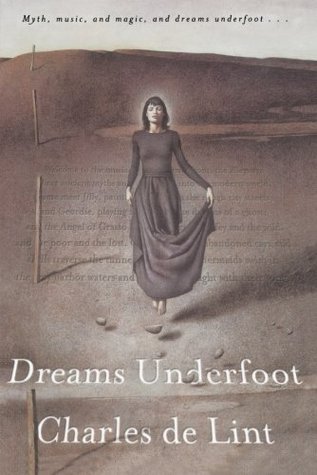
Dreams Underfoot by Charles de Lint

Dreams Underfoot by Charles de Lint

Completion Date: April 11, 2011
Reason for Reading: Carry on with the series.
Welcome to Newford. . . .

Welcome to the music clubs, the waterfront, the alleyways where ancient myths and magic spill into the modern world. Come meet Jilly, painting wonders in the rough city streets; and Geordie, playing fiddle while he dreams of a ghost; and the Angel of Grasso Street gathering the fey and the wild and the poor and the lost. Gemmins live in abandoned cars and skells traverse the tunnels below, while mermaids swim in the grey harbor waters and fill the cold night with their song.

Like Mark Helprin's A Winter's Tale and John Crowley's Little, Big, Dreams Underfoot is a must-read book not only for fans of urban fantasy but for all who seek magic in everyday life.
Today I am posting a buddy review with Meghan from Medieval Bookworm. She posted a list of possible reads for the Once Upon a Time challenge. When I saw this book on her list, I thought it would be fun to review it together because I was hoping to read it, too. This is our first time reviewing together, but hopefully it will not be our last!

For the review, she asked me three questions and I answered them below. Then, I asked her three questions and she posted about them on her blog. Enjoy!

1. Which was your favourite story in the collection? Why?
This is the hard question to answer both because I am not sure I can pick a favourite and because I am reading two short story collections by de Lint at the same time, so stories are running together in my mind a bit. I really enjoyed this collection from the very first story, 'Uncle Dobbin's Parrot Fair'. The whole idea behind that story really struck a cord with me. I also enjoyed stories like 'The Stone Drum' because they revealed even more about Jilly, who has always been my favourite de Lint character. To be honest, I couldn't really pick any story that I didn't like. They all had their merits and overall I was very pleased with the collection.

2. Throughout the whole anthology Jilly Coppercorn seems like the glue that holds everyone together - she appears in many of the stories and is almost a physical representation of the kinder side of Newford's underworld. I've read a lot about how she is everyone's favourite character (and she is mine). Was there a least favourite character for you? Was your favourite character a different choice?
Well, Jilly has always been my favourite. I think that is because the first book I read and loved by de Lint was The Onion Girl and that centres around Jilly. Reading short stories where she plays a central role has always made me enjoy her more and more. I have had Widdershins, the sequel to The Onion Girl, for a while and only haven't read it because I was planning to go back and read the books in order. While I was reading this book, I also started The Very Best of Charles de Lint. That was actually a good thing because it means that while characters are fresh in my mind, I am visiting with them again. I have to say that Meran has really started to intrigue me. I have read about her before, but only briefly. There were two stories in this collection including her, I believe, and I have all ready read 3 by her in The Very Best of Charles de Lint. I also enjoy Christy, the writer, and Geordie, the musician. There are other characters that I enjoy, but they didn't play a prominent role in this particular collection. As to any that I dislike.... Not really. I think they are all well-written and add to the story. There are none that I don't appreciate seeing more from, even if they are less than stellar people.

3. Have you read any of the other Newford stories, like the novels? How does this compare for you, considering it's the 'starting point' for readers of the series?
I have been meaning to read this book for a while because it is technically the first book, but beforehand I read a few novels and a couple short story collections. I do not find that anything was lost having read other books before this one, so I probably won't worry about reading order now. It was nice to go back and get introduced to the characters that I have come to love, but I didn't find it necessary. It has reached a point where many of them feel like I am visiting with old friends in a place I have easily come to recognize.

Another great de Lint book! Maybe this year will be the Year of de Lint... I know that I at least want to get to Widdershins this year.

Don't forget to visit Meghan's blog to see her answers!

Series (de Lint's Suggested Reading Order)
Dreams Underfoot
The Dreaming Place
A Whisper To A Scream (originally credited to "Samuel M. Key")
I'll Be Watching You (originally credited to "Samuel M. Key")
Memory And Dream
The Ivory And The Horn
Trader
Someplace To Be Flying (Read, but never reviewed.)
Moonlight And Vines
Forests Of The Heart
The Onion Girl
Seven Wild Sisters (also available in Tapping the Dream Tree)
Tapping the Dream Tree
Spirits in the Wires
Medicine Road
The Blue Girl (Read, but never reviewed.)
Widdershins
Make a Joyful Noise
The Hour Before Dawn
Old Man Crow
Little (Grrl) Lost (Read, but never reviewed.)
Promises to Keep
Dingo
Muse & Reverie

I am so bad at this reviewing thing...

Monday, April 18, 2011

Short Story Monday - The Very Best of Charles de Lint Part 2

At turns whimsical, dark, and mystical, this extraordinary collection of retold fairy tales and new, modern myths redefine the boundaries of magic. Compiling favored stories suggested by the author and his fans, this delightful treasury contains the most esteemed and beloved selections that de Lint has to offer. Innovative characters in unexpected places are the key to each plot: playful Crow Girls who sneak into the homes of their sleeping neighbors; a graffiti artist who risks everything to expose a long-standing conspiracy; a half-human girl who must choose between her village and her strange birthright; and an unrepentant trickster who throws one last party to reveal a folkloric tradition. Showcasing some of the finest offerings within the realms of urban fantasy and magical realism, this essential compendium of timeless tales will charm and inspire.
Today is part two of my discussion of The Best of Charles de Lint with Carl from Stainless Steel Droppings. This week he came up with the questions about the tree stories. Enjoy!

Stories Read This Week:
'The Badger in the Bag'
'And the Rafters were Ringing'
'Merlin Dreams in the Moondream'

1. Naming and the power of naming is a really big aspect of "The Badger in the Bag". Did you ever name an inanimate object, like a musical instrument, bicycle, vehicle?
No. I have lots of friends that name their cars and things, but it has never been something I have done. I always think about it, but then never actually do so. Even with my eReader. Apparently one of the companies has a slot where you can name it, so I thought maybe I would name mine. Never done so... I think my computer has a name, but that's only because they make you and I have no idea what it even is. I guess I am like Meran in the early part of the story with this idea.

2. Like the previous Meran stories in this collection, "And the Rafters were Ringing" is set in a time of belief in spirits, both good and evil, (and mischievous). In many ways we are better off living a less superstitious (for lack of a better word) life. What, if anything, do you feel we have lost as a people in not being as open to "magical" things?
Imagination. I have a big imagination and hope to always. It's why I read fantasy and other types of fiction. The other day, though, I was watching a childhood movie and there was a 12-year-old there. By the end of the movie I was shocked because he is still really young, and all he did was criticize the magic of the movie. I have to admit that the movie was sort of ruined because I can see messages that I didn't really see when I was a child, but I still enjoyed the fairies and other magical creatures. And, I could not imagine being 12 and not wanting to believe in those things at all. I think it comes from having ideas and then having them be shot down, so you start to think so logically that you can't see the magic in the world.

3. "Merlin Dreams in the Moondream" wood has a big emphasis on trees. Or one tree in particular. Actually these past 4 stories (with Meran's life tree) have acknowledged an important bond to trees. In what ways have trees played a significant part in your life, imagination, etc.?
I loved this story! I always enjoy Arthurian retellings, though, and I thought that this one was really well written! I have always been a tree person. To this day I constantly look at trees and see more than just the tree. I think that is why I enjoy the Ents in Tolkien's work so much. And, the trees in C.S. Lewis. The trees are alive in a way that is magical and I have always wished that was true. I think that trees have spirit and personality. I refuse to allow the cc to cut down our weeping willow because of the tree in Disney's Pocahontas. It was also one of the aspects of Avatar that I actually enjoyed. The idea that trees are all connected, that they are more than just trees, that they have personalities and feelings of their own... The use of trees in de Lint's stories are one of my favourite things. I believe that is why Meran is growing on me so much!


Previous Weeks: