Showing posts with label Short Story Anthology. Show all posts

Tuesday, February 14, 2012

Songs of Love and Death Edited by George R.R. Martin and Gardner Dozois

Songs of Love and Death: All Original Tales of Star-Crossed Love Edited by George R.R. Martin and Gardner Dozois

Completion Date: February 13, 2012
Reason for Reading: Fun!
IN this star-studded cross-genre anthology, seventeen of the greatest modern authors of fantasy, science fiction, and romance explore the borderlands of their genres with brand-new tales of ill-fated love. From zombie-infested woods in a postapocalyptic America to faery-haunted rural fields in eighteenth- century England, from the kingdoms of high fantasy to the alien world of a galaxy-spanning empire, these are stories of lovers who must struggle against the forces of magic and fate. 
Featuring stories by New York Times bestselling romance authors Jo Beverley and Mary Jo Putney, and by such legends of the fantasy genre as Peter S. Beagle and Tanith Lee, as well as many other popular writers, including Marjorie M. Liu, Jacqueline Carey, Carrie Vaughn, and Robin Hobb. This exquisite anthology, crafted by the peerless editing team of George R. R. Martin and Gardner Dozois, is sure to leave you under its spell.
I must say that I was very impressed with this short story collection. I tend to get bored, but there were no stories at all that disinterested me. They were all well-written and entirely deserved their spot in this collection. I thought I would post it as a special Valentine's Day feature.

'Love Hurts' by Jim Butcher - Read January 30, 2012
The collection starts off with a short story set in the world Butcher has created for his famous series The Dresden Files. I am a bit worried I spoiled part of the series for myself, but I am sure it wasn't too major and by the time I get to that part of the series I will have forgotten anyway. This story centres around Harry Dresden and Murphy, his police contact. This story involves mind control and love. A vast majority of the story takes place at a fair. Overall an enjoyable story. I really need to read more Jim Butcher.

'The Marrying Maid' by Jo Beverly - Read January 31, 2012
This story was perfectly timed after reading 'A Midsummer's Night Dream' earlier this month. It is basically a retelling of the famous play with fairies and some interesting twists. It is basically a romance story, but not entirely what you would expect. As someone that quite enjoys the elements of fairies I enjoyed this story more than I expected to. The story played out a bit weirdly, but it all makes sense by the end. Recommended.

'Rooftops' by Carrie Vaughn - Read February 1, 2012
I did read the first Kitty Norville book by Vaughn, but in amongst all my other series it sort of got lost. Last year, though, I read one of her standalone books and got a bit interested in seeing more from her. I was happy to see another standalone included in this collection. Vaughn is a good writer and really will have to get back to her major series. This is a story about superheroes which has been appearing in my reading a lot lately, (new Fables and The Unwritten for example), so I was curious what Vaughn's take would be. The story centres around a playwright who finds herself in the middle of a robbery one night. A masked man saves her and she can't entirely forget about him after that. The events of that night largely change who she is as a person as the story progresses. A fun take on the superhero idea. Recommended.

'Hurt Me' by M.L.N. Hanover - Read February 4, 2012
This story starts out creepy and then gets disturbing. It is an interesting look at domestic abuse and the use of ghosts. I think I will just leave it at that, but I will say this story will stick with me.

'Demon Lover' by Cecelia Holland - Read February 4, 2012
Cecelia Holland is an author I have long wanted to try, so I am happy to at least have read a short story by her. It was a good story, too. It takes in the fairy realm, magic, demons, and a tragic fate. Oh, and the importance of names. It was a good retelling of many popular tales.

'The Wayfarer's Advice' by Melinda M. Snodgrass - Read February 5, 2012
I am not even sure if I have heard of this author before, but she writes interesting science-fiction based on this story. I suppose I have been in a science-fiction mood lately, so this added to it. It was a bit predictable, but that was not necessarily a bad thing. I am glad I read it.

'Blue Boots' by Robin Hobb - Read February 6, 2012
I really should read more of Robin Hobb because I enjoy everything that I try. This was no exception. This is a short story that is set in the same world she created for her popular Farseer series. It was nice to revisit even if it was with different characters. Hobb is an author that I knew within one chapter of my first read by her that I was going to love. She has written some of the most memorable characters for me. So far this short story is probably the one that will stick with me the longest.

'The Thing About Cassandra' by Neil Gaiman - Read February 6, 2012
I know a lot of people love Neil Gaiman, but he is a bit hit-or-miss with me. I still have many of his popular novels on my TBR pile, though, so maybe I will love one of those enough to get beyond my typical hesitation about his reads. Now, this story, I actually enjoyed. I liked how everything came together in the end and it was creative idea for a story. This is an instance where Gaiman was a hit for me.

'After the Blood' by Marjorie M. Liu - Read February 10, 2012
This was an interesting vampire story. I am getting a bit tired of the sub-genre, but there are a few exceptions here and there. This is actually the first time I have ever even heard of the author before, but she writes well enough. It actually reminded me a bit of Carrie Ryan writing about vampires instead of zombies. I liked the characters and am a bit curious about what else the author has written.

'You, and You Alone' by Jacqueline Carey - Read February 10, 2012
I have wanted to read Jacqueline Carey for a while, but I am not so sure if she is for me. This is a short story set in her famous world, though. It was interesting, but I am not so sure I would want to read an entire novel. You never know, though, I might read more from her one day. She does write really well, but romance novels have never really been my thing and this takes that idea to the extremes.

'His Wolf' by Lisa Tuttle - Read February 12, 2012
I read Lisa Tuttle once a while ago but the book did not have a lasting effect on me. That is not to say that she is not a good author, but more that I read so many authors for the first time and have a very hard time getting back to them. This book sort of reminded me I should read her again. I actually really enjoyed this story, too. It was a very creative approach to the werewolf idea.

'Courting Trouble' by Linnea Sinclair - Read February 12, 2012
Another author I have never really read before, but I have heard of her. This was actually a science-fiction story. It was an interesting space opera and I think the author has a lot of potential for full-length novels. I will look forward to reading more from her in the future.

'The Dream Dancer' by Mary Jo Putney - Read February 12, 2012
I really liked this story. I thought it was a bit of an adventure, but also a sweet story. I really enjoyed how it all played out and have to applaud the author for her fun idea.

'Under/Above the Water' by Tanith Lee - Read February 13, 2012
This is one story I was a bit baffled with. It is not that I didn't like it, but more that it was so different that I wasn't entirely sure if I got everything that was going on until the end. It was a really good idea and everything, but I am not sure if I was paying the appropriate attention to what was happening. I am going to have to try again.

'Kaskia' by Peter S. Beagle - Read February 13, 2012
Okay, here's the deal. I have tried to read Beagle twice and never really got the big deal about him. This story, though, I have to admit was well-written. I still don't get an overwhelming love of him, but I think this was a much better attempt than previous ones.

'Man in the Mirror' by Yasmine Galenorn - Read February 13, 2012
This was a dark sort of romance story and not typical at all. It is also a ghost story. I quite enjoyed yet another creative idea for a story. I am glad I had the chance to read it.

'A Leaf on the Wind of all Hallows' by Diana Gabaldon - Read February 13, 2012
When I said that I was reading this short story collection many people mentioned being interested in this story in particular. I have only read the one book by Diana Gabaldon. I enjoyed it, but I have never felt any pressing desire to read more by her. I am not sure why that is because so many people enjoy her series. This story is related to one of the later books in the series. I have to admit I was a bit intrigued to see this short story played out a bit more, but who knows if I will ever tackle the series.

Friday, October 21, 2011

A Short Story Interlude

Z: Zombie Stories edited by J.M Lassen
When the zombie apocalypse comes, it's not just those crusty old folks who will struggle against the undead, it's young people.

What happens when you come of age during the zombie apocalypse? Z: Zombie Stories has the answer to that question.

Z: Zombie Stories gathers together some of the hottest zombie fiction of the last two decades, from authors including Kelly Link, Jonathan Maberry, and Catherynne M. Valente.

These stories focus on those who will inherit a world overrun with the living dead: a young man who takes up the family business of dealing with the undead, a girl dealing with her abusive father... who has become a zombie, a poet who digs up the wrong grave, and a Viking maiden imprisoned with the living dead...
I seem to be have technological problems. I requested this book from NetGalley, loaded it on my e-reader, and now it absolutely refuses to let me read the next story. I even tried re-dowloading it. It wouldn't go to the next page, so I tried to skip to a later page. It won't do anything. I am a bit disappointed, so I will have to get a print copy when it comes out. In the meantime, I did get to read the first story, so I figured I might as well at least talk about that.

Family Business by Jonathan Maberry

I was thinking I was getting a bit tired of short stories lately, but a collection of short stories about zombies sounded right up my alley. I was a bit disappointed it was PDF format. I hate PDF format, but I was determined to get beyond that because there are stories by Kelly Link and Catherynne Valente in the collection. Plus, some new-to-me authors, like Jonathan Maberry. I thought it would be a great read to finish October with since I have completed Fragile Things by Neil Gaiman.

The first story was really quite good. Imagine a world where there was a huge epidemic and a large part of the population became zombies. The people that were not affected had to move to smaller areas in order to stay safe. The zombies took over everything else. The story focuses on two brother. The younger one is close to the age of 15, and in that society it means he has to find a job soon. His brother is a considerable amount older and has his own business. The younger brother does not want to work with his older brother, so he decides to try anything else but. The only thing is that the jobs do not work out.

In the end, the two brothers get the chance to work together. It turns out to be a learning experience for both the readers and the younger brother. He had an idea about his brother that turned out to be entirely wrong. The story actually turns out to be rather heart-warming. If I say too much more, I will give the story away, so that's all you get. I enjoyed it and look forward to reading the rest of the stories in this collection at some point.

I will be back later today with my next edition of Friday Reads.

Wednesday, July 20, 2011

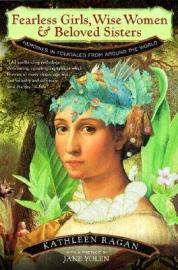
Short Story Wednesday - Fearless Girls, Wise Women & Beloved Sisters: Heroines in Folktales From Around the World edited by Kathleen Ragan Part 5

One hundred great folk tales and fairy tales from all over the world about strong, smart, brave heroines. A definitive sourcebook of folktales and fairytales and the first of its kind to feature a variety of multicultural heroines. Dismayed by the predominance of male protagonists in her daughters' books, Kathleen Ragan set out to collect the stories of our forgotten heroines: courageous mothers, clever young girls, and warrior women who save villages from monsters, rule wisely over kingdoms, and outwit judges, kings, and tigers. Gathered from around the world, from regions as diverse as sub-Saharan Africa and Western Europe, from North and South American Indian cultures and New World settlers, from Asia and the Middle East, these 100 folktales celebrate strong female heroines. In "The Mirror of Matsuyama," we see the power of a mother's love overcome even the silence imposed by death. In "Moremi and the Egunguns," a fearless girl faces messengers from the land of the dead. Fearless Girls, Wise Women, and Beloved Sisters is for all women who are searching to define who they are, to redefine the world and shape their collective sensibility. It is for men who want to know more about what it means to be a woman. It is for our daughters and our sons, so that they can learn to value all kinds of courage, courage in battle and the courage of love. It is for all of us to help build a more just vision of woman. Fearless Girls, Wise Women, and Beloved Sisters breaks new ground by reexamining our notions about heroism. This book will appeal to parents who want to foster positive role models for their children. An invaluable resource of multicultural heroines for any school library.
Okay, I will admit it... This book is starting to drag for me. We live in a depressing world because this is the best of examples for empowering women! I keep hoping for better and it is not happening. If it wasn't for the buddy read I probably would have given up, but I do hope that things will improve as we move around the world. You can read Amy's thoughts on this questions on her blog.

Stories Read This Week:
‘The Tiger and the Coal Peddler’s Wife’ (Korea)
‘The Plucky Maiden’ (Korea)
‘The Phoenix and Her City’ (Hui People, China)
‘Sailimai’s Four Precious Things’ (Hui People, China)
‘A Woman’s Love’ (Uighur People, China)
‘Maiden Liu, the Songster’ (Yao People, China)
‘The Festival of Pouring Water’ (Yunnan, China)
‘A Polite Idiosyncrasy’ (Kwangtung, China)
‘The Young Head of the Family’ (Kwangtung, China)
‘Altyn-Aryg’ (Altaian People, Siberia)
‘The Wife Who Stole a Heart’ (Kalmuck People, Siberia)

1. We both were getting frustrated with the stories recently because they are starting to fall into certain stereotypes. Do you feel they got better or worse this week and why?
There was only one story that I found myself skimming through, but I am still just sad. There is no other way to look at it. If this is all we can come up with then we need to do better folks! The stories are better than the 'typical' stories, but they are still disappointing for me. The stories have smart women, but I think I was just expecting more. It is hard to really put it in word.

2. In 'The Plucky Maiden' the plucky maiden really just looks out for herself - what did you think of this in terms of an empowering tale? Do you think it is truly feminist?
I think the problem I have with these stories is that they are not feminist. They are making the women smarter, braver, etc, but at the sake of their integrity. I guess I would like to see women that don't have to be underhanded or selfish in order to fit into this book.

3. Starting with 'The Phoenix and Her City' and then again in a few more of the stories Ragan specifically compares the events of the story to a 'Western' feminist, what did you think of this? Why do you think it only came up now in this section and do you think this is a good thing?
Oh, man, 'The Phoenix and Her City' just dragged! I hardly even remember it! Her notes are a problem, though. I don't think these stories should necessarily be compared to other sections because it is like she is saying one place is better than another. Honestly, seeing these representations I am not really seeing much difference...

4. Following on the answer above, in 'Maiden Liu, the Songster' Ragan in the note area compares Liu to people like Jane Goodall who also studied and worked with 'another group'. What did you think of this message and comparison?
Did this comparison make sense to you? She was talking about monkeys and chimpanzees and things. I didn't get how she was even making these comparisons... It seemed random!

5. Did you like the way relationships were portrayed in 'A Polite Idiosyncrasy'? Do you see this as a fairy tale?
This story made me smile, actually. It was almost a comedy and that was refreshing, but yes, it was a good portrayal of relationships. I am not so sure it is a fairy tale, though. It could easily happen in real life.

6. In 'The Young Head of the Family' Ragan points out how stereotypical behavior can hurt women, what do you think of this? Did you see the tale as subversive in that sense?
hm, I don't think I paid as close attention to the notes as you! I do think that stereotypical behaviour can hurt women, but I didn't think this story was as bad as some. At least the head of the family was a woman and she was portrayed well. That being said, the other women were not so much. It is hard to really say.

7. What did you think of the way 'The Wife Who Stole a Heart' begins? Do you think this story is really feminist and helps women or does the women against woman aspect of it hurt?
This was a strange story. I didn't really like it at all. I hate stories where women are pitted against other women. It is not empowering when writers have to resort to that.

Previous Weeks:

Wednesday, July 13, 2011

Short Story Wednesday - Fearless Girls, Wise Women & Beloved Sisters: Heroines in Folktales From Around the World edited by Kathleen Ragan Part 4

One hundred great folk tales and fairy tales from all over the world about strong, smart, brave heroines. A definitive sourcebook of folktales and fairytales and the first of its kind to feature a variety of multicultural heroines. Dismayed by the predominance of male protagonists in her daughters' books, Kathleen Ragan set out to collect the stories of our forgotten heroines: courageous mothers, clever young girls, and warrior women who save villages from monsters, rule wisely over kingdoms, and outwit judges, kings, and tigers. Gathered from around the world, from regions as diverse as sub-Saharan Africa and Western Europe, from North and South American Indian cultures and New World settlers, from Asia and the Middle East, these 100 folktales celebrate strong female heroines. In "The Mirror of Matsuyama," we see the power of a mother's love overcome even the silence imposed by death. In "Moremi and the Egunguns," a fearless girl faces messengers from the land of the dead. Fearless Girls, Wise Women, and Beloved Sisters is for all women who are searching to define who they are, to redefine the world and shape their collective sensibility. It is for men who want to know more about what it means to be a woman. It is for our daughters and our sons, so that they can learn to value all kinds of courage, courage in battle and the courage of love. It is for all of us to help build a more just vision of woman. Fearless Girls, Wise Women, and Beloved Sisters breaks new ground by reexamining our notions about heroism. This book will appeal to parents who want to foster positive role models for their children. An invaluable resource of multicultural heroines for any school library.
I wasn't thinking and agreed to do the Dune read-a-long posts on Saturdays. I knew this buddy read was expected to be posted on Saturdays, too, but I wasn't putting the two things together in my head. It came down to post twice a day, or change dates. Amy suggested just changing to Wednesday, so here we are!

Stories Read This Week:

Tales From Asia:
A Rani's Revenge
How Parvatibai Outwitted the Dacoits
The Close Alliance: A Tale of Woe
The Barber's Clever Wife
A Wonderful Story
The Importance of Lighting
The Story of Death
The Story of Princess Amaradevi
The Tale of the Oki Islands
The Monkey Bridegroom
The Mirror of Matsuyama: A Story of Old Japan

Questions That I Came Up With This Week:

1. We have now moved to stories set in Asia. What did you think of these stories compared to the other sections we have all ready explored?
I enjoyed these stories set in Asia because I don't read a lot of books with that setting. There were a few differences in the ideals of the people, but generally the stories were similar to others in the collection. I think even if you didn't know where the stories took place, there are clues in the stories themselves that would have easily narrowed it down.

2. What did you think of the stories? Did any of them stand out or bother you?
I think this section started to disappoint me. There were some stories that I did like, but when you think of the idea behind this book it is sad that women are not better represented. Several of these stories were told from a male point-of-view and were just barely criteria that would even fit this collection. This is obviously more a representation of how women are treated in Asia than anything else.

3. Between reading the stories and reading the notes included, do you find so far that these stories are good representations of women in literature or do you still think there is room to improve?
I have to admit that I am almost disappointed in this collection. There have been stories that I really enjoyed, but there have been more stories that have really bothered me. Some of the stories still rely on men to come to a satisfactory conclusion and some stories do not show women in a positive light at all. I feel like the authors felt like they had to come down to a very questionable level in order to showcase their strengths. If this is the best the world has to offer for empowering women stories, we had a long way to go.

4. In the notes for 'A Rani's Revenge', the editor quotes G.K. Chesterton: "Children are innocent and love justice; While most of us are wicked and prefer mercy." What do you think of this idea?
I thought this quote was interesting enough to mark down and then use in this question. I am not entirely sure I agree with it. I suppose it is all in how you look at it. I think it is brave, not wicked, to want mercy for people. It is not something that happens a lot in society, so when it does, it gives hope that people can forgive and move on. While children, I think they just want a story. They don't necessarily think in a way that they want justice, but they want the story to play out in such a way that it is interesting to listen to and read. I don't think it is necessarily a preference.

5. What did you think of the story 'The Barber's Clever Wife'?
This story really stuck out for me because the woman in it was so clever! She found a way to save the day over and over again. Then, we reach the end of the book and the HUSBAND is offered a lucrative position. It was a huge disappointment to read that after enjoying the story so much.

6. What are your thoughts on the resourcefulness of the character in 'The Importance of Lighting'? Was it a believable story?
I was rather surprised by this story. The original telling and thought process behind it was impressive. This is a story of a family that lives in poverty and is given the chance to have anything they want. The young heroine of the story knows that poverty exists in their household, so there is no point in asking for money because they will just lose it again. What she needs to do is drive poverty out of the house and welcome wealth in. The actual way she goes about doing this, by having her house be the only one with lights in the whole area, is a bit unbelievable, but the idea behind it was an interesting one and makes a lot of sense.

7. 'The Child of Death' was one of the stories in this collection that I had to pause after finishing because I wasn't entirely sure what had just happened. What did you think of the story?
I still think this story is strange! (I apologize for the typo in this question, Amy. I need to reread things before sending them along.) Anyway, I enjoyed the idea that if the dead has a purpose it can live on after death to serve that purpose. It is a bit creepy to think about, but interesting at the same time.

8. What did you think of the legend presented in 'The Tale of the Oki Islands'. Do you think this story is how Tokyo got its name?
I loved this story because I would like to think this was the creation story that lead to Tokyo having the name it has. A story about an empowering woman and possibly written by a woman. After some depressing stories, this gave me a bit of a hope about the lasting power of women's writing. I am not sure if it is true, but I'd like to think it was.

9. What do you hope from the rest of the stories in this section?
I am hoping for some fresh stories that are a bit more hopeful and don't rely on men. I'd like to think that is possible!

Be sure to check out Amy's blog for her answers to these questions!

Previous Weeks:

Saturday, July 02, 2011

Short Story Saturday - Fearless Girls, Wise Women & Beloved Sisters: Heroines in Folktales From Around the World edited by Kathleen Ragan Part 3

One hundred great folk tales and fairy tales from all over the world about strong, smart, brave heroines. A definitive sourcebook of folktales and fairytales and the first of its kind to feature a variety of multicultural heroines. Dismayed by the predominance of male protagonists in her daughters' books, Kathleen Ragan set out to collect the stories of our forgotten heroines: courageous mothers, clever young girls, and warrior women who save villages from monsters, rule wisely over kingdoms, and outwit judges, kings, and tigers. Gathered from around the world, from regions as diverse as sub-Saharan Africa and Western Europe, from North and South American Indian cultures and New World settlers, from Asia and the Middle East, these 100 folktales celebrate strong female heroines. In "The Mirror of Matsuyama," we see the power of a mother's love overcome even the silence imposed by death. In "Moremi and the Egunguns," a fearless girl faces messengers from the land of the dead. Fearless Girls, Wise Women, and Beloved Sisters is for all women who are searching to define who they are, to redefine the world and shape their collective sensibility. It is for men who want to know more about what it means to be a woman. It is for our daughters and our sons, so that they can learn to value all kinds of courage, courage in battle and the courage of love. It is for all of us to help build a more just vision of woman. Fearless Girls, Wise Women, and Beloved Sisters breaks new ground by reexamining our notions about heroism. This book will appeal to parents who want to foster positive role models for their children. An invaluable resource of multicultural heroines for any school library.
This is the third edition of our reading of Fearless Girls, Wise Women, & Beloved Sisters by Kathleen Ragan. I got a bit behind on the reading, but I am working to catch-up now. Amy is ahead of me, she posted her review of these stories on the correct day, but my computer was broken. And, now I am just slow!

Stories Read This Week:

Tales from North and South America:
Native Americans:
'The Vampire Skeleton'
'The Flying Head'
'Where the Girl Saved Her Brother'
'Chief Joseph's Story of Wallowa Lake'
'The Origin of the Potlatch'
'The Princess and the Mountain Dweller'
'The Princess and the Magical Hat'
'The Lytton Girls Who Were Stolen by Giants'
'The Legend of the Coppermine River'
'The Huntress'
New World Newcomers:
'"I'm Tipingee, She's Tipingee, We're Tipingee, Too"'
'The Innkeeper's Wise Daughter'
'Molly Cotton-Tail Steals Mr. Fox's Butter'

1. We've moved on from Europe to the Americas. The stories we read this week were further sub-categorized as 'Native American' tales and 'New World Newcomer Tales'. How did you find they compared overall to the stories from Europe in terms of familiarity?
Some of the stories seemed a bit fresh, but then others used elements from common stories. A common theme was the "Bluebeard" theme. Women married, sometimes not by their will, men that were serial killers of some nature. Others were a bit different, but still had some similar ideas represented. One even reminded me of "Beatrix Potter". A few others were a bit different and I enjoyed that.

2. I was a little surprised the stories seemed to be almost all from North America with very few contributions from Central or South America - did this surprise you at all? Why do you think that is?
I think it probably is a simple fact of what remains. I am sure there are a lot more stories that could be from Central or South America, but it might not have been as easy to obtain. It is also possible the stories have not been recorded. In the beginning tales were told orally.

3. Did you have a favorite story this week? Why?
I thought that the story 'Vampire Skelton' was an interesting start to the section. Vampires are a bit popular at the moment and this was a bit original of a telling. This collection is like an collection, some stories I found dragged a bit and others were pretty good. I am not sure if I really had an overall favourite, though.

4. What was your least favorite and why?
'The Princess and the Mountain Dweller'. In the end I liked the story, but for some reason I had a very hard time getting into it. I was reading along happily and then when I arrived at this story I was a bit disinterested.

5. One of the stories, 'Where the Girl Saved Her Brother' is actually a legend based on the Battle of the Rosebud. What do you think the link is between fairy tales and legends - do you think some of the other tales are also likely based on true events?
Of course! I think they would have to get their start in the first place from oral tales. I am sure that somewhere along the lines there was a real person or event that inspired the story. I am sure there was some exaggeration in the tales as they went along, but I am sure at the root there was truth.

6. In 'The Princess and the Mountain Dweller' I loved the comparison that Ragan made in her end note to Bluebeard and how "'Bluebeard' focuses so strongly on Bluebeard's wife's 'sins', one is apt to forget that her husband is a serial murderer who is concealing the bodies of his former wives." In fact I thought this was possibly my favorite line in the collection (so far anyway!). Do you think this is a larger issue at play that is turning the table in historic tales to point the blame on the woman?
I really liked that sentence myself. It is actually something that I have not thought of before, actually, and that makes me feel bad. I never really thought of her as sinning either, though. Women are often to blame in historical records, but that is mainly because history is recorded by men.

7. Did you find any major thematic differences between the Native American tales and the New World Newcomer tales?
I didn't actually think of it at the time. The stories were not all that different. There were a couple changes, of course, but ultimately it is a similar theme.

8. In 'I'm Tipingee, She's Tipingee, We're Tipingee, Too' the seemingly powerless girls work together to present a solid front and beat those trying to harm Tipingee. Do you think this was a subversive message as Ragan states?
It's possible. It really depends on the author and what they were thinking when they wrote this story. It could have been innocent, it could have been intentional, or we may be reading too much into what the author was ultimately attempting to do. I always worry about that when reading stories or novels.

9. In 'The Inkeeper's Wise Daughter' the daughter manages to answer all the riddles put to her, and outwits her husband at every turn, ending up happy. What do you think the take away was from this tale?
I was wrong, now that I rethink this story is probably my favourite. I thought it was rather witty. I took away from this story that women are actually a lot smarter than men give them credit for. It was refreshing how she outwitted him even until the end.

10. The last tale we read this week, 'Molly Cotton-Tail Steals Mr. Fox's Butter' starts off rather clever with two children asking for a tale from their Aunt Nancy and discusses some gender stereotypes which was really great. These included that women could be smarter than men and that men could stay home sometimes and watch kids. Like 'The Fortune-Teller' that we read last week, however, Molly Cotton is shown as a bit of a scoundrel. Do you think this is a heroine role?
I am not sure what to think of this story. I originally thought of it as 'Beatrix Potter' in nature. There was obviously a bit more going on than originally thought, though. I felt that on the one hand it was a witty story, but on the other hand it was playing into stereotypes and not being very fresh about it.

Previous Week:

Saturday, June 04, 2011

Short Story Saturday - Fearless Girls, Wise Women & Beloved Sisters: Heroines in Folktales From Around the World edited by Kathleen Ragan Part 2

One hundred great folk tales and fairy tales from all over the world about strong, smart, brave heroines. A definitive sourcebook of folktales and fairytales and the first of its kind to feature a variety of multicultural heroines. Dismayed by the predominance of male protagonists in her daughters' books, Kathleen Ragan set out to collect the stories of our forgotten heroines: courageous mothers, clever young girls, and warrior women who save villages from monsters, rule wisely over kingdoms, and outwit judges, kings, and tigers. Gathered from around the world, from regions as diverse as sub-Saharan Africa and Western Europe, from North and South American Indian cultures and New World settlers, from Asia and the Middle East, these 100 folktales celebrate strong female heroines. In "The Mirror of Matsuyama," we see the power of a mother's love overcome even the silence imposed by death. In "Moremi and the Egunguns," a fearless girl faces messengers from the land of the dead. Fearless Girls, Wise Women, and Beloved Sisters is for all women who are searching to define who they are, to redefine the world and shape their collective sensibility. It is for men who want to know more about what it means to be a woman. It is for our daughters and our sons, so that they can learn to value all kinds of courage, courage in battle and the courage of love. It is for all of us to help build a more just vision of woman. Fearless Girls, Wise Women, and Beloved Sisters breaks new ground by reexamining our notions about heroism. This book will appeal to parents who want to foster positive role models for their children. An invaluable resource of multicultural heroines for any school library.
Today is the second part of my buddy read with Amy from Amy Reads of this short story collection. It was my turn to come up with the questions for the 12 stories that we read. You can read Amy's answers at her blog.

Stories Read This Week:
'"My Jon's Soul"'
'The Ghost at Fjelkinge'
'Little Red Cap'
'The Wood Maiden'
'The Child Who Was Poor and Good'
'The Pigeon's Bride'
'How the King Chose a Daughter-in Law'
'Marichka'
'Davit'
'Anait'
'The Fortune-Teller'
'The Tsaritsa Harpist'

1. What do you think the author of the story ' "My Jon's Soul" ' was trying to accomplish with this story?
This was an interesting story. It started off a bit strange. The main character was worried about the soul of her husband and whether or not he was going to be able to get into heaven. So, she takes it upon herself to go to heaven and make sure he will be able to get in. The idea behind it didn't really go with the whole 'empowering' image that these stories were trying for, but the conclusion did. She doesn't back down and she accomplishes her goal, so it all worked out in the end.

2. What did you think of 'The Ghost at Fjelkinge' in comparison with other ghost stories you have read?
This story actually reminded me of other stories that I have read. There were a couple aspects that were parts of other stories, at least in my mind. The being buried under the floor boards, for example, reminded me of 'The Tell-Tale Heart'. Most people were too worried about the ghost to understand what was going on, but this one woman stayed until the end and accomplished what the ghost had been trying for all along.

3. How does the story 'Little Red Cap' compare to other versions of the popular story?
When I read the first part of the story, I was surprised this book was in the collection. It was the typical story and it really about a little girl not listening, getting eaten by a wolf, and then saved by a passing woodsmen. It was not until she included the last paragraph that I understood why it was in there. It changes the story.

4. What did you think of the comparison between 'Little Red Cap' and 'The Wood Maiden' in the note section? Which idea do you think stories should portray?
In the note section, the editor compares these two stories by saying that by not following the rules, Little Red Cap is punished. In The Wood Maiden, though, the daughter is rewarded for not doing what her mother tells her to do. I think both stories have merit. I always found Little Red to be about not talking to strangers and not straying off the path because it can be dangerous when you are a child. The other story, the daughter just dances and has fun. I am not sure the severity of the situation is really the same. I think you can read both of them and get two different ideas without leading children to do the wrong things.

5. Do you think the dependable happy ending of 'The Child Who Was Poor and Good' gives a positive message to those who read stories such as that?
Sometimes I prefer stories that don't have happy endings. I will be reading and hoping that the author will do something different. I read a lot and I need some variety, but rarely do we see that in books as much as I would want to. This story had that perfect ending, but I think it would give an unrealistic view of what is like in the 'real' world.

6. What did you take away from the story 'The Pigeon's Bride'?
This story didn't really seem all that different than other popular stories. It was basically a retelling of another story. The title is alluding me at the moment. The guy appears to the princess as a pigeon, but if she tells anyone the truth then he will no longer be able to visit her. So, she tells her parents and he stops visiting, so then she goes on a trek to find him and win him back. I was not crazy about this story, really...

7. How does the story 'How the King Chose a Daughter-in Law' compare to other popular stories you have read?
This story sort of reminded me of 'The Princess and the Pea'. I am not entirely sure why, but the whole time I read it I was thinking about this... Instead of a pea under a mattress, though, this young woman has to find her way out of a very elaborate maze. It was also not a princess that succeeds at this.

8. The editor compares the story 'Marichka' to 'Hamlet'. What did you think about this?
This was a story about revenge. A woman bides her time and kills someone. It started out similar to Hamlet, but it is different in the end.

9. What did you think of the male filter idea that the editor mentions about the story 'Davit'?
That's my biggest problem with the popular stories. Even when stories are written to make women seem empowering, it still falls back on the popular aspects of other stories and makes it less about the woman and more about the man.

10. Judging by the first part of the story 'Anait', did you think it was going to be an empowering story?
I think that Anait was an empowering character, but I am not sure if the story itself seemed that way. Once it was played out, though, it made a lot more sense.

11. What message does the story 'The Fortune-Teller' carry with it?
I don't think this story was the best example. It made this woman out as a con artist, which doesn't seem like a strong character to me. Yes, male characters are played out this way often in books, but I don't think women need to be showed the same way.

12. What was your impression of the overall story 'The Tsaritsa Harpist'?
I really liked this story. It was a story of a woman using her brain to come to the aid of her husband. She was not compromising herself by dressing up as a man. She was just doing what needed to be done. It is refreshing to read stories where women rescue men instead of the popular story of women being rescued by men.

And, a general question, this concludes the section of stories from Europe. What do you think these stories tell about the culture of this country and the stories that come from it?
I might seem very picky with my answers above, but I did enjoy this collection so far. I just wanted very different from the norm stories. A lot of these so far, though, read more like retellings. It makes sense because a lot of the original stories came from these areas, but I still was hopeful that this collection would blow my mind a bit.

Saturday, May 28, 2011

Short Story Saturday - Fearless Girls, Wise Women & Beloved Sisters: Heroines in Folktales From Around the World edited by Kathleen Ragan

One hundred great folk tales and fairy tales from all over the world about strong, smart, brave heroines. A definitive sourcebook of folktales and fairytales and the first of its kind to feature a variety of multicultural heroines. Dismayed by the predominance of male protagonists in her daughters' books, Kathleen Ragan set out to collect the stories of our forgotten heroines: courageous mothers, clever young girls, and warrior women who save villages from monsters, rule wisely over kingdoms, and outwit judges, kings, and tigers. Gathered from around the world, from regions as diverse as sub-Saharan Africa and Western Europe, from North and South American Indian cultures and New World settlers, from Asia and the Middle East, these 100 folktales celebrate strong female heroines. In "The Mirror of Matsuyama," we see the power of a mother's love overcome even the silence imposed by death. In "Moremi and the Egunguns," a fearless girl faces messengers from the land of the dead. Fearless Girls, Wise Women, and Beloved Sisters is for all women who are searching to define who they are, to redefine the world and shape their collective sensibility. It is for men who want to know more about what it means to be a woman. It is for our daughters and our sons, so that they can learn to value all kinds of courage, courage in battle and the courage of love. It is for all of us to help build a more just vision of woman. Fearless Girls, Wise Women, and Beloved Sisters breaks new ground by reexamining our notions about heroism. This book will appeal to parents who want to foster positive role models for their children. An invaluable resource of multicultural heroines for any school library.
Finally, today is the first post for my buddy read with Amy from Amy Reads. I have been very slack, but hopefully we are on track now!

Stories Read This Week:
'The Stolen Bairn and the Sidh'
'The Three Sisters and Their Husbands, Three Brothers'
'The Corpse Watchers'
'The Crookened Back'
'The Horned Women'
'Whuppity Stoorie'
'Molly Whuppie'
'The Treasure of Downhouse'
'The Hand of Glory'
'Tamlane'
'The Night Troll'
'The Grateful Elfwoman'

general / introduction

1. In the introduction Ragan talks about how little truly feminist fairy tales exist in popular culture - would you agree with this? Can you think of a fairy tale that you loved as a child with a strong female lead?
When I was a kid I never really thought about male or female. I just read for the sake of reading. She starts off talking about how Dr. Seuss is very male-dominated. I didn't notice that as an adult. (In my defense, I don't have children to read all these things to.) When I got a bit older, though, I started to really not like the popular stories. I started to get annoyed with the women in them and how they were often 'too stupid to function'. I really cannot think of anything when I was younger that really showed empowering women. It was only later when I started concentrating on branching out that I found empowering stories.

2. What do you think of the layout of the book and the way the stories are divided by country?
I think that dividing it by country is an interesting idea. It means that when it is over you can compare the stories that come out of each country and see the similarities and differences. I have to admit, though, that part of the reason this book has been sitting on my TBR pile as long as it has is the formating. I wasn't crazy about the small text, but having read the first few stories I have found it is not as bad as I was anticipating.

3. Do you like the fact that each story ends with a short note from the author?
When I read the first couple I was not entirely sure what to make of them. I didn't really understand their purpose. Once you get going, though, they are rather interesting. They make you think of things that you might not have originally picked up from the reading of the actual story.

about the stories

4. The stories we looked at this week were all set in Europe, I found many of them seemed moderately familiar. I found it surprising how so many of them were similar to tales that are more popular only here the female character is the one saving the day. Would you agree? Do you think this is a trend that will continue?
I enjoyed that the stories were familiar, but different at the same time. It was refreshing to tweak a few details and have a story that was a bit more empowering. The men still play a role and the stories are not always one-sided, but they show a side of stories that you don't see very often. I am hoping the stories will continue to be a bit familiar, but I am also hoping for entire originality, too.

5. Did you have a favorite from the first twelve that we read? If so, why did you like that one?
I enjoyed all of the stories that we read this time around. My favourite, though, was probably 'Tamlane'. I really like retellings of the 'Tam Lin' story, so I was happy to see one included in this collection. It was not that much different than the popular story, but it was still a worthy addition to the collection.

6. The stories celebrate a number of characteristics beyond the traditional Disney ones of selflessness, modesty, beauty, etc. At first I found it hard to really see the heroine as such because of this fact, but it is one of the things I'm liking best about the collection so far - do you have a favorite characteristic from one of the stories?
I think it is refreshing that there are different characteristics to these stories rather than the norm. I enjoy that the women in these stories seem normal. They are not necessarily any different than other women. They are just trying to survive and doing what it takes for that to happen. Or, not even surviving, just using their brains. I also enjoyed that they are written as smart women instead of the typical damsel in distress.

7. I found Molly Whuppie interesting because as she goes back again and again to the giants house she basically says that he lives in Spain. Do you think this was done specifically because the two countries weren't getting along and it was seen as a more dangerous place?
I thought the fact she kept mentioning Spain was a bit random. I wasn't entirely sure what to make of it because it didn't seem to have any purpose. I have to admit I never considered it was because there were problems between England and Spain, but when you mention it that makes sense.

Saturday, May 14, 2011

Short Story Saturday - A New Project

A definitive sourcebook of folk tales and fairy tales and the first of its kind to feature a variety of multicultural heroines, this book of 100 stories celebrates strong female heroines across time and space.
I bought this book on a whim quite a while ago, but just never got around to reading it. When it turned out that both Amy and I owned it, we decided that we should divide it up into sections and read it together. We were going to start today, but I sort of lost track of time. So, instead we are introducing the new project. I am really excited about this collection overall, so I look forward to exploring all the different stories included.

As it stands right now, we will read 12 stories for next Saturday. Then, we will answer questions on our blogs about the stories. It is essentially the same idea as my current read-along with Carl of the Charles de Lint collection. Hopefully you will join us as we explore stories of women from all over the world.

Saturday, April 30, 2011

Trickster and Ghostopolis - A Graphic Novel Twosome

Trickster - Native American Tales: A Graphic Collection edited by Matt Dembicki

Completion Date: April 25, 2011
Reason for Reading: Fun!
This extraordinary graphic novel depicts traditional Native American trickster tales with inspired artists and native writers.
This is a collection of stories told in graphic novel format. Like most short story collections, there were some really good stories and others that I didn't enjoy quite as much. Most of the stories revolve around the idea of a Trickster, but there are other characters that make an appearance. They are mostly Native traditions, so some of the stories you will recognize as retellings, but others are entirely new. The emotion behind the stories are all over the place, too. Some are playful, but others are dark in nature. Some of the stories will remind you of Aesop's fables by their morals at the end of them.

This collection was a lot of fun and I am glad I read it. It is worth reading if you get a chance.

This book counts for the Once Upon a Time Challenge.

Ghostopolis by Doug TenNapel

Completion Date: April 26, 2011
Reason for Reading: Fun!
Imagine Garth Hale's surprise when he's accidentally zapped to the spirit world by Frank Gallows, a washed-out ghost wrangler. Suddenly Garth finds he has powers the ghosts don't have, and he's stuck in a world run by the evil ruler of Ghostopolis, who would use Garth's newfound abilities to rule the ghostly kingdom. When Garth meets Cecil, his grandfather's ghost, the two search for a way to get Garth back home, and nearly lose hope until Frank Gallows shows up to fix his mistake.
This graphic novel was a lot of fun. I don't read a lot of books set in the afterlife, but it leads to interesting settings and stories. The artwork is done really well, too. In the real world, Garth is battling with a terrible reality that he has a life-threatening disease. This is something that his mother refuses to face, so she continues to find another answer. Then, Garth is accidentally transported into the Afterlife by Frank Gallows and everything changes. Garth discovers that he has powers in this world and his whole attitude begins to change. He is taken around the world by the ghost of his grandfather, which opens up even more in the healing path. Overall, it was a pretty good read and well worth your time if you haven't read it yet.

This counts for the Once Upon a Time Challenge.

Thursday, April 07, 2011

terribly twisted tales edited by Jean Rabe and Martin H. Greenberg

terribly twisted tales edited by Jean Rabe and Martin H. Greenberg

Completion Date: April 6, 2011
Reason for Reading: Once Upon a Time V - Short Story Quest
eighteen stories that offer a new twist on old fairy tales

From Hansel and Gretel and Goldilocks, to Snow White, Cinderella, Jack and the Beanstalk, and more, here are eighteen stories that take familiar fairy tales and twist them around to give them an entirely new slant. Any fan of far-out fantasy is sure to be delighted.
Suey, from It's All About Books, has been posting lately about books that are discussed at the bookish events that she attends. On one such list was this book. I had never heard of it before, but I love fairy tale re-tellings and wanted to attempt the Short Story Quest for the Once Upon a Time challenge. So, I took a risk and bought a copy. Overall, it was a fun collection. I am glad I took a chance on it and had a lot of fun reading it. Like all short story collections, some stories were better than others, but still, it was pretty good.

Waifs by Dennis L. McKiernan:
I read this story and the very first few sentences fully convinced me that this is not your typical fairy tale collection. This is a retelling of Hansel and Gretel, but includes cameos from other fairy tale characters. This is also reminds me that McKiernan is an author that I have a series on the go by... It was different, that's for sure!

My Great-Great-Grandma Golda Lockes by Annie Jones:
In this story, an author I have never heard of before, sets the record straight about who Golda Lockes (Goldie Locks) really was and what she really was doing living with a bunch of bears. I think she did a good job setting the record straight.

Once They Were Seven by Chris Pierson:
What this retells should be clear from the title, but with seven being a popular number in fairy tales it never occurred to me that it was retelling of Snow White and the Seven Dwarfs. I liked the overall idea of this story, actually.

Capricious Animistic Tempter by Mickey Zucker Reichert:
This story is by an author that my eye tends to fall on when I am in the bookstore, but this is the first time I actually have read him. It was an interesting retelling of Puss in Boots and includes a bit different Jack than the one we are used to seeing.

A Charming Murder by Mary Louise Eklund:
A re-telling of the Cinderella story. It is not exactly the story that we are used to hearing...

Jack and the Genetic Beanstalk by Robert E. Vardeman:
This was entertaining. Jack reappears ago, but with a very strange twist that you are probably not expecting!

What's in a Name? by Kathleen Watness:
A common characteristic in fairy tales and fantasy is the power behind a persons real name. This story is about just how powerful a name is and is essentially also a retelling of Rumpelstiltskin (did I actually spell that right?).

No Good Deed by Jody Lynn Nye:
I am not entirely sure what this is a retelling of, to be honest.

The Red Path by Jim C. Hines:
Retelling of 'Little Red Riding Hood'. This story is very popular at the moment with the movie release and there are actually a couple re-tellings. This is a bit more of an empowering story version.

Lost Child by Steven D. Sullivan:
This is a re-telling of 'Peter Pan', which is not something you see very often, so I enjoyed it!

Rapunzel Strikes Back by Brendan DuBois:
An interesting re-telling of 'Rapunzel'. Again, a bit more empowering.

Revenge of the Little Match Girl by Paul Genesse:
This story still depressed me, but it was a bit different than the original tale and I am not entirely sure I agreed with the ending, but I suppose it makes sense.

Clockwork Heart by Ramsey "Tomw Wyrm" Lundock:
A re-telling of 'Pinocchio', which is another story I don't see retold very often. It is also a story about ones purpose in life...

The Hundred Year Nap by Skip and Penny Williams:
'Sleeping Beauty', of course. I have always, and continue to, HATED the original versions of this fairy tale. This wasn't so bad, I suppose. At least when the princess awakes they don't get married that second and live happily ever after.

Five Goats and a Troll by Elizabeth A. Vaughan:
Re-telling of the famous Goat story. It was an interesting retelling.

Something About Mattresses by Janet Deaver-Pack:
This was a combination re-telling of 'The Princess and the Pea' and a Space Opera? It actually sort of worked...

Three Wishes by Kelly Swails:
Look at the common idea of three wishes found in stories. I really liked this story by the end.

The Adventure of Red Riding Hoods by Michael A. Stackpole:
Another re-telling of Red Riding Hood. It includes a character that I think was likely modeled off Sherlock Holmes.

Monday, March 07, 2011

Zombies vs Unicorns edited by Holly Black & Justine Larbalestier

Zombies vs Unicorns edited by Holly Black & Justine Larbalestier

Completion Date:
Reason for Reading: Fun!
It's a question as old as time itself: which is better, the zombie or the unicorn? In this anthology, edited by Holly Black and Justine Larbalestier (unicorn and zombie, respectively), strong arguments are made for both sides in the form of short stories. Half of the stories portray the strengths—for good and evil—of unicorns and half show the good (and really, really bad-ass) side of zombies. Contributors include many bestselling teen authors, including Cassandra Clare, Libba Bray, Maureen Johnson, Meg Cabot, Scott Westerfeld, and Margo Lanagan. This anthology will have everyone asking: Team Zombie or Team Unicorn?
I thought this was a fun idea and I really should read more short story collections. Plus, the stories included are by some of my favourite fantasy authors, so how could I resist? Apparently it all started back in 2007 and this anthology is decide which is better once and for all. It is an interesting idea.

Team Unicorn:
Edited by Holly Black

Kathleen Duey
Meg Cabot
Garth Nix
Margo Lanagan
Naomi Novik
Diana Peterfreund

Team Zombie:
Edited by Justine Larbalestier

Libba Bray
Cassandra Clare
Alaya Dawn Johnson
Maureen Johnson
Carrie Ryan
Scott Westerfeld

Which side are you on?

'The Highest Justice' by Garth Nix (Unicorns)
The first story in the anthology and I thought it started off very well. This story actually includes zombies AND unicorns, but Nix is playing for Team Unicorn. The story is quick, but a lot happens in a short time. There is also a lot of things you can deduce without them being written down, so in a way the story is a lot longer than the page count. I thought that clearly represents a good story. Also, it has been a while since I read Garth Nix and I had forgotten how well he writes.

'Love Will Tear Us Apart' by Alaya Dawn Johnson (Zombies)
I have never heard of this author before, but she wrote an interesting story for the zombie team. It is a zombie romance to be more specific. It also officially makes this collection count for the GLBT challenge if you are participating. I was surprised. Not only is this a zombie romance, but it is a gay zombie romance. Not something I see everyday! It is written in a strange format, but it works. It also has lots of music references, like the title. Most of the bands I have heard of, but am not really familiar with, though.

'Purity Test' by Naomi Novik (Unicorns)
This was a fun story. It will make you laugh at times, actually. Naomi Novik is an author that I enjoy, but haven't read in a while. It was nice to visit with her, even if it was a totally different story than her famous series. Although, she did include that dragons exist and unicorns are, sort of, capable of killing them. This story also plays with the idea of unicorns only appearing to virgins. It was a good story.

'Bougainvillea' by Carrie Ryan (Zombies)
Yay! Carrie Ryan's trilogy is coming to a close very soon, but in the meantime this is a story set in the same world. The characters are different, but it still includes Carrie's take on zombies. The story jumps back and forth from the present to the past before the Return. It makes for an interesting story. I enjoyed how she mentioned things from the past that we use everyday. It was nice to have a main character that remembers what it was like before the Return.

'A Thousand Flowers' by Margo Lanagan (Unicorns)
I read this after just finishing Tender Morsels by her and I must say, she does nothing lightly. This was as much a troubling story as Tender Morsels was a troubling novel. It is a different take on the normal unicorn stories I read. It was horrifying, really. It takes the idea of innocence to an entirely new level and when you finish you will not quite be sure what to make of it. I think I liked it, but I haven't entirely decided yet.

'The Children of the Revolution' by Maureen Johnson (Zombies)
Well, this was interesting... I might be reading more into it than is there, but this sounded an awful lot like the author was making fun of certain things without actually naming them. Just she added in the zombies. I found this story a bit predictable, but very entertaining at the same time. You have to read it to believe it!

'The Care and Feeding of Your Baby Killer Unicorn' by Diana Peterfreund (Unicorns)
Even though I haven't read Diana's recent book, I did really enjoy her first one about unicorns. Unicorns may be popular overall, but I haven't read a lot of books about them. It was fun to read something entirely different than the 'normal' stories. This short story is set in the same world, but has a different main character. This character could kill unicorns if she wanted to, but instead she saves a baby unicorns life and raises it. It made me really want to get around to reading her newest novel.

'Inoculata' by Scott Westerfeld (Zombies)
Back in 2009, I easily went through 'The Year of Scott Westerfeld'. I had never read him before, but that year I read several books by him. Despite meaning to several times, I have not really read him lately and really should. This was an excellent story by him, further proof that all those unread novels I still have by him should amount to some treasures. This story takes place after zombies have taken over most of the population, but it is not your normal tale. He takes the basics and then puts his own spin on them. It made for good reading.

'Princess Prettypants' by Meg Cabot (Unicorns)
Meg Cabot is another author I sort of lapsed on reading. This was a story about a very unlikely birthday present that turned out to be more useful than any one knew. It is also a story about standing up to bullies. I think it was a very fitting story for these times because bullying has been so much in the news the last few years. It is obviously not exactly how things would play out in the 'real' world, but many of the themes and messages still apply. It is a bit of an empowering story mixed up with a unicorn story.

'Cold Hands' by Cassandra Clare (Zombies)
Cassandra Clare is an author that I have heard of, but not actually read before. This was a good story. It was a zombie romance, of sorts. I enjoyed that the stories in here were not the 'conventional' ones. They made for good reading, but weren't too gruesome. They definitely had fun with it. This story made me want to read Clare at some point very soon because this was good and it says good things about her novels.

'The Third Virgin' by Kathleen Duey (Unicorns)
This story was... interesting... This takes killer unicorns to the next level for sure. The story is almost entirely about the unicorn and its experiences. It is only at the end of the book that things change. I am not sure what I thought of this story. It was my first experience with Duey. I had never even heard of her before this story.

'Prom Night' by Libba Bray (Zombies)
Libba Bray, how I love thee. You are what got me back to reading young adult books when I read the Gemma Doyle series, and I have enjoyed everything since. This was just another example of how great you are and I am very much looking forward to your new novel later this year. As to this story, it about the aftermath of a zombie infection. There are only children left and they have to survive in a very different world.

In the end, I enjoyed all the stories. There were none that I strongly disliked... That's very rare for short story anthologies and it was a lot of fun to read!

Thursday, December 10, 2009

Asleep by Banana Yoshimoto

Today is a buddy review with Amanda from The Zen Leaf. I needed another read for the Japanese Reading Challenge and she owned this book, so seemed a good a choice as any! I have the first part and then you can read the second part on her blog.

Banana Yoshimoto's novels have established her as one of Japan's finest and most popular writers, and an acclaimed and best-selling literary star all over the world. Now she delivers three novellas that develop her , sophisticated, resonant, and artfully simple vision, in Asleep, a book that is already an international best-seller and may be her most charming since Kitchen.

Banana Yoshimoto has a nuanced and magical ability to animate the lives of her young characters, and here she spins the stories of three women, all bewitched into a spiritual sleep. One, mourning for a lost lover, finds herself sleepwalking at night. Another, who has embarked on a relationship with a man whose wife is in a coma, finds herself suddenly unable to stay awake. A third finds her sleep haunted by another woman whom she was once pitted against in a love triangle. Sly and mystical as a ghost story, with a touch of Kafkaesque surrealism, Asleep is an enchanting new book from one of the best writers of contemporary international fiction.
Amanda: Hi Kelly! Well I suppose I'll just start this thing by asking what your overall thoughts are on the whole book before we split into talking about individual stories.

Kelly: Hi! I have to say that I wanted to love this book. There was just something about it that made me think I would, but then I finished it earlier today (Tuesday) and promptly the stories have left my head. I honestly will have to have the book close by to remember what happened, which is really bad! The third story probably stuck with me the best. There were aspects of the stories that I really enjoyed, but otherwise I probably will forget I have even read this book in the future. There was just nothing about it that was so amazing that it will stick with me forever. How about you?

Amanda: Well...let me just say, first, that I rescued this book from the throwaway pile at Half Price Books not long ago. I'd heard other people talking about Banana Yoshimoto in the past, but had never been interested in trying her books. I've not read a lot of Japanese literature. After reading The Housekeeper and the Professor, though, which I loved to pieces, I was really looking forward to trying more Japanese authors. This seemed short and quick, easy to read, and I'd heard it was simple and good. I wanted to like it. I expected to like it. But then I started reading, and was just bored. Sometimes almost offended by some of the things in the stories. By the end, I admit, I was skimming. I doubt I'll remember anything from these stories. I don't even remember anyone's names at this point, and I just read them.

I suppose we ought to break into sections for the individual stories? Or would you like to add anything else about the book in general?

Kelly: I have to be honest and admit that I saw you were going to be reading this book soon, so I added it to my library pile because I am in the Japanese reading challenge and am having a hard time finding books to read for it!

The first story is called 'Night and Night's Travelers'. I found this story a bit random. I think she was trying for some suspense by not telling everything right away, but I was just uninterested by it all. What did you think about it?

Amanda: Okay. Night and Night's Travelers. First let me say - since I'm not sure we have the same edition - that the back of my book was very misleading. What it said was that all three stories were about women who were bewitched into spiritual sleep. What it said about this story in particular was that a woman mourning for a lost lover starts sleepwalking. Maybe I just completely misunderstood the story, but I don't remember any sleepwalking at all! I mean, the narrator's cousin stays awake a lot at night, but she's not sleepwalking!

Because that was the first story in the book, it was the one I paid the most attention to. At this point, I still was assuming it was automatic that I'd like the book. I'm not sure why I just assumed that, but I did. It was a quick read, but in the end, I didn't feel like anything happened. The story didn't go anywhere, and I had no emotional response to it at all. And again, there was no betwitching, no "spiritual sleep," no "Kafkaesque surrealism" (which the back of the book also misleadingly said). I was disappointed. I wanted those things, especially the surrealism. I wonder if my disappointment was greater because of the misleading blurb? How about you? Did you have conflict with the back of your version?

Kelly: First I should say that I am weird and never read the back of the book. I was totally not sure what this book was about at all. I had heard of the author, so that was really all my criteria was for reading this book. I watched the first part of your response show up on my screen, though, so while you were typing I read my own back of the book. It says the exact same thing! So, yes, that is very misleading because if there was sleepwalking going on I entirely missed it. Unless it was a metaphor. Otherwise, that description makes no sense. So, I went into this book not really knowing what to expect and I was still disappointed.

Like you, since this was the first story in the book, I paid a lot of attention to what was going on. I knew we were going to be reviewing it, so I wanted it to be clear in my mind. Also, like you, I was less than enthused. I didn't feel like there was really anything going on and I couldn't sympathize with the characters at all. I just didn't care... It was just there and I read it and that is really all there is for me to say about it. It isn't even as if I can say I hated the story. I just didn't care enough to like it or hate it.

Amanda: I know what you mean. I didn't hate it either. I just didn't care. Which is strange, because many of the characters in it ought to have been interesting. I skimmed back through for their names - I'm bad with Japanese names, plus the characters just didn't stand out for me - and really, Mari, Yoshihiro, and Sarah were all interesting characters. Or they could have been. The problem, I think, was Shibami - the narrator. She was completely uninteresting, and since this was all told from her point of view, the other characters just kind of died out. For me, at least. I wonder if maybe this had been told from Mari or Sarah's point of view, would it have been more interesting? Maybe. I don't know. But as it was, it's already fading from my mind.

However - if it's okay to move on to the second story, "Love Songs," - I didn't find "Night and Night's Travelers" offensive. It was just there. "Love Songs," on the other hand, was plain awful to me. What did you think?

Head on over to The Zen Leaf to see the second half of the review!

Wednesday, October 14, 2009

The Love We Share Without Knowing by Christopher Barzak


In this haunting, richly woven novel of modern life in Japan, the author of the acclaimed debut One for Sorrow explores the ties that bind humanity across the deepest divides. Here is a Murakamiesque jewel box of intertwined narratives in which the lives of several strangers are gently linked through love, loss, and fate.

On a train filled with quietly sleeping passengers, a young man’s life is forever altered when he is miraculously seen by a blind man. In a quiet town an American teacher who has lost her Japanese lover to death begins to lose her own self. On a remote road amid fallow rice fields, four young friends carefully take their own lives—and in that moment they become almost as one. In a small village a disaffected American teenager stranded in a strange land discovers compassion after an encounter with an enigmatic red fox, and in Tokyo a girl named Love learns the deepest lessons about its true meaning from a coma patient lost in dreams of an affair gone wrong.

From the neon colors of Tokyo, with its game centers and karaoke bars, to the bamboo groves and hidden shrines of the countryside, these souls and others mingle, revealing a profound tale of connection—uncovering the love we share without knowing.

Exquisitely perceptive and deeply affecting, Barzak’s artful storytelling deftly illuminates the inner lives of those attempting to find—or lose—themselves in an often incomprehensible world.

Dear Ana,

In lieu of Dewey letters or writing to the author themselves, I have decided to write a letter directly to the person responsible for me reading this book: Nymeth (Ana). I blame you entirely for this, and the thing is... it's good blame, but it is also bad blame. The truth of the matter is I loved this book! I consider it one of my favourite reads of the year and I think everyone should read it because it is just that good! So, you are probably wondering where the bad part plays in, right? Well, because I think I read this book like six months ago! I didn't know what to say at first, and then I let too much time go by and was really worried I wouldn't do the book justice, and now it has been so long I would have to reread it to make any sense!

So, you see, I feel terrible about this! This is why I need to keep up on my reviews, but that hasn't happened in the history of this blog, so I wouldn't hold my breath! To add to it all, because of you, Ana, I got a signed copy of this book from the author. He is probably wondering if he wasted his time because there was never a review, but he didn't! I promise I loved it and I have recommended it to scores of people, but I just didn't review it... Set in Japan this is the type of book that I wouldn't normally like. It's a lyrical writing style (in my opinion) and I am more of a get to the point in this century type of reader. So, imagine my shock and surprise when I was glued to this book.

Just reading the description above brings me joy. I think back on the great characters and how he materfully weaves all the storylines together. I think about how the beginning about a young boy and a red fox didn't sound very exciting to me, but actually ended up being fantastic! (That's this book, right, Ana?). I think the highest praise I can give this book is to be very simple, so here goes. This is not my kind of book. I loved it, anyways! Barzak has done a brilliant job and I am so sorry it has taken me MONTHS to review this book... You all should read it NOW! You have all the months of my slacking to make up for, so do not delay!

I guess I should say thank you, Ana, for bringing me and this book together! This is also a lesson in not judging an author by one book because I read his other book, too, and it was one of my few DNFs of the year. I just couldn't connect with it. I am going to try again, though!

So, yes, read this book. Also, if you would like to know what this book is about, you should probably read Ana's review! It makes more sense than mine does...

Thanks Ana! Oh, and thanks to the author for sending me a copy of this book!

Monday, March 23, 2009

Short Story Sunday on Monday - The Once Upon a Time Edition


I have had this book for two years! I have picked it up to read several times, but just never got around to it. Then, last year I just hardly read at all, so lots of books stayed on my TBR pile untouched. Since I received this book from Carl, I figured it was fitting to try and read it for this years Once Upon a Time Challenge. Reading fantasy is not a challenge for me. I love fantasy and I read it all the time (as most of you know). Reading short stories, though, is a challenge. I am more likely to pick up a novel than a short-story collection. That is just how I am. So, this is my challenge.
“Between the years when the oceans drank Atlantis and the gleaming cities . . . there was an Age undreamed of, when shining kingdoms lay spread across the world like blue mantles beneath the stars. . . . Hither came Conan, the Cimmerian, black-haired, sullen-eyed, sword in hand . . . to tread
the jeweled thrones of the Earth under his sandalled feet.”

Conan is one of the greatest fictional heroes ever created–a swordsman who cuts a swath across the lands of the Hyborian Age, facing powerful sorcerers, deadly creatures, and ruthless armies of thieves and reavers.

In a meteoric career that spanned a mere twelve years before his tragic suicide, Robert E. Howard single-handedly invented the genre that came to be called sword and sorcery. Collected in this volume, profusely illustrated by artist Mark Schultz, are Howard’s first thirteen Conan stories, appearing in their original versions–in some cases for the first time in more than seventy years–and in the order Howard wrote them. Along with classics of dark fantasy like “The Tower of the Elephant” and swashbuckling adventure like “Queen of the Black Coast,” The Coming of Conan the Cimmerian contains a wealth of material never before published in the United States, including the first submitted draft of Conan’s debut, “Phoenix on the Sword,” Howard’s synopses for “The Scarlet Citadel” and “Black Colossus,” and a map of Conan’s world drawn by the author himself.

Here are timeless tales featuring Conan the raw and dangerous youth, Conan the daring thief, Conan the swashbucklingpirate, and Conan the commander of armies. Here, too, is an unparalleled glimpse into the mind of a genius whose bold storytelling style has been imitated by many, yet equaled by none.
"The Pheonix on the Sword"

This story introduces us to Conan of Cimmerian. He has battled hard and won the kingship for himself. He doesn't like being king, though. He prefers battle and laments the days when he was able to simply ride a horse. He is special. The gods favour him, as he learns when his enemies decide that he has been king for long enough. They want the kingdom for themselves, even if it is going to take a lot of killing to do so. I love sword and sorcery stories. I really haven't read enough of them in the last few years, so I can see me really loving this collection. Already I want to know more about Conan and his adventures and I have only read one story!

"The Frost-Giant's Daughter"

This was a fun story. Well, in a way. I really liked the Frost-Giants Daughter, but on the other hand I didn't. Conan is the sole survivor of a horrific battle when a woman dressed only in a cloth of glossamer comes to him. She leads him on a chase that could end in Conan's death. For a minute it seems like Conan is going to take advantage of her, but Howard has this female have more brains and power at her disposal than originally thought. I really like Howard's writing style, too. It flows really well and is very descriptive.

"The God in the Bowl"

This story further shows that Conan is better with his sword than he is with communicating with people. Caught up in a murder, Conan witnesses the 'justice' of the town he is in. Finding someone to blame is more important than being innocent or guilty. Conan can get himself out of a jam, though. There is more going on that just the murder, though. They might just have to figure out who the real murderer is because he might have more deaths in mind... It was a page-turning story and had a really creepy feel to it.

---------------------------------------------
That's it for this week! More, hopefully, next weekend. Later today there will be Bad Bloggers and then tomorrow will be Non-fiction Tuesday where I am going to post chapter overviews from two non-fiction books I have on the go. It will include the Introductions and three chapters this week. One is for Dewey's Reading Challenge and the other is for The Once Upon a Time Challenge. If it becomes a regular feature it will probably be just one book a week, but this is because of library due dates.

Wednesday, February 04, 2009

The Starry Rift Edited by Jonathan Strahan


Books Completed: 27
Completion Date: January 29, 2009
Pages: 530
Publication Date: April 22, 2008

Reason for Reading: Recommendation, Sci-Fi Experience
Truly successful science fiction does two things: it gives credible glimpses into the future while entertaining the reader. With this in mind, noted anthologist Jonathan Strahan-who is also the reviews editor of Locus magazine-asked sixteen of today's most inventive, compelling writers to look past the horizon of the present day. Neil Gaiman (Anansi Boys), Kelly Link (Magic for Beginners), Garth Nix (the Abhorsen Trilogy), Scott Westerfeld (Uglies; Pretties; Specials) and their colleagues have crafted a dazzling range of stories. Whether on spaceships, in suburbia, or in simulated gaming worlds, whether about cloning, battle tactics, or corporate politics, the stories of The Starry Rift will give every reader something to consider. This original anthology is crucial reading for those who want to see where the future-and the future of science fiction-is headed.
So, I am not exactly a person that reads a lot of short story collections. Once in a while they appear on my radar, though, and I feel I need to at least give them a try. The Starry Rift is a book that I have seen reviewed a few times lately, and I decided that it was worth giving a try. There are a lot of award-winning authors in this collection. Some, this is the first time I have read them, while others were authors that I have experienced before. There are sixteen stories in this book, and I think the easiest thing to do is to say something on each story individually. I actually liked all the stories in this book. Some were better than others, but there is not really any in here that I can say I hated and couldn't wait to see the end of. That says something about a collection.

Ass-Hat Magic Spider by Scott Westerfield - This is actually the story that inspired me to get this book. I had heard good things about it, and Carl recommended it to me. This really is a story about a girl that will do anything for a book. I think it is a story that many people can relate to, even if science-fiction is not their usual type of reading. It was also the first time I have read Scott Westerfield, but I have Uglies out from the library right now.

Cheats by Ann Halam - This is a story about a future where you can be inside video games. Instead of using a controller, like most video games today, you can get right inside and experience. The children in this book do not like the players that abuse the system, though, and are attempting to fix the problem.

Orange by Neil Gaiman - I have read Neil Gaiman before, but he is rather hit or miss with me. I have to say, though, I really liked the idea behind this story. You are only given the answers, so you have to figure out the questions yourself. It makes for an interesting story!

The Surfer by Kelly Link - This is the story of aliens. I have watched a lot of shows where aliens are a possibility, and I think I for the most part believe in extraterrestrials. This is a scary future, though. By the sounds of it, humans have become immune to most forms of medication, so a flu-epidemic is a scary thing. This is a group of people under quarrantine, and a man has a suitcase full of science-fiction books that he uses as a sort of library. I like the idea!

Repair Kit by Stephen Baxter - I liked this story, but I have to say... The ending hurt my head. I think I am a bit too practical with some things, and I couldn't wrap my head around how the repair kit worked. I am not going to say much more because I don't want to give anything away.

The Dismantled Invention of Fate by Jeffrey Ford - This story was actually a bit complex, but then it was about fate and fate is a bit complex. It doesn't really make a lot of sense at first, but when the ending is reached and everything is cleared up I was impressed by it.

Anda's Game by Cory Doctorow - Another story about video games. The author says in his note he is addressing how people are becoming desensitized to violence. That is something that is happening nowadays, to be truthful. The story is also about the new wave of harsh treatment in sweatshops in Mexico. It was an interesting idea.

Sundiver Day by Kathleen Ann Goonan - What if you could clone the person that you loved, would you? This story looks at the moral and emotional results of this option.

The Dust Assassin by Ian McDonald - This is a sad story, actually. I really felt bad for the main character by the end. There is some very cool technology available in this story!

The Star Surgeon's Apprentice by Alastair Reynolds - A story about pirates! I really don't read enough about pirates... It is also about some not so friendly cyborgs.

An Honest Day's Work by Margo Lanagan - Okay, I was wrong. I forgot I didn't really care for this story. I just found I couldn't get caught up in it, and I hardly even remember it, though it is has only been a couple days since I finished it.

Lost Continent by Greg Egan - My second Greg Egan short story. He is a pretty good short story writer, I must say. This is a story about the ability to travel to the future to escape from wars in the past. They think that life will be better for them there, but things don't always work out how you planned.

Incomers by Paul McAuley - This story might take place on a moon of Saturn, but it could just as easily be taking place on Earth. It is a story of how people are so interested in the modern world that they live in, but forget about the past that got them there. Other things happen, but I think that is an important message.

Post-Ironic Stress Syndrome by Tricia Sullivan - Another story about technological advances, but instead of a game, they are fighting for the world. It doesn't exactly turn out how they planned, though.

Infestation by Garth Nix - A vampire story! What's a short story collection without vampires. It gives a really interesting twist on the usual story, though.

Pinocchio by Walter Jon Williams - I was really interested to learn why this story had this name. It totally baffled me as the story started, but as I started to get into the story I couldn't help being really impressed by the relationship between the title and story.

And, that's the collection! I have another collection edited by Jonathan Strahan coming to me from Carl, so I will be interested to see if it is just as good!